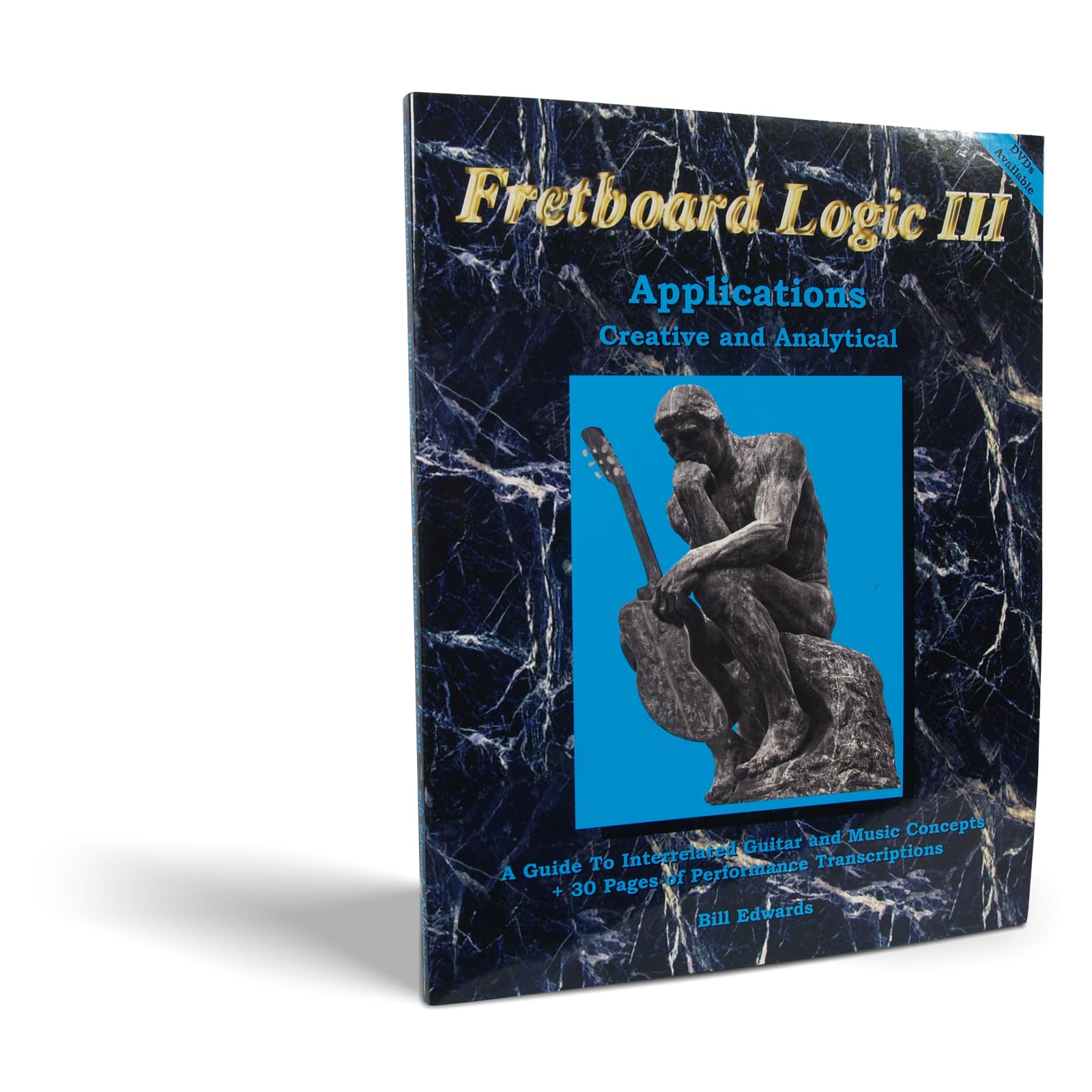



Fretboard Logic Volume III: Applications, Creative, and Analytical Guitar Theory Ready to unlock your full creative potential? Fretboard Logic Volume III is the critical final step in the series, focusing on the application of your newly mastered patterns and fretboard knowledge. After establishing the necessary foundations in Volumes I and II, this book integrates advanced music theory directly into the unique characteristics of the guitar. This volume gives the guitarist the requisite skillset to tackle complex pitch and time relationships and, more importantly, to apply them in real-world playing situations . You'll learn how to take your CAGED system understanding and use it for improvisation , songwriting, and advanced analysis. The wide range of subjects are presented in a convenient non-linear format, allowing you to study what is relevant to your needs without wasting time on areas in which you have no interest. Fretboard Logic III offers a way to navigate the complexities of advanced guitar concepts without the frustration usually associated with traditional instruction. Elevate your guitar playing from technical execution to intelligent musical expression. 🌟 Real-World Application: Bridge the gap between theory and performance by learning to apply pitch, rhythm, and pattern knowledge in real-world playing situations and creative musical settings. 🌟 Advanced Music Theory: Integrate high-level guitar music theory concepts directly into the unique characteristics of the instrument, moving beyond the basics established in Volumes I and II. 🌟 Creative Guitar Instruction: Focus on the analytical and creative aspects of advanced guitar playing , including improvisation , composition, and arranging, using the Fretboard Logic system. 🌟 CAGED System Application : Learn the practical uses and musical flexibility of the CAGED system patterns and forms, using them as tools for musical expression across the entire fretboard . 🌟 Non-Linear Study: Features a comprehensive, non-linear format that allows the advanced guitarist to study only the most relevant subjects, maximizing learning efficiency and avoiding boredom. Volume III expands exponentially on the foundations established in the first two books. Much broader in scope, it touches on a wide range of subjects without being superficial. --From the Publisher I had two goals with Vol. III. First I tried to put down everything I wished my teachers had taught me. Second, I wanted to conclude the series with a bang... something that would make people remember Fretboard Logic for the rest of their lives. The overall objective was to produce an approach that wasnt limited to any one specific style of music, technique or type of guitar. --From the Author From Chapter 3: Analysis is the separation of a whole into its constituent parts. In the field of chemistry, the term also applies to determining the proportions of those parts. The concept of (a reduction to) elements and their proportions provides us with both a qualitative and a quantitative means for understanding music. In order to provide an understanding of the different types of guitar music, the common elements are listed in a menu fashion. This way, the music styles that you as an individual are interested in can be seen in terms of how each piece is composed of these elements, and then consider them in terms of each elements relative significance to the overall result. --Excerpt. © Reprinted by permission. All rights reserved. Volume III expands exponentially on the foundations established in the first two books. Much broader in scope, it touches on a wide range of subjects without being superficial. I had two goals with Vol. III. First I tried to put down everything I wished my teachers had taught me. Second, I wanted to conclude the series with a bang... something that would make people remember Fretboard Logic for the rest of their lives. The overall objective was to produce an approach that wasnt limited to any one specific style of music, technique or type of guitar. Author Bill Edwards started learning music on the piano at a young age in the traditional manner, playing classical music and reading standard notation. He became interested in popular music and the guitar in high school but those educational experiences centered around learning rock and roll songs by ear from records, and figuring leads and rhythms out by trial and error. In college, working part time as a music teacher, these dissimilar educational approaches finally came together when a guitar student asked him to show them how he was able to figure things out just by listening to it. The result was a discovery that became the cornerstone of Fretboard Logic, which is that while it has gone unrecognized and unexplained for centuries, the guitar's tuning system produces a separate and unique area of study and puts the instrument into a class by itself. The author took advan