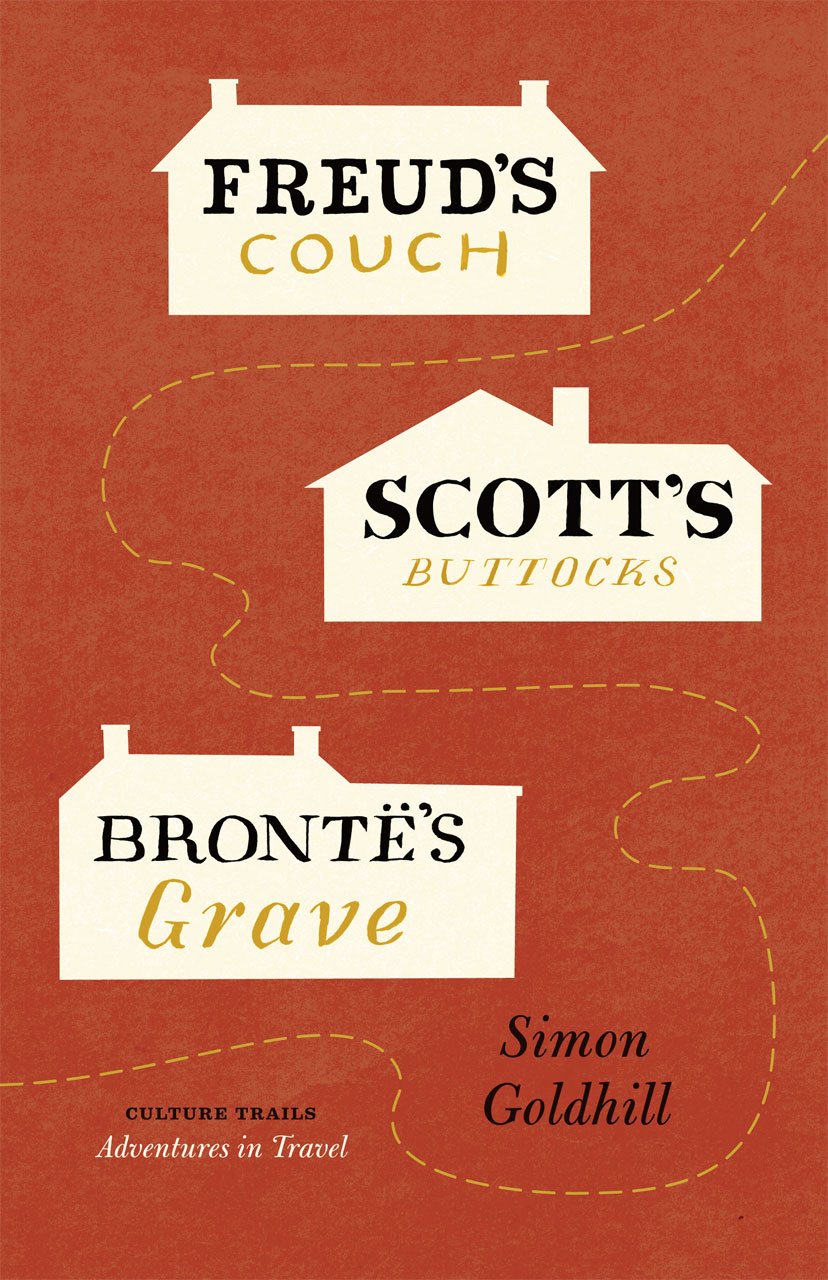
Freud's Couch, Scott's Buttocks, Brontë's Grave (Culture Trails: Adventures in Travel)
$24.00
by Simon Goldhill



The Victorian era was the high point of literary tourism. Writers such as Charles Dickens, George Eliot, and Sir Walter Scott became celebrities, and readers trekked far and wide for a glimpse of the places where their heroes wrote and thought, walked and talked. Even Shakespeare was roped in, as Victorian entrepreneurs transformed quiet Stratford-upon-Avon into a combination shrine and tourist trap. Stratford continues to lure the tourists today, as do many other sites of literary pilgrimage throughout Britain. And our modern age could have no better guide to such places than Simon Goldhill. In Freud's Couch, Scott’s Buttocks, Brontë's Grave , Goldhill makes a pilgrimage to Sir Walter Scott's baronial mansion, Wordsworth's cottage in the Lake District, the Bront ë parsonage, Shakespeare's birthplace, and Freud's office in Hampstead. Traveling, as much as possible, by methods available to Victorians—and gamely negotiating distractions ranging from broken bicycles to a flock of giggling Japanese schoolgirls—he tries to discern what our forebears were looking for at these sites, as well as what they have to say to the modern mind. What does it matter that Emily Brontë’s hidden passions burned in this specific room? What does it mean, especially now that his fame has faded, that Scott self-consciously built an extravagant castle suitable for Ivanhoe—and star-struck tourists visited it while he was still living there? Or that Freud's meticulous recreation of his Vienna office is now a meticulously preserved museum of itself? Or that Shakespeare’s birthplace features student actors declaiming snippets of his plays . . . in the garden of a house where he almost certainly never wrote a single line? Goldhill brings to these inquiries his trademark wry humor and a lifetime's engagement with literature. The result is a travel book like no other, a reminder that even today, the writing life still has the power to inspire. "Wryly funny, deeply thoughtful musings on literary pilgrimage--why readers visit writers' houses, and what, if anything, we gain by it. . . . Part travel memoir, part literary inquiry, with a large dose of history and frequent dashes of dry humor, this book will appeal to bookworms, Anglophiles and anyone who loves to visit historical sites but rolls their eyes at the overpriced rubbish in the gift shop." ― Shelf Awareness for Readers "Unfailingly enjoyable. . . . Goldhill's book is an evocative excursion, a joy to read and full of interest." ― The Tablet: The International Cattholic Weekly “Mr. Goldhill's lightly worn wit and learning summon these vanished luminaries briefly back before us. Neither the fabled chair where Sir Walter Scott's buttocks once rested nor Charlotte Brontë's tattered stocking can compete with the words they once sent out into the world. After all, these writers lived by words, and by words they still live.” ― Wall Street Journal Simon Goldhill is professor of Greek literature and culture and fellow and director of studies in classics at King's College, Cambridge, as well as director of the Cambridge Victorian studies group. He is the author of many books, including Love, Sex, and Tragedy: How the Ancient World Shapes Our Lives . FREUD'S COUCH SCOTT'S BUTTOCKS BRONTË'S GRAVE By Simon Goldhill UNIVERSITY OF CHICAGO PRESS Copyright © 2011 The University of Chicago All right reserved. ISBN: 978-0-226-30131-0 Contents Acknowledgments..........................................vii1 THE GOLDEN TICKET......................................12 LION HUNTING IN SCOTLAND...............................173 PANTING UP THE ENDLESS ALP OF LIFE.....................374 SEETHING IN YORKSHIRE..................................615 OH FOR A MUSE OF FIRE!.................................836 FREUD, ACTUALLY........................................103How to Get There.........................................123Photo Credits............................................131Further Reading..........................................127 Chapter One THE GOLDEN TICKET I HAVE NEVER STOPPED being slightly anxious about the premise of this book. "Make a pilgrimage," proposed my editor over a grilled tuna salad. "Go anywhere and write about it." It sounds at first like a golden ticket. A set of destinations rose like a sunrise in my mind. The romance of the dusty open road, or at very least a Kerouac fantasy, is part of the adolescent mind of everyone of my generation. The mysterious traveler who blows into town, the life-changing encounter with a stranger, never forgotten, never recovered, the slow climb that reveals the breathtaking view—we all share these cultural myths, as we trudge to work or sit halfheartedly at the desk. The trouble is that any really serious pilgrim travels alone. You are meant to make a journey where the very traveling leads you to explore yourself, your relation to God, or your life or your past. The endpoint is somehow only a small part o