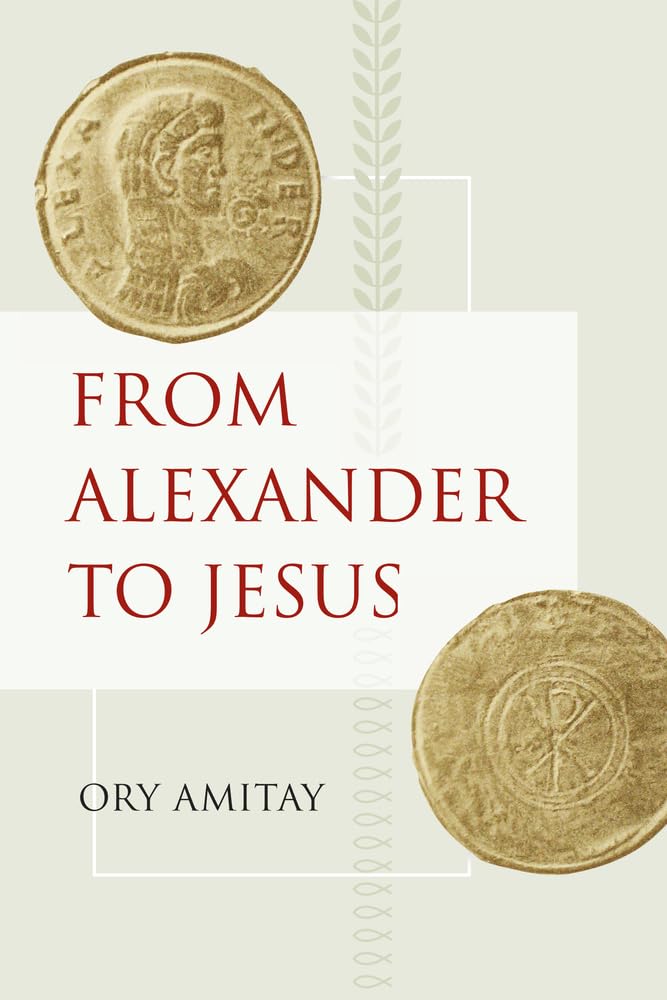



Scholars have long recognized the relevance to Christianity of the many stories surrounding the life of Alexander the Great, who claimed to be the son of Zeus. But until now, no comprehensive effort has been made to connect the mythic life and career of Alexander to the stories about Jesus and to the earliest theology of the nascent Christian churches. Ory Amitay delves into a wide range of primary texts in Greek, Latin, and Hebrew to trace Alexander as a mythological figure, from his relationship to his ancestor and rival, Herakles, to the idea of his divinity as the son of a god. In compelling detail, Amitay illuminates both Alexander’s links to Herakles and to two important and enduring ideas: that of divine sonship and that of reconciliation among peoples. "[An] interesting and worthwhile book." -- Paul McKechnie ― Prudentia Published On: 2013-06-01 "Amitay thoroughly and convincingly traces the idea of Alexander the Great as the son of [a] god . A unique and remarkable book." Richard Stoneman, author of Alexander the Great: A Life in Legend "Amitay traces the relationship between Alexander and the Greek hero Herakles, the heroic ancestor of the Argead dynasty. This has never been done before and represents a significant contribution to Alexander scholarship." Stanley Burstein, author of Readings in Greek History: Sources and Interpretations "Amitay thoroughly and convincingly traces the idea of Alexander the Great as the son of [a] god…. A unique and remarkable book."―Richard Stoneman, author of Alexander the Great: A Life in Legend "Amitay traces the relationship between Alexander and the Greek hero Herakles, the heroic ancestor of the Argead dynasty. This has never been done before and represents a significant contribution to Alexander scholarship."―Stanley Burstein, author of Readings in Greek History: Sources and Interpretations Ory Amitay is Lecturer at the University of Haifa. From Alexander to Jesus By Ory Amitay UNIVERSITY OF CALIFORNIA PRESS Copyright © 2010 The Regents of the University of California All rights reserved. ISBN: 978-0-520-26636-0 Contents Acknowledgments, xi, Introduction, 1, 1. Son of Man, Son of God, 9, 2. In the Footsteps of Herakles, 27, 3. The Passage to India, 39, 4. Symbiosis, 56, 5. Amazon Queen, 78, 6. Post Mortem, 87, 7. Alexander and the End of Days, 104, 8. Alexander and Jesus, 123, Conclusion, 147, Appendix A. Alexander and David, 151, Appendix B. Sacrifices and Related Matters in the Alexander Histories, 155, Appendix C. Alexander Alcoholicus, 163, Notes, 167, References, 217, Index, 233, CHAPTER 1 Son of Man, Son of God HERITAGE AND CHILDHOOD Herakles begat Hyllos; Hyllos begat Kleadates and he Aristomachos; Aristomachos begat Temenos, who ruled in Argos. Three of the descendants of Temenos went from Argos as exiles; the youngest of these, Perdikkas, became the ruler of the Macedonians. Perdikkas begat Argaios, Argaios Philippos and Philippos Aeropos; his son was Alketes and his Amyntas. Amyntas begat Alexander, who ran the stadion in Olympia and was recognized as a Greek from Argos by the Hellenodikai —the official referees of the ancient Olympic games. This Alexander bore Amyntas and he Arrhidaios and he Amyntas, who was King. His son was Philippos, who subdued all of Hellas. His son was Alexander. Or so might a Macedonian serving under Alexander relate the essential history of his Royal House. A fan of Euripides—there were many in the Macedonian court, not least of them Alexander—might tell a different story: Archelaos, a son of Temenos, had been exiled from Argos by his brothers. Having fled to Thrace, he won renown as a warrior, but also aroused the suspicion of the local king, who attempted to kill him off. Archelaos managed to slay the king and was once more forced to flee. Inspired by Apollo and led by a goat, he arrived in Macedonia and founded its ancient capital—Aigai (Goatville). The connection of the Macedonian Royal House with Herakles was no trifle. The story of King Alexander (`the first,' as he is known to modern historians) is proof enough. His ability to produce a lineage going all the way to Herakles (or perhaps to Temenos; Herodotus does not say) made him eligible to compete in the Olympic games. Proven Heraklid descent was the ultimate answer to the all-important question, "Who is a Greek?" From the Greek perspective, shared by both the Olympic judges and the Macedonian King, their recognition had transformed him from barbarian to Greek. Heroic ancestry was serious business. One might consider Herodotus's introduction of the leaders of the Greek navy that assembled in Aigina in the spring of 480: "Their general and admiral was Leutychides son of Menares, who traced his lineage from son to father through Hegesilaos, Hippokratides, Leutychides, Anaxilaos, Archidemos, Anaxandrides, Theopompos, Nikandros, Charilaos, Eunomos, Polydektes, Prytanis, Euryphron, Prokles, Aristodemos, Aris