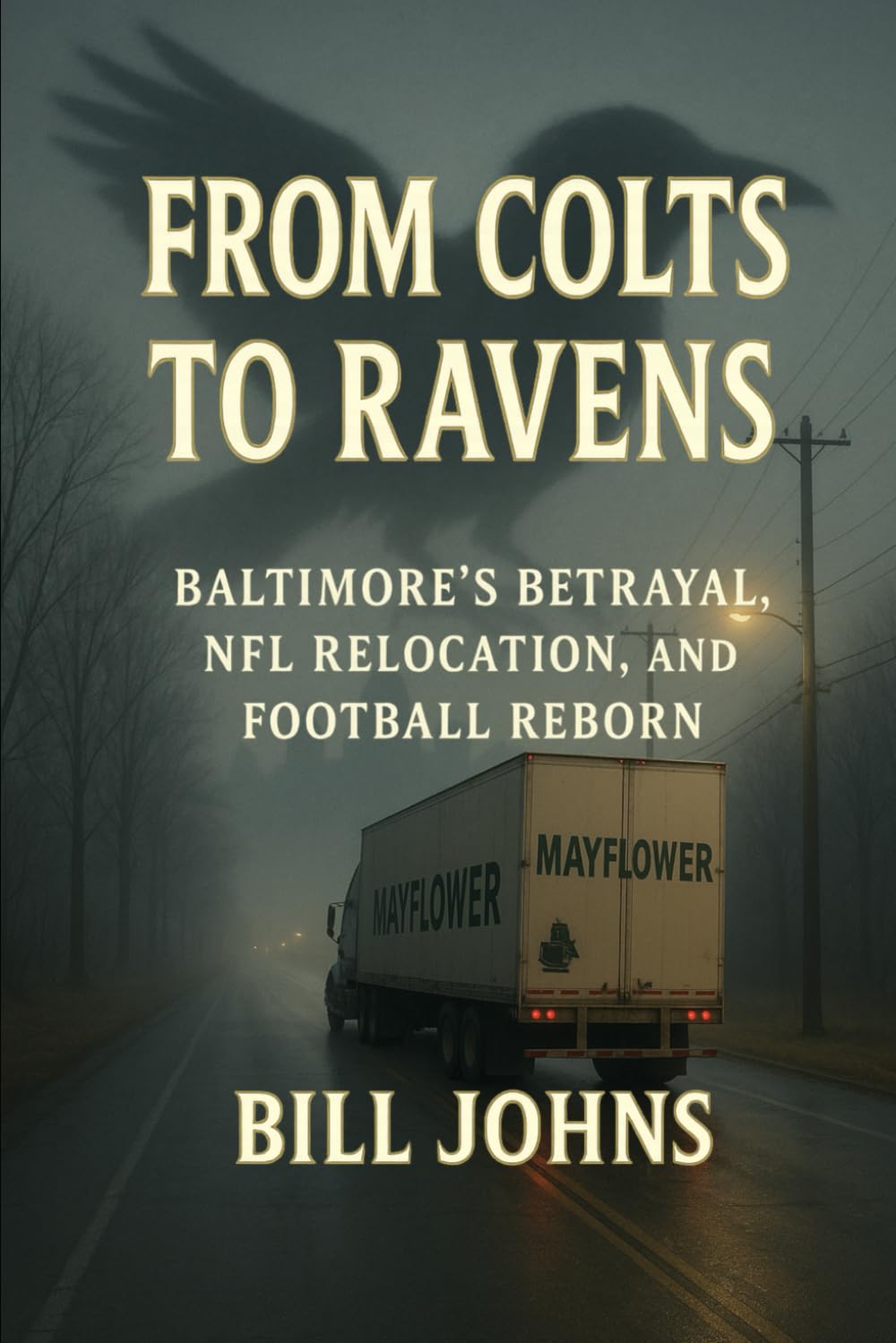
From Colts to Ravens: Baltimore’s Betrayal, NFL Relocation, and Football Reborn (Legends of the Lineup: Icons in American Sport)
$19.99
by Bill Johns



In March 1984, the Baltimore Colts vanished into the night, packed into Mayflower vans under a late-winter snowstorm. In a single act of betrayal by owner Robert Irsay, a proud city lost its team, its Sundays, and its sense of belonging in the National Football League. From Colts to Ravens: Baltimore’s Betrayal, NFL Relocation, and Football Reborn is the definitive cultural history of that disappearance and the remarkable rebirth that followed with the rise of the Baltimore Ravens at M&T Bank Stadium. This book tells the story of Baltimore football not just as sport but as identity. It follows the grief that spread through neighborhoods after the Colts left for Indianapolis, the civic fight to win a team back, and the persistence of memory that would not die. It captures the band that kept playing the Colts fight song at parades and civic events when there was no team to cheer. It explores courtroom battles, stadium debates, and the scars left on a city forced to live without football. When the Ravens arrived in 1996 through Art Modell’s controversial relocation of the Cleveland Browns, Baltimore was ready. The book traces the transformation of that franchise into champions, propelled by Ray Lewis’s fire and the disciplined architecture of Jonathan Ogden and Ed Reed. It places Super Bowl XXXV in 2000 and Super Bowl XLVII in 2013 not only in football history but in the city’s narrative of resilience. Victory in purple and black was more than athletic success; it was civic vindication. At the heart of the story are two statues outside M&T Bank Stadium. Johnny Unitas, immortalized in bronze in 2002, recalls the loyalty and precision of Baltimore’s Colts era. Ray Lewis, unveiled in 2014, embodies the passion of the Ravens’ rebirth. Together they form a dialogue across decades — Unitas’s calm discipline facing Lewis’s eruptive fire — a silent conversation that captures the essence of Baltimore. Fans rub Unitas’s cleats smooth for luck; they stomp and roar in mimicry of Lewis’s dance. These rituals turn statues into living memory, binding generations together in scarred but unbroken loyalty. The book also places Baltimore’s story within the broader history of NFL relocation and expansion. It examines Irsay’s midnight move, the league’s expansion politics, and the civic maneuvering that eventually delivered football back to the Chesapeake. It sets Baltimore’s exile alongside Cleveland’s loss, showing how relocation reshaped American football culture and fractured civic trust. Bill Johns, author of acclaimed works on Johnny Unitas, Ray Lewis, Cal Ripken Jr., Frank Robinson, and Chesapeake culture, brings his signature blend of narrative precision and cultural insight to this story. His writing moves beyond statistics into the deeper layers of civic pride, betrayal, ritual, and resilience. He situates Baltimore football within the city’s broader cultural life, treating M&T Bank Stadium as not just a venue but a shrine, a place where memory and identity converge every Sunday. For readers of sports history, cultural history, and Baltimore history alike, From Colts to Ravens offers more than the story of a team. It is the story of a city scarred by loss, sustained by loyalty, and vindicated in rebirth. It speaks to anyone who has ever felt the pain of betrayal and the joy of return, anyone who understands that sport is not only about winning but about who we are when we endure. This is a book about football, but it is also a book about memory. To read it is to walk the plaza between Unitas and Lewis, to feel the scar that still runs through Baltimore, and to know that resilience is louder than betrayal.