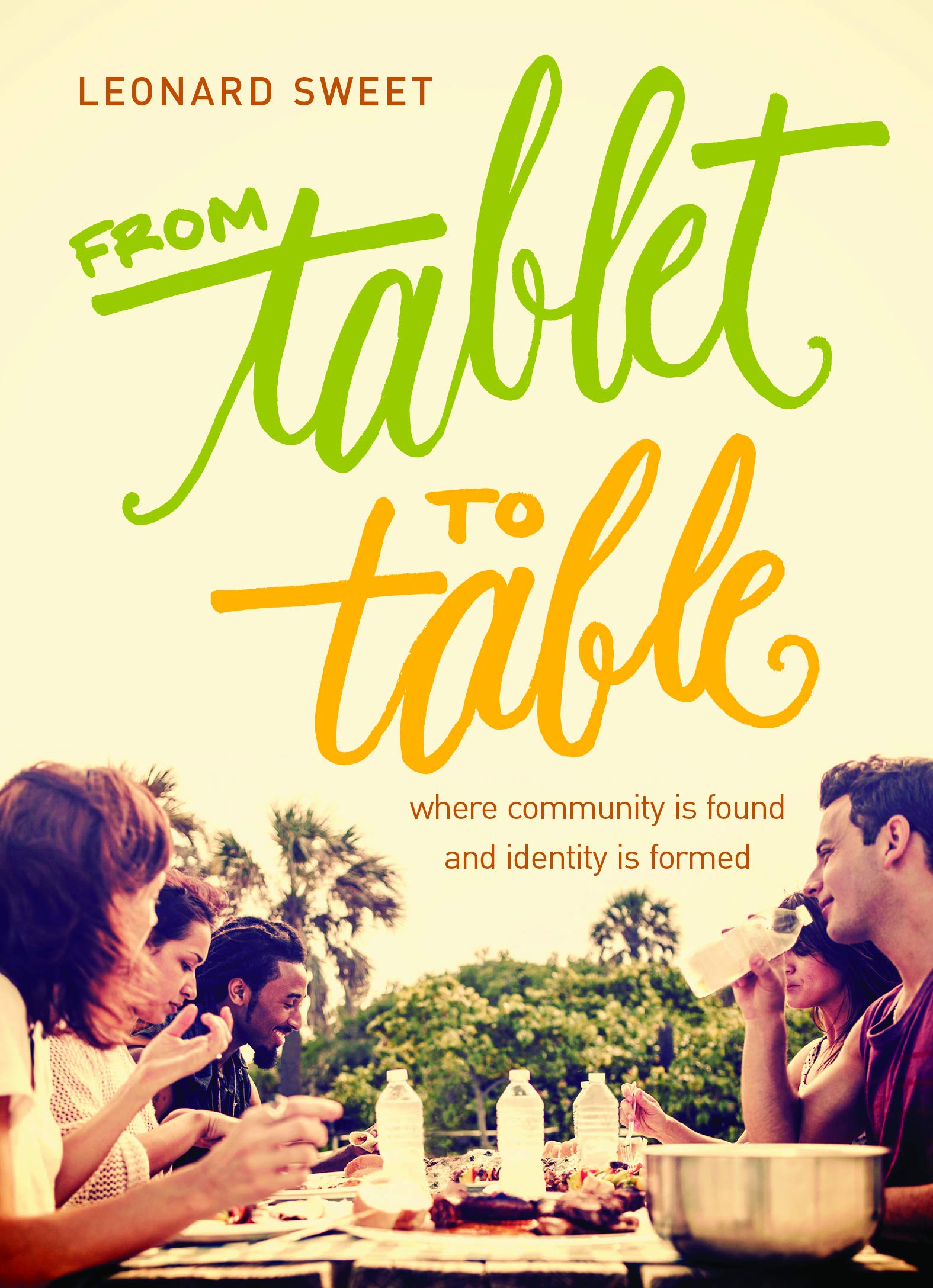
From Tablet to Table: Where Community Is Found and Identity Is Formed
$14.99
by Leonard Sweet



Worship Leader magazine has named From Tablet to Table one of the five best books of 2015! What if the Bible were seen less as a tablet of ink than as a table of food? From Tablet to Table invites readers to explore the importance of The Table in biblical theology, and what it might mean for us to bring back the table to our homes, our churches, and our neighborhoods. The table pictures the grace of God’s provision for all aspects of our lives, a place of safe gathering, of finding identity in shared stories, of imparting food and faith, of playing host and finding satisfaction as a guest. Sweet explores how our failure to understand and appreciate “the most sacred item of furniture in every home” has created such a deficit in our fast-food, take-what-you-like-smorgasbord, together-but-separate society. From Tablet to Table Where community is found and identity is formed By Leonard Sweet NavPress Copyright © 2014 Leonard Sweet All rights reserved. ISBN: 978-1-64158-245-2 Contents Acknowledgments, xi, Introduction: Bring Back the Table, 1, PART I: Table It, ONE: Every Story I Know Best I Learned from a Flannelgraph, 23, TWO: "Thou Preparest a Table Before Me", 43, THREE: Jesus, the Messiah of the Open Table, 61, PART II: Life's Three Tables, FOUR: Setting the Table at Home, 77, FIVE: Setting the Table at Church, 107, SIX: Setting the Table in the World, 137, Conclusion, 161, Notes, 165, About the Author, 173, CHAPTER 1 EVERY STORY I KNOW BEST I LEARNED FROM A FLANNELGRAPH A Well-Storied Faith * * * Wisdom ... has prepared her meat and mixed her wine; she has also set her table. PROVERBS 9:1-2 Have you ever said something you wish you could take back? I've certainly written some things I wish I could take back. One of these mea culpas is a mocking of certain people I have tardily come to honor and celebrate. In one of my early books, I wrote about how the church finds itself in a digital, electronic culture with computer-savvy kids. Yet our churches are still trying to teach the Bible through flannelgraphs, chalk talks, and chalk artists. I made sport of those people and their ministries. Now I am so repentant, so embarrassed I ever said such a thing. Every time I meet someone who uses flannelgraphs, I kneel down in front of them and beg, "Please forgive me. I'm so sorry for what I've done. I'm grateful to God for you." Why the turnaround? Every story I know best I learned from a flannelgraph. I'm a slow learner about some things, and it took me too long to realize this. For much of my life I have unknowingly suffered from a serious and stealthy illness: versitis. No, not "bursitis." "Versitis." What is "versitis," you ask? A burglar broke into a home late one night while a couple was sleeping upstairs. The woman of the house, a Christian who knew her Bible, came to the head of the stairs, saw the shadow of the burglar in the living room, and shouted out, "Acts 2:38!" That's the verse where Peter tells the crowd, "Repent!" Immediately the burglar fell to the floor, his hands over his head. He stayed there motionless until the police arrived and took him away. As he got into the car, the cop said, "So it was Scripture that got you to give up?" "What? That wasn't Scripture. She yelled she had an axe and two .38s." From my childhood I have accessed the Bible through the template of books (66), chapters (1,189), and verses (31,103). The problem is that this template is alien to the material. The Bible wasn't written numerically. The Bible was written narratively, metaphorically, in stories and poems and songs and letters and memoirs and autobiographies and dreamscapes. The original template of the Bible is not numbers; it's narraphors. I started learning the chapter-and-verse template as early as my nursery days, through the church's "farm system," a training regimen made up of Sunday school pins, Upper Room certificates, "sword drills" in youth group, college "mission bingos," N. A. Woychuk's Bible Memory Association prizes, and Awana "jewels." This training regimen is systematically being dismantled, however, as more and more resources are being diverted from the farm system to preserve the bureaucracy's factory system. Hence our children's increasing biblical illiteracy, even of the alien template, not to mention their disconnect from the ritual life of the church. Because the farm system was still vibrant as I grew up in the church, I entered college well-versed in the Bible. At least I thought so. It wasn't until well into my ministry that I realized that, while I had memorized hundreds of Bible verses, I had never memorized a Bible story. Not one. In other words, what I had learned "by heart" was not the story, but the verses. I had "hidden ... in my heart" (Psalm 119:11) only the parts, not the whole. When I began itemizing what stories I knew best (Daniel in the Lions' Den, David and Goliath, Jonah and the Whale, Noah and the Flood, the Woman at the Well