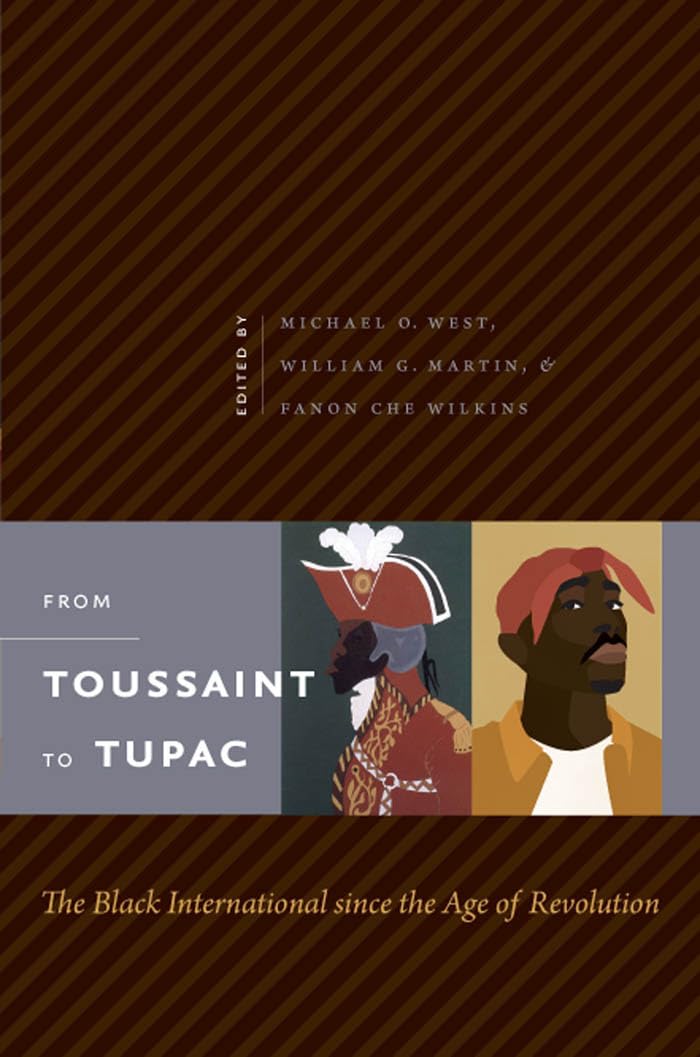
From Toussaint to Tupac: The Black International since the Age of Revolution
$32.00
by Michael O. West



Transcending geographic and cultural lines, From Toussaint to Tupac is an ambitious collection of essays exploring black internationalism and its implications for a black consciousness. At its core, black internationalism is a struggle against oppression, whether manifested in slavery, colonialism, or racism. The ten essays in this volume offer a comprehensive overview of the global movements that define black internationalism, from its origins in the colonial period to the present. From Toussaint to Tupac focuses on three moments in global black history: the American and Haitian revolutions, the Garvey movement and the Communist International following World War I, and the Black Power movement of the late twentieth century. Contributors demonstrate how black internationalism emerged and influenced events in particular localities, how participants in the various struggles communicated across natural and man-made boundaries, and how the black international aided resistance on the local level, creating a collective consciousness. In sharp contrast to studies that confine Black Power to particular national locales, this volume demonstrates the global reach and resonance of the movement. The volume concludes with a discussion of hip hop, including its cultural and ideological antecedents in Black Power. Contributors: Hakim Adi, Middlesex University, London Sylvia R. Frey, Tulane University William G. Martin, Binghamton University Brian Meeks, University of the West Indies, Mona, Jamaica Marc D. Perry, University of Illinois, Urbana-Champaign Lara Putnam, University of Pittsburgh Vijay Prashad, Trinity College Robyn Spencer, Lehman College Robert T. Vinson, College of William and Mary Michael O. West, Binghamton University Fanon Che Wilkins, Doshisha University, Kyoto, Japan A model in which the struggles of black people worldwide from the Haitian Revolution to contemporary rap fundamentally inform and shape historical questions and understandings. . . . Recommended.-- Choice Michael West and William Martin's stirring introduction precedes a fascinating, well-argued collection of essays whose breadth, both temporally and geographically, issues a dramatic call to scholars of the global Black Freedom struggle.-- Kalfou This masterful collection proposes an alternative paradigm for our interpretation of modern 'world history,' reconsidering the histories of South Africa, West Africa, the Caribbean, the United States, and Europe. It is a bold intervention whose intellectual, chronological, cultural, social, and geographical sweep is without rival.--Komozi Woodard, author of A Nation within a Nation: Amiri Baraka (LeRoi Jones) and Black Power Politics Reclaiming a cross-national, radical black consciousness This collection of essays explores black internationalism--the struggle against oppression, whether manifested in slavery, colonialism, or racism. Contributors focus on three moments in global black history: the American and Haitian revolutions, the Garvey movement and the Communist International following World War I, and the Black Power movement of the late twentieth century to demonstrate how black internationalism emerged and influenced events in particular localities, how participants in the various struggles communicated across natural and man-made boundaries, and how the black international aided resistance on the local level, creating a collective consciousness. This collection of essays explores black internationalism--the struggle against oppression, whether manifested in slavery, colonialism, or racism. Contributors focus on three moments in global black history: the American and Haitian revolutions, the Garvey movement and the Communist International following World War I, and the Black Power movement of the late twentieth century to demonstrate how black internationalism emerged and influenced events in particular localities, how participants in the various struggles communicated across natural and man-made boundaries, and how the black international aided resistance on the local level, creating a collective consciousness. Michael O. West is professor of sociology and Africana studies at Binghamton University. William G. Martin is professor of sociology at Binghamton University. Fanon Che Wilkins is associate professor of African American history and culture in the Graduate School of American Studies at Doshisha University in Kyoto, Japan.