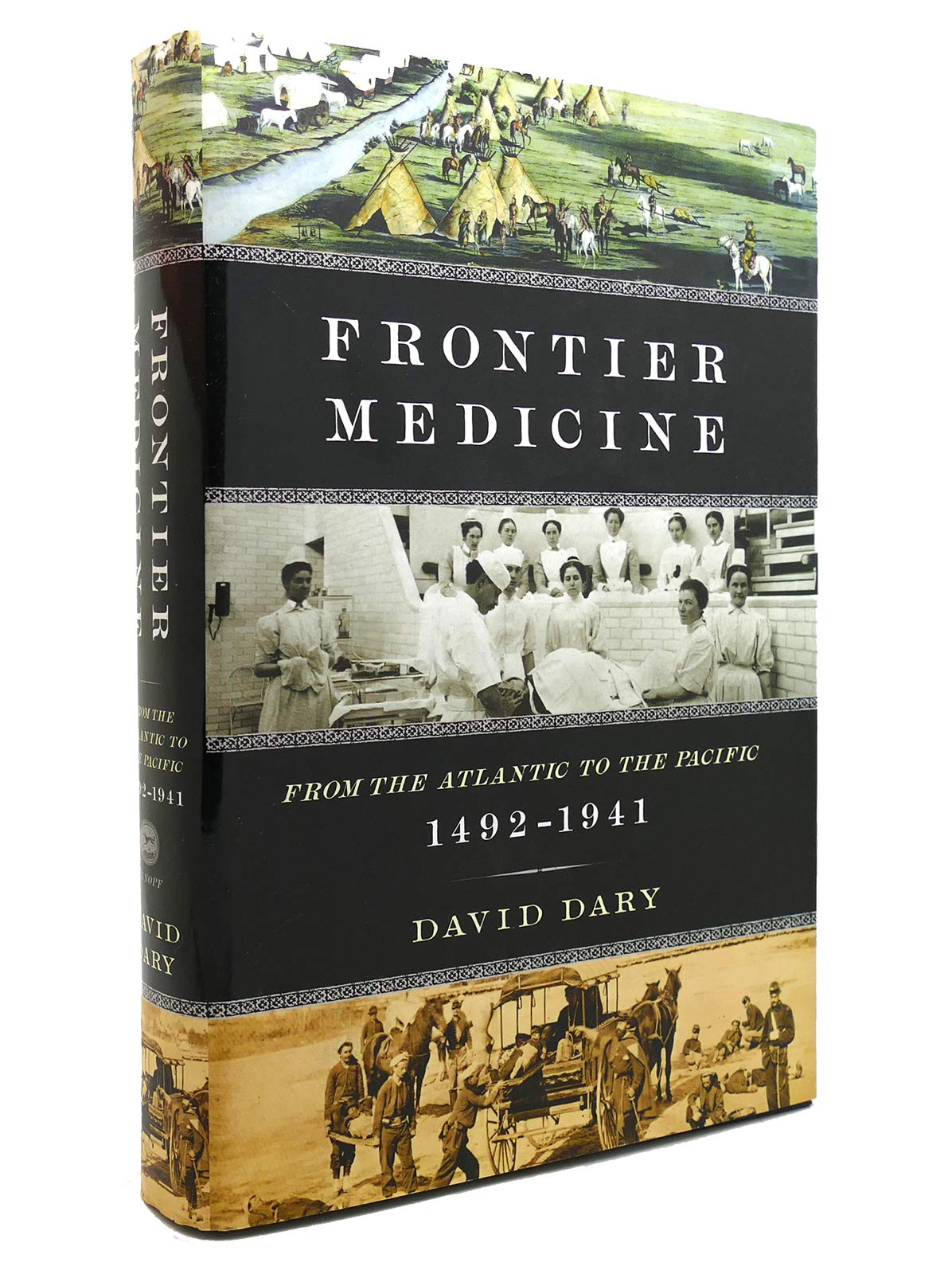



In his new book, David Dary, one of our leading social historians, gives us a fascinating, informative account of American frontier medicine from our Indian past to the beginning of World War II, as the frontier moved steadily westward from the Atlantic coast to the Pacific Ocean. He begins with the early arrivals to our shores and explains how their combined European-taught medical skills and the Indians’ well-developed knowledge of local herbal remedies and psychic healing formed the foundation of early American medicine. We then follow white settlement west, learning how, in the 1720s, seventy-five years before Edward Jenner’s experiments with smallpox vaccine, a Boston doctor learned from an African slave how to vaccinate against the disease; how, in 1809, a backwoods Kentucky doctor performed the first successful abdominal surgery; how, around 1820, a Missouri doctor realized quinine could prevent as well as cure malaria and made a fortune from the resulting pills he invented. Using diaries, journals, newspapers, letters, advertisements, medical records, and pharmacological writings, Dary gives us firsthand accounts of Indian cures; the ingenious self-healings of mountain men; home remedies settlers carried across the plains; an early “HMO” formed by Wyoming ranchers and cowboys to provide themselves with medical care; the indispensable role of country doctors and midwives; the fortunes made from patent medicines and quack cures; the contributions of army medicine; Chinese herbalists; the formation of the American Medical Association; the first black doctors; the first women doctors; and finally the early-twentieth-century shift to a formal scientific approach to medicine that by the postwar period had for the most part eliminated the trial-and-error practical methods that were at the center of frontier medicine. A wonderful—often entertaining—overview of the complexity, energy, and inventiveness of the ways in which our forebears were doctored and how our medical system came into being. Author of the excellent western histories The Santa Fe Trail (2000) and The Oregon Trail (2004), Dary here eclectically surveys the treatment of health in the days of explorers and settlers. Dary investigates how Indians remedied the injuries and ailments of life, citing forms as varied as handbooks imparting native knowledge of medicinal herbs, roots, and barks and the appropriation of tribal names to hawk medicine-show palliatives such as Cherokee Liniment. Proceeding chronologically as the line of settlement advanced, Dary introduces surgeons who accompanied expeditions of discovery and doctors whose presence lent instant status to rough new towns and summarizes their careers and any nonmedical distinctions (one composed the song “Home on the Range”). The book also covers medicine in the Civil War, pioneering female doctors and dentists, the work of midwives, and frauds such as Dr. John Brinkley (the subject of Pope Brock’s Charlatan! 2008). A wealth of historical discovery for readers drawn to the prescientific, preregulation era of American medical practice. --Gilbert Taylor “Bear attacks. Syphilis. Bullet wounds. Malaria. Scalpings. Cholera. Arrows shot into the skull. Scurvy. Rabies. Ax mishaps. Crushing by moving wagon on wheels. Outsize tumors. Snake bites. . . David Dary relates the story of Westward expansion while examining these misfortunes, and many others, from the point of view of men and women who tried to heal the often ruinously injured. The results are both a horror show and undeniably engrossing: “MASH” meets Edgar Allan Poe. He knows his material cold, and his narrative accumulates authority and dignity as it rolls along. As he piles story upon story and anecdote upon anecdote, you’ll find yourself walking around the house reading horrific bits out loud to anyone who will listen, to the great distress of the squeamish.” —Dwight Garner, The New York Times “Masterly . . . enthralling . . . [Dary] does an admirable job of pulling together stories about health care as practiced by the Native Americans, Lewis and Clark, Civil War doctors and even 20th-century quacks. Moving briskly from one episode to the next, Mr. Dary is particularly effective at showing us the strengths and foibles of early American doctors, an often suspect class of professionals who now and again did more harm than healing. It is entertaining, enlightening material.” —Ira Rutkow, The Wall Street Journal David Dary is the author of more than a dozen previous books including The Buffalo Book, Cowboy Culture, Entrepreneurs of the Old West, Seeking Pleasure in the Old West, Red Blood and Black Ink, The Santa Fe Trail, The Oregon Trail, and True Tales of the Prairies and Plains . He is the recipient of two Wrangler Awards from the National Cowboy and Western Heritage Museum, two Western Writers of America Spur Awards, the WWA’s Wister Owen Award for lifetime achievement, the Westerners International Best Nonfiction Boo