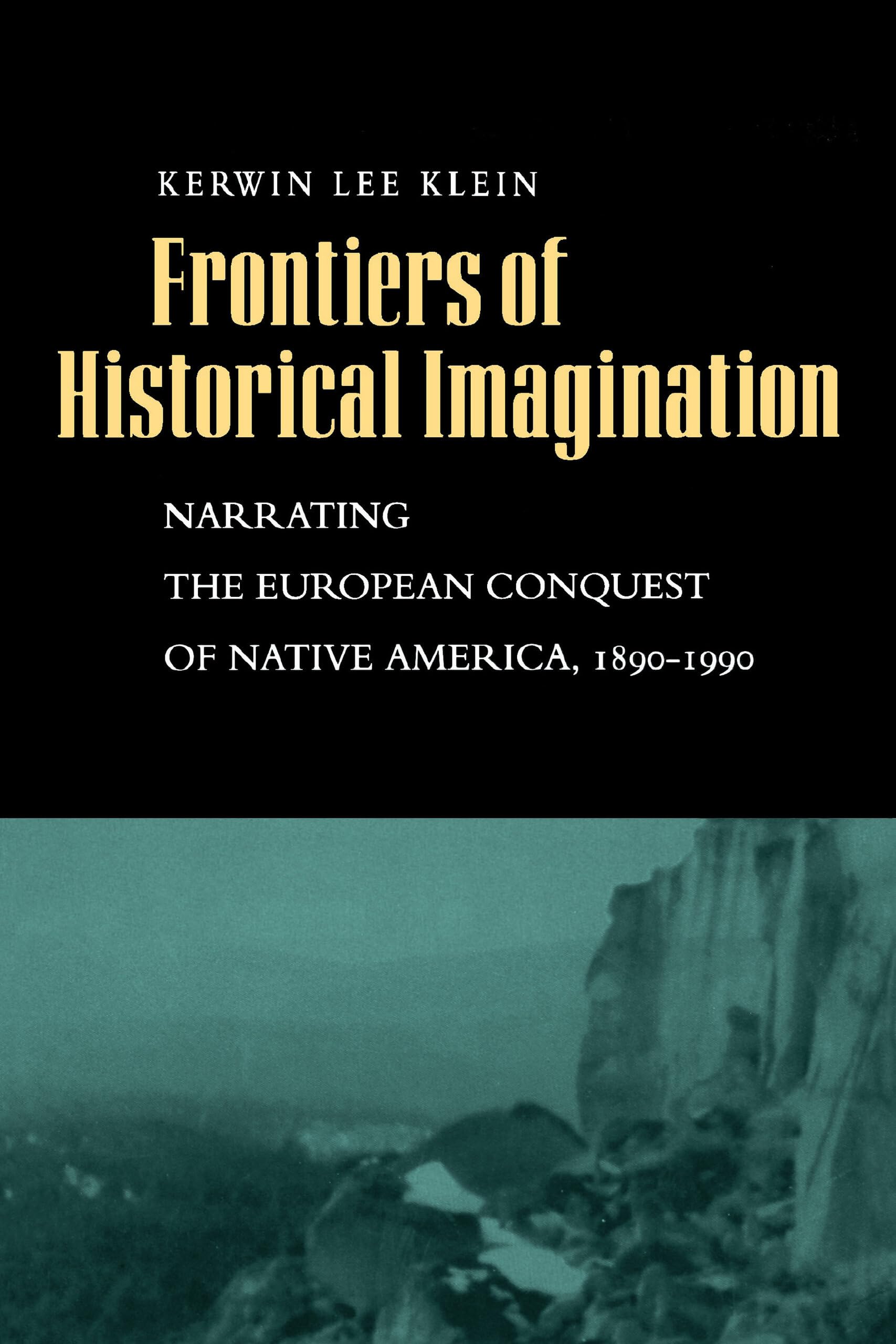
Frontiers of Historical Imagination: Narrating the European Conquest of Native America, 1890-1990
$25.99
by Kerwin Lee Lee Klein



The American frontier, a potent symbol since Europeans first stepped ashore on North America, serves as the touchstone for Kerwin Klein's analysis of the narrating of history. Klein explores the traditions through which historians, philosophers, anthropologists, and literary critics have understood the story of America's origin and the way those understandings have shaped and been shaped by changing conceptions of history. The American West was once the frontier space where migrating Europe collided with Native America, where the historical civilizations of the Old World met the nonhistorical wilds of the New. It was not only the cultural combat zone where American democracy was forged but also the ragged edge of History itself, where historical and nonhistorical defied and defined each other. Klein maintains that the idea of a collision between people with and without history still dominates public memory. But the collision, he believes, resounds even more powerfully in the historical imagination, which creates conflicts between narration and knowledge and carries them into the language used to describe the American frontier. In Klein's words, "We remain obscurely entangled in philosophies of history we no longer profess, and the very idea of 'America' balances on history's shifting frontiers." "A surprising book, an intellectual history that is detailed, passionate, and at its best, absorbing."--Ann Fabian, "Reviews in American History "A thorough and breathtaking review of modern historiography, anthropology, and literary criticism as they relate to the American frontier."Robert V. Hine, author of Second Sight "A thorough and breathtaking review of modern historiography, anthropology, and literary criticism as they relate to the American frontier."―Robert V. Hine, author of Second Sight Kerwin Lee Klein is Assistant Professor of History at University of California, Berkeley. Frontiers of Historical Imagination Narrating European Co By Kerwin Lee Klein University of California Press Copyright © 1999 Kerwin Lee Klein All right reserved. ISBN: 9780520221666 Introduction History, Narrative, West The twentieth century has transfigured American historical imagination in dramatic but poorly understood ways. One of the most visible is the growing willingness to imagine America's past as tragic conflict. Once upon a time historians celebrated the making of democracy. Nowadays many imagine that democracy founded on a Native American holocaust. And a suspicion of historical knowledge has accompanied these diverging interpretations. Can histories tell the truth about the past? Such questions have proliferated in recent years, with "yeses," "no's," and "maybe's" ringing back in answer. Some of the more provocative responses have come from historiographers like Hayden White who have told us that since historians write narratives, and since no event is narrative in form, histories cannot correspond to their objects. One of the most resounding affirmations of historical knowledge has come from historians Joyce Appleby, Lynn Hunt, and Margaret Jacob, who believe that we may, although imperfectly, know that past which is the object of scholarly inquiry. Yet even they concede that "historical narratives are actually a literary form without any logical connection to the seamless flow of events that constitute living."1 We often imagine such disputes as conflicts over whether history can be "objective." Peter Novick's magisterial social history of the discipline, That Noble Dream, narrates a history of contention between those who believed history was an objective science and those who believed it was not.2 But characterizing the difference between White and critics like Appleby, Hunt, and Jacob in "subjectivist" and "objectivist" terms is potentially confusing, since they all share a basic belief that narrative and figurative language are the weak links in historical knowledge. The antagonisms of "narrative" and "literary form," on the one hand, and "logical connection" and "events," on the other, stand on intellectual traditions that are almost immeasurably deep. The unhappy dichotomy of narrative and knowledge has inspired a series of linguistic purges as historians try to cast out "soft" poetic and rhetorical forms. Some believe we have escaped the old-fashioned narrative history of Great Men, wars, and elections and now can write "analytic" or "structural" histories of culture and society. The more polemical accounts represent the new history as a higher intellectual pursuit and place it at the summit of a lengthy evolution out of narrative evil.3 American history's creation tale, into which young historians are socialized, has institutionalized the suspicion of historical figures, and it goes something like this: In the beginning the Romantic Historians told pretty stories but did not rise to empirical analysis. They were followed by the Scientific Historians, who profession