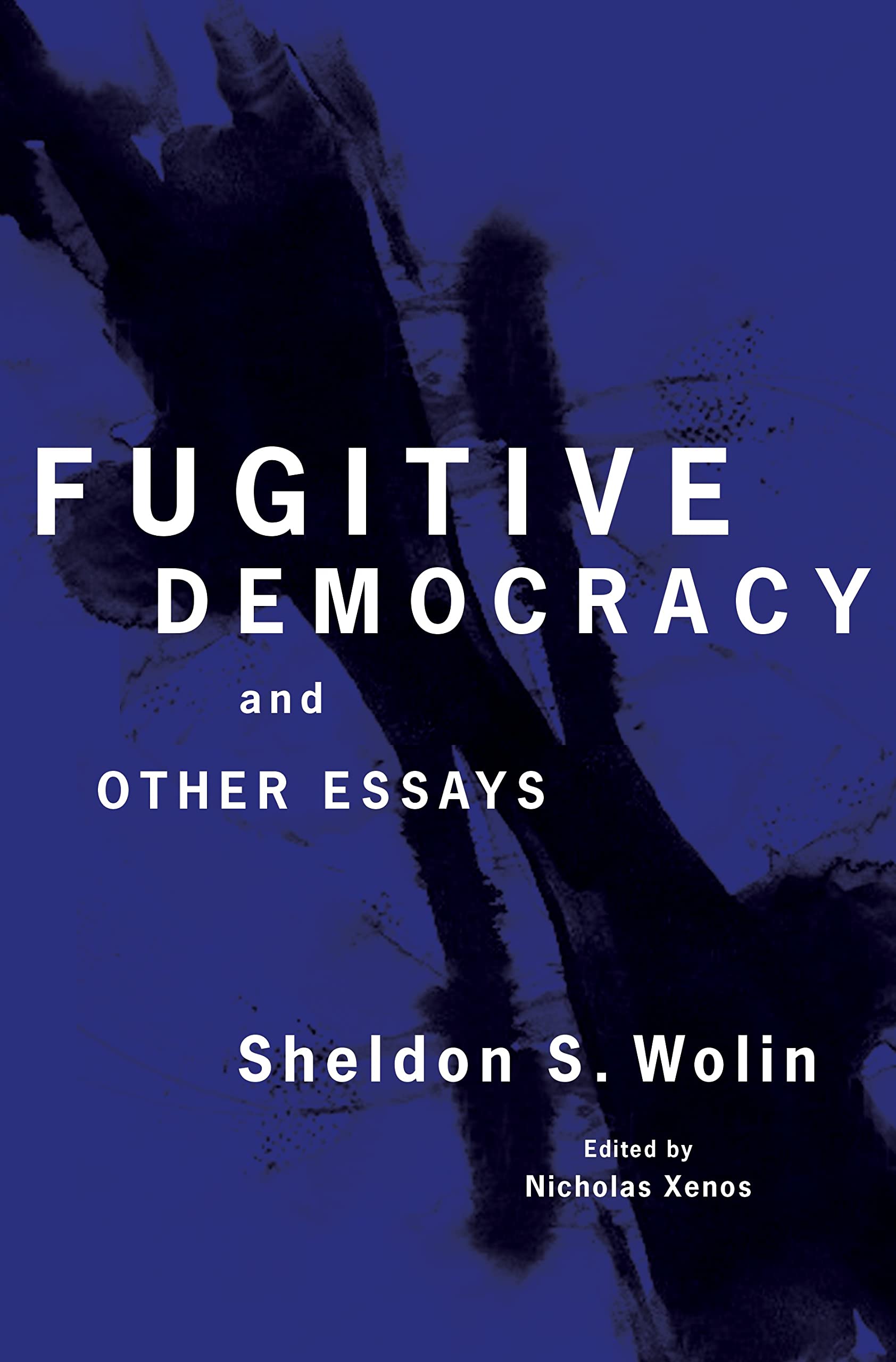



An authoritative collection of the most important writings of an influential political thinker Sheldon Wolin was one of the most influential and original political thinkers of the past fifty years. Fugitive Democracy brings together his most important writings, from classic essays such as "Political Theory as a Vocation," written amid the Cold War and the conflict in Vietnam, to his late radical essays on American democracy such as “Fugitive Democracy,” in which he offers a controversial reinterpretation of democracy as an episodic phenomenon distinct from the routinized political management that passes for democracy today. The breathtaking range of Wolin's scholarship, political commitment, and critical acumen are on full display in this authoritative and accessible collection. He critically engages a diverse range of political theorists, including Thomas Hobbes, Karl Marx, Max Weber, Hannah Arendt, John Rawls, Michel Foucault, and Richard Rorty. These essays grapple with topics such as power, modernization, the sixties, revolutionary politics, and inequality, all the while showcasing Wolin’s enduring commitment to writing civic-minded theoretical commentary on the most pressing political issues of the day. Here, Wolin laments the rise of conservatives who style themselves as revolutionary, criticizes Rawlsian liberals as abstract to the point of being apolitical, diagnoses postmodern theory as a form of acquiescence, and much more. Fugitive Democracy offers enduring insights into many of today’s most pressing political predicaments, and introduces a whole new generation of readers to this provocative figure in contemporary political thought. "These essays are stunning. No one speaks for democracy as Wolin does." --Anne Norton, author of On the Muslim Question "This collection is long overdue. Fugitive Democracy is a book that every current and future political theorist and political philosopher should own." --Melissa A. Orlie, author of Living Ethically, Acting Politically "These essays are stunning. No one speaks for democracy as Wolin does." ―Anne Norton, author of On the Muslim Question "This collection is long overdue. Fugitive Democracy is a book that every current and future political theorist and political philosopher should own." ―Melissa A. Orlie, author of Living Ethically, Acting Politically "These essays are stunning. No one speaks for democracy as Wolin does." --Anne Norton, author of On the Muslim Question "This collection is long overdue. Fugitive Democracy is a book that every current and future political theorist and political philosopher should own." --Melissa A. Orlie, author of Living Ethically, Acting Politically Sheldon S. Wolin (1922–2015) was professor emeritus of politics at Princeton University. His books include Politics and Vision: Continuity and Innovation in Western Political Thought and Democracy Incorporated: Managed Democracy and the Specter of Inverted Totalitarianism (both Princeton). Nicholas Xenos is professor of political science at the University of Massachusetts, Amherst. His books include Cloaked in Virtue: Unveiling Leo Strauss and the Rhetoric of American Foreign Policy . Fugitive Democracy and Other Essays By Sheldon S. Wolin, Nicholas Xenos PRINCETON UNIVERSITY PRESS Copyright © 2016 Princeton University Press All rights reserved. ISBN: 978-0-691-13364-5 Contents Foreword, vii, Editor's Introduction, xiii, PART ONE * THE POLITICAL AND THEORETICAL, Chapter 1 Political Theory as a Vocation, 3, Chapter 2 Political Theory: From Vocation to Invocation, 33, PART TWO * HISTORICAL, Ancient and Modern Democracy, 51, Chapter 3 Transgression, Equality, and Voice, 53, Chapter 4 Norm and Form: The Constitutionalizing of Democracy, 77, Chapter 5 Fugitive Democracy, 100, Hobbes, 115, Chapter 6 Hobbes and the Epic Tradition of Political Theory, 117, Chapter 7 Hobbes and the Culture of Despotism, 149, Modern Theorists, 171, Chapter 8 On Reading Marx Politically, 173, Chapter 9 Max Weber: Legitimation, Method, and the Politics of Theory, 195, PART THREE * RECENT THEORISTS, Chapter 10 Reason in Exile: Critical Theory and Technological Society, 217, Chapter 11 Hannah Arendt: Democracy and the Political, 237, Chapter 12 Hannah Arendt and the Ordinance of Time, 250, Chapter 13 The Liberal/Democratic Divide: On Rawls's Political Liberalism, 260, PART FOUR * POSTMODERNS, Chapter 14 On the Theory and Practice of Power, 283, Chapter 15 Democracy in the Discourse of Postmodernism, 300, Chapter 16 Postmodern Politics and the Absence of Myth, 316, Chapter 17 The Destructive Sixties and Postmodern Conservatism, 330, Chapter 18 From Progress to Modernization: The Conservative Turn, 348, PART FIVE * REVISIONING DEMOCRACY, Chapter 19 Editorial, 363, Chapter 20 What Revolutionary Action Means Today, 368, Chapter 21 The People's Two Bodies, 379, Chapter 22 The New Public Philosophy, 394, Chapter 23 Democracy, Difference,