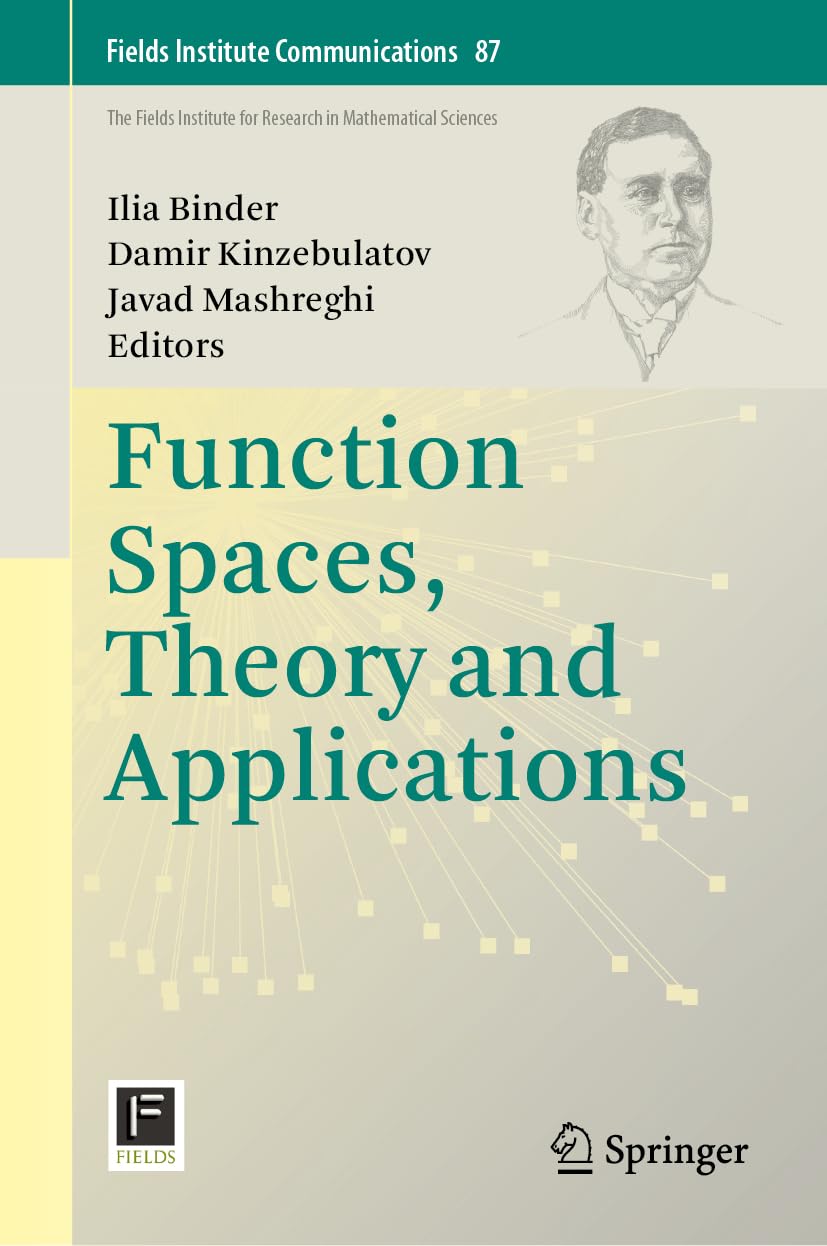
Function Spaces, Theory and Applications (Fields Institute Communications, 87)
$130.13
by Ilia Binder



The focus program on Analytic Function Spaces and their Applications took place at Fields Institute from July 1st to December 31st, 2021. Hilbert spaces of analytic functions form one of the pillars of complex analysis. These spaces have a rich structure and for more than a century have been studied by many prominent mathematicians. They also have several essential applications in other fields of mathematics and engineering, e.g., robust control engineering, signal and image processing, and theory of communication. The most important Hilbert space of analytic functions is the Hardy class H2. However, its close cousins, e.g. the Bergman space A2, the Dirichlet space D, the model subspaces Kt, and the de Branges-Rovnyak spaces H(b), have also been the center of attention in the past two decades. Studying the Hilbert spaces of analytic functions and the operators acting on them, as well as their applications in other parts of mathematics or engineering were the main subjects of this program. During the program, the world leading experts on function spaces gathered and discussed the new achievements and future venues of research on analytic function spaces, their operators, and their applications in other domains. With more than 250 hours of lectures by prominent mathematicians, a wide variety of topics were covered. More explicitly, there were mini-courses and workshops on Hardy Spaces, Dirichlet Spaces, Bergman Spaces, Model Spaces, Interpolation and Sampling, Riesz Bases, Frames and Signal Processing, Bounded Mean Oscillation, de Branges-Rovnyak Spaces, Operators on Function Spaces, Truncated Toeplitz Operators, Blaschke Products and Inner Functions, Discrete and Continuous Semigroups of Composition Operators, The Corona Problem, Non-commutative Function Theory, Drury-Arveson Space, and Convergence of Scattering Data and Non-linear Fourier Transform. At the end of each week, there was a high profile colloquium talk on the current topic. The program also contained two semester-long advanced courses on Schramm Loewner Evolution and Lattice Models and Reproducing Kernel Hilbert Space of Analytic Functions. The current volume features a more detailed version of some of the talks presented during the program. The focus program on Analytic Function Spaces and their Applications took place at Fields Institute from July 1st to December 31st, 2021. Hilbert spaces of analytic functions form one of the pillars of complex analysis. These spaces have a rich structure and for more than a century have been studied by many prominent mathematicians. They also have several essential applications in other fields of mathematics and engineering, e.g., robust control engineering, signal and image processing, and theory of communication. The most important Hilbert space of analytic functions is the Hardy class H2. However, its close cousins, e.g. the Bergman space A2, the Dirichlet space D, the model subspaces Kt, and the de Branges-Rovnyak spaces H(b), have also been the center of attention in the past two decades. Studying the Hilbert spaces of analytic functions and the operators acting on them, as well as their applications in other parts of mathematics or engineering were the main subjects of this program. During the program, the world leading experts on function spaces gathered and discussed the new achievements and future venues of research on analytic function spaces, their operators, and their applications in other domains. With more than 250 hours of lectures by prominent mathematicians, a wide variety of topics were covered. More explicitly, there were mini-courses and workshops on Hardy Spaces, Dirichlet Spaces, Bergman Spaces, Model Spaces, Interpolation and Sampling, Riesz Bases, Frames and Signal Processing, Bounded Mean Oscillation, de Branges-Rovnyak Spaces, Operators on Function Spaces, Truncated Toeplitz Operators, Blaschke Products and Inner Functions, Discrete and Continuous Semigroups of Composition Operators, The Corona Problem, Non-commutative Function Theory, Drury-Arveson Space, and Convergence of Scattering Data and Non-linear Fourier Transform. At the end of each week, there was a high profile colloquium talk on the current topic. The program also contained two semester-long advanced courses on Schramm Loewner Evolution and Lattice Models and Reproducing Kernel Hilbert Space of Analytic Functions. The current volume features a more detailed version of some of the talks presented during the program. Ilia Binder is a professor of Mathematics at the University of Toronto. His research interests are Geometric Function Theory, Complex Analysis and Potential Theory, Complexity and Computability in Analysis and Dynamical Systems, Complex Dynamics, Stochastic Löwner Evolution, Multifractal Analysis, Quasi-periodic and random Shroedinger and Jacobi operators. He is also the Chair of the Mathematical and Computational Sciences Department at the University of Toronto Mississauga. Damir Kinzebulatov is