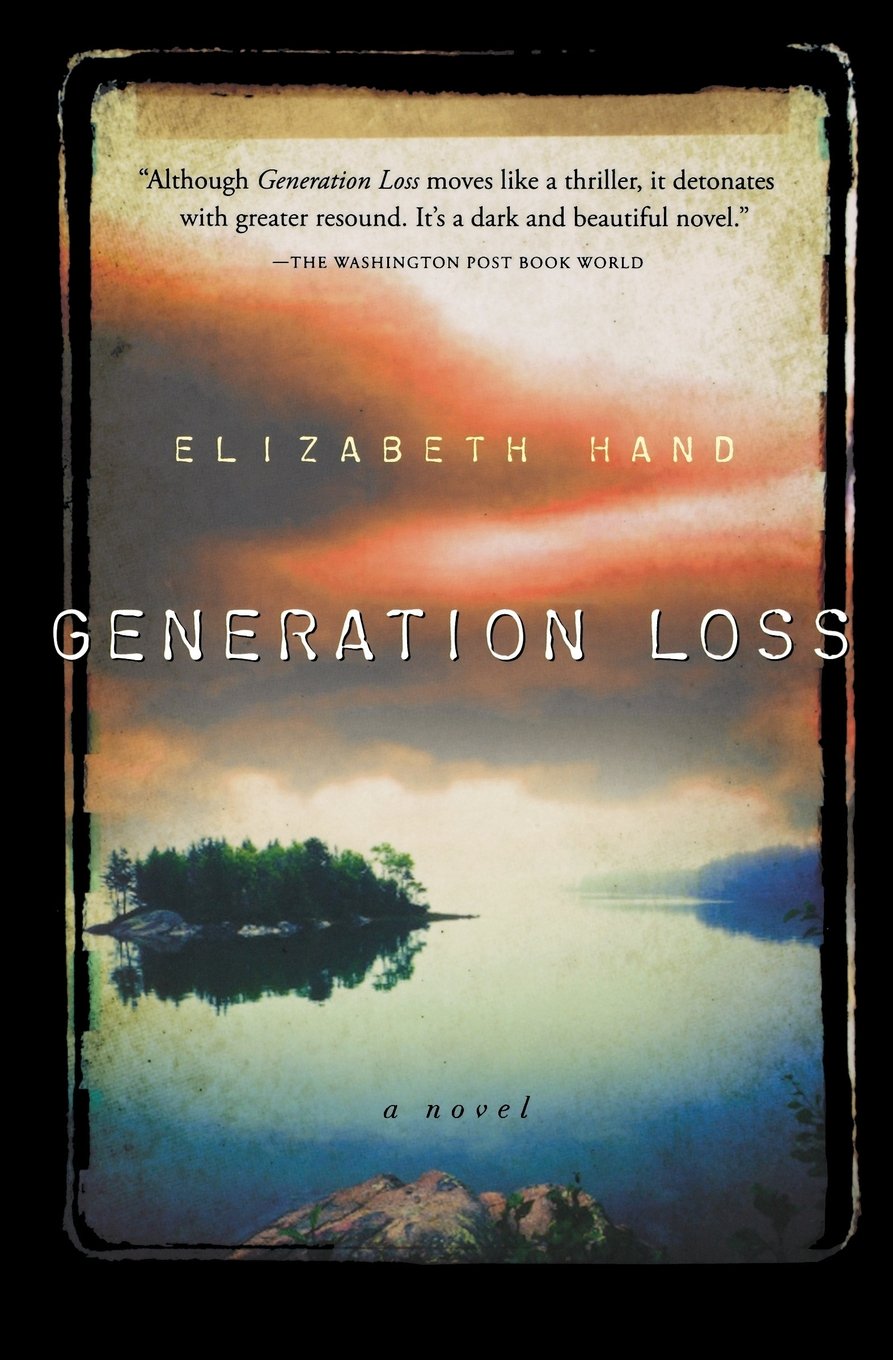



Cass Neary made her name in the seventies as a photographer embedded in the burgeoning punk movement in New York City. Her pictures of the musicians and the hangers-on, the infamous, the damned, and the dead, earned her a brief moment of fame. Thirty years later she is adrift, on her way down, and almost out when an old acquaintance sends her on a mercy gig to interview a famously reclusive photographer who lives on an island in Maine. When she arrives Down East, Cass stumbles across a decades-old mystery that is still claiming victims, and she finds one final shot at redemption. Patricia Highsmith meets Patti Smith in this mesmerizing literary thriller. PRAISE FOR GENERATION LOSS "Although Generation Loss moves like a thriller, it detonates with greater resound. It's a dark and beautiful novel."― The Washington Post Book Review "Intense and atmospheric, Generation Loss is an inventive brew of postpunk attitude and dark mystery. Elizabeth Hand writes with craftsmanship and passion."―George Pelecanos ELIZABETH HAND, a New York Times notable and multiple-award-winning author, has written eight novels, including the cult classic Waking the Moon, and several short-story collections. She is a longtime contributor to numerous publications, including the Washington Post Book World and the Village Voice Literary Supplement. She and her two children divide their time between the coast of Maine and North London. There’s always a moment where everything changes. A great photographersomeone like Diane Arbus, or me during that fraction of a second when I was greatshe sees that moment coming, and presses the shutter release an instant before the change hits. If you don’t see it coming, if you blink or you’re drunk or just looking the other waywell, everything changes anyway, it’s not like things would have been different. But for the rest of your life you’re fucked, because you blew it. Maybe no one else knows it, but you do. In my case, it was no secret. Everyone knew I’d blown it. Some people can make do in a situation like that. Me, I’ve never been good at making do. My life, who could pretend there wasn’t a big fucking hole in it? I grew up about sixty miles north of the city in Kamensic Village, a haunted corner of the Hudson Valley where three counties meet in a stony congeries of ancient Dutch-built houses, farmland, old-growth forest, nouveau-riche mansions. My father wasisthe village magistrate. I was an only child, and a wild thing as the privileged children of that town were. I had from earliest childhood a sense that there was no skin between me and the world. I saw things that other people didn’t see. Hands that slipped through gaps in the air like falling leaves; a jagged outline like a branch but there was no branch and no tree. In bed at night I heard a voice repeating my name in a soft, insistent monotone. Cass. Cass. Cass. My father took me to a doctor, who said I’d grow out of it. I never did, really. My mother was much younger than my father, a beautiful Radcliffe girl he met on a blind date arranged by his cousin. She died when I was four. The car she was driving, our old red Rambler station wagon, went off the road and into the woods, slamming into a tree on the outskirts of town. It was an hour before someone noticed headlights shining through the trees and called the police. When they finally arrived, they found my mother impaled on the steering column. I was faceup on the backseat, surrounded by shattered glass but unhurt. I have no memory of the accident. The police officer told my father that I didn’t cry or speak, just stared at the car’s ceiling, and, as the officer carried me outside, the night sky. Nowadays there would have been a grief counselor, a child psychologist, drugs. My father’s Irish Catholic sensibility, while not religious, precluded any overt emotion; there was a wake, a funeral, a week of visiting relatives and phone calls. Then my father returned to work. A housekeeper, Rosie, was hired to tend me. My father wouldn’t speak of my mother unless asked, and, forty-odd years ago, one didn’t ask. Her presence remained in the framed black-and-white photos my father kept of her in his bedroom. While Rosie vacuumed or made lunch I would sit on his bed and slowly move my fingers across the glass covering the pictures, pretending the dust was face powder on my mother’s cheeks. I liked being alone. Once when I was fourteen, walking in the woods, I stepped from the trees into a field where the long grasses had been flattened by sleeping deer. I looked up into the sky and saw a mirror image of the grass, black and yellow-gray whorls making a slow clockwise rotation like a hurricane. As I stared the whorl began to move more quickly, drawing a darkness into its center until it resembled a vast striated eye that was all pupil, contracting upon itself yet never disappearing. I stared at it until a low buzzing began to sound in my ears. Then I ran. I didn’t