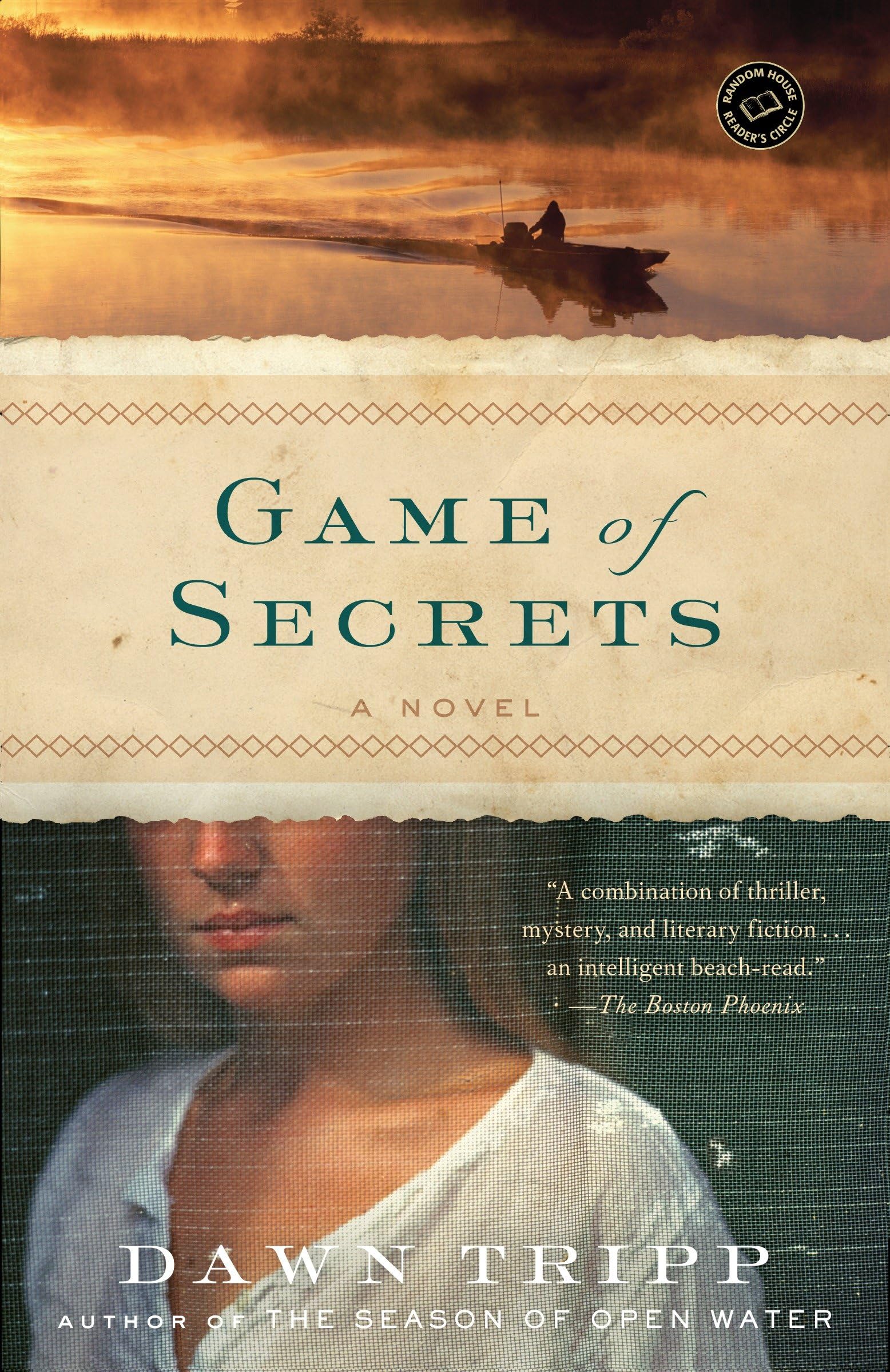



Jane Weld was eleven years old when her father, Luce, disappeared in 1957. His skiff was found drifting near a marsh, empty except for his hunting coat and a box of shotgun shells. No one in their small New England town knew for sure what happened until, three years later, Luce’s skull rolled out of a gravel pit, a bullet hole in the temple. Rumors sprang up that he had been murdered by the jealous husband of his mistress, Ada Varick. Now, half a century later, Jane is still searching for the truth of her father’s death, a mystery made more urgent by the unexpected romance that her willful daughter, Marne, has struck up with one of Ada’s sons. As the love affair intensifies, Jane and Ada meet for their weekly Friday game of Scrabble, a pastime that soon transforms into a cat-and-mouse game of words long left unspoken, and dark secrets best left untold. A Boston Globe bestseller Look for special features inside. Join the Circle for author chats and more. “A combination of thriller, mystery, and literary fiction . . . an intelligent beach-read.”— The Boston Phoenix “Drop-dead Yankee storytelling . . . Elizabeth Strout fans will find a lot to admire about [ Game of Secrets ], cleverly framed around the idea of revealing old family mysteries through a continuing series of Scrabble games.”—Minneapolis Star Tribune “Like a Faulkner novel, Game of Secrets weaves in and out of time. . . . The varied points of view and fragments are rendered with such poetry, each sentence is a pleasure.” —The Providence Journal “A gracefully told character study of three intelligent, forbidding women and the men who love them, wrapped up in a taut, suspenseful mystery.” —Booklist “Irresistible . . . An unusual love story melded to a literary thriller, and filled with exquisite language and dazzlingly alive characters, Game of Secrets is unlike anything you’ve ever read before.”—Caroline Leavitt, author of Pictures of You Dawn Tripp graduated from Harvard and lives in Massachusetts with her husband and two sons. She is the author of the novels Moon Tide and The Season of Open Water, which won the Massachusetts Book Award for Fiction. Ray Marne June 3, 2004 Back in January, I got the phone call from Alex that brought me home from California. The next week, I took my mother grocery shopping up at Lees. She got stuck only once, in the produce section, picking through the pears, unable to decide which ones she should buy. “So many choices these days,” she murmured to me, apologetic and with a touch of sadness, like she could feel the glitch in her but was unable to correct it, so I decided for her. In the checkout line, I had that feeling you get sometimes when someone’s eyes are on you, and I turned and saw Ray three aisles away and, for a moment, I couldn’t place him, then all at once I did. His face looked thin, much thinner than it should have—a look in his eyes like they’d been scraped. Then the girl at the register was asking whether I wanted plastic or paper, and Ray was still looking at me, that look in his eyes replaced by something different that gave me a little jump, electric-like, and I stared back. Just stared. “There’s Ray,” my mother said. I snapped out of it and gave him a wave like I should have in the first place, he smiled and waved back, and everything was natural, normal, like it should be. And after he’d made it through checkout, he stopped to say hello, and asked when I’d gotten back from California. By then, our groceries were bagged and loaded into the cart, and he walked outside with us, and the winter sunlight hit me hard as we stepped through the automatic door, untenable and bright, everything caught up short in the unexpected. He was getting a divorce, my brother Alex told me. Of course, over the next couple of months, I’d run into him here and there. Or he’d drop by the house, looking for Alex. But whenever Ray’s around, I can’t seem to find two words to rub together, a tense kind of rustle moves through me—the wrong kind of feeling, I know, for someone so off-limits. Two strikes up front: He’s my brother’s best friend, and Ada Varick’s son. Ada’s wreaked her share of havoc in our family. She was the irresistibly beautiful reason my grandfather Luce Weld was killed, back in 1957—murdered, so it’s said, for loving her too much. Not that Ada’s hold has been any lighter on the rest of us—look at my mother, still trekking over to the Council on Aging every Friday, still in thrall to her Ada and their games. It’s hard to imagine sometimes—it’s a thing I’ve never quite gotten my mind around—how my mother, Luce Weld’s only daughter, came to be friends with Ada Varick in the first place. Ada was twenty years older, a different ilk. I asked my mother once how it started, how she came to be invited into that knot of four or five women who met every Friday for Scrabble. “Vivi Butler called me up one day out of the blue and asked me,” she answered, simply.