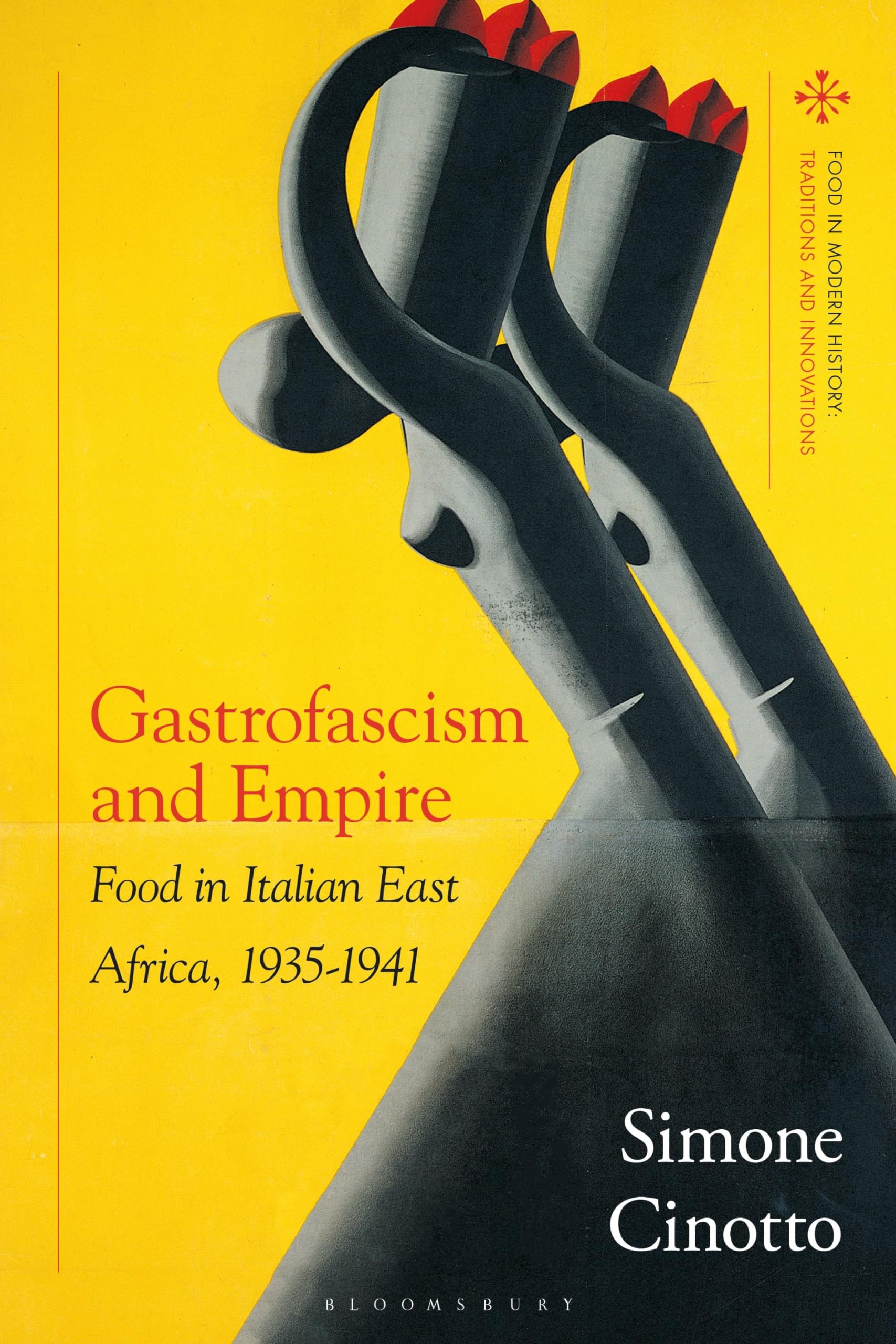
Gastrofascism and Empire: Food in Italian East Africa, 1935-1941 (Food in Modern History: Traditions and Innovations)
$39.95
by Simone Cinotto



Food stood at the centre of Mussolini’s attempt to occupy Ethiopia and build an Italian Empire in East Africa. Seeking to redirect the surplus of Italian rural labor from migration overseas to its own Empire, the fascist regime envisioned transforming Ethiopia into Italy’s granary to establish self-sufficiency, demographic expansion and strengthen Italy’s international political position. While these plans failed, the extensive food exchanges and culinary hybridizations between Ethiopian and Italian food cultures thrived, and resulted in the creation of an Ethiopian-Italian cuisine, a taste of Empire at the margins. In studying food in short-lived Italian East Africa, Gastrofascism and Empire breaks significant new ground in our understanding of the workings of empire in the circulation of bodies, foodways, and global practices of dependence and colonialism, as well as the decolonizing practices of indigenous food and African anticolonial resistance. In East Africa, Fascist Italy brought older imperial models of global food to a hypermodern level in all its political, technoscientific, environmental, and nutritional aspects. This larger story of food sovereignty—entered in racist, mass settler colonialism—is dramatically different from the plantation and trade colonialisms of other empires and has never been comprehensively told. Using an original decolonizing food studies approach and an unprecedented variety of unexplored Ethiopian and Italian sources, Cinotto describes the different meanings of different foods for different people at different points of the imperial food chain. Exploring the subjectivities, agencies and emotions of Ethiopian and Italian men and women, it goes beyond simple colonizer/colonized binaries and offers a nuanced picture of lived, multisensorial experiences with food and empire. "In this important book, Simone Cinotto portrays the intertwined gastronomic and racial fears and fantasies that inspired fascist Italy’s empire in Ethiopia. Despite attempts to segregate European and African foods and bodies, an ideal shared by contemporary nationalist politicians, a hybrid Italian-Ethiopian cuisine lives on in both countries." - Jeffrey Pilcher, Professor of Food Studies, University of Toronto, Canada " Gastrofascism and Empire is a brilliant and biting analysis of Fascist Italy’s bioimperialism and Italian East Africa’s resistance to the empire of food. Deconstructing one model of colonial gastronomy, Cinotto maps out the movement of people, practices of taste and disgust, and an indigenous attempt at food sovereignty. A new model in fascist studies." - Stanislao Pugliese, Professor of History, Hofstra University, USA " A compelling examination of the connections between food and Italian Fascist imperialism. Simone Cinotto offers a new lens on the history of occupied East Africa. He examines the devastating impact of Italian imperialism on East African food security, and how Fascist ideologies and practices of racism and autarchy influenced food politics. An original and welcome study." - Ruth Ben-Ghiat, Professor of History and Italian Studies, New York University, USA Simone Cinotto is Professor of Modern History at the University of Gastronomic Sciences in Pollenzo, Italy, where he is the Director of the Master's program in World Food Studies and Reference Professor for Fulbright cultural exchange programs between Italy and the United States. He has been a visiting professor and research fellow at many international universities, including Columbia University, New York University, and Indiana University. Cinotto is the author of Gastrofascism and Empire: Food in Italian East Africa, 1935-1941 (2024), The Italian American Table: Food, Family, and Community in New York City (2013), Soft Soil Black Grapes: The Birth of Italian Winemaking in California (2012), and the editor of Food Mobilities: Making World Cuisines (2023), Global Jewish Foodways: A History (University of Nebraska Press 2018), and Making Italian America: Consumer Culture and the Production of Ethnic Identities (2014), which won the 2015 John G. Cawelti Award for the Best Textbook/Primer of the Popular Culture Association/American Culture Association. His article “Leonard Covello, the Covello Papers, and the Eating Habits of Italian Immigrants in New York” won the 2004 David Thelen Prize awarded by the Organization of American Historians for the best article on American History published in a language other than English, and was published in the Journal of American History . Cinotto is on the Editorial Board of several journals, including Food , Culture, and Society , Gastronomica , Global Food History , and the Italian American Review . Peter Scholliers is Professor of Contemporary History at the Vrije Universiteit Brussel. He edited Food, Drink and Identity : Cooking, Eating and Drinking in Europe since the Middle Ages (2001) , and published Food Culture in Belgium . Peter