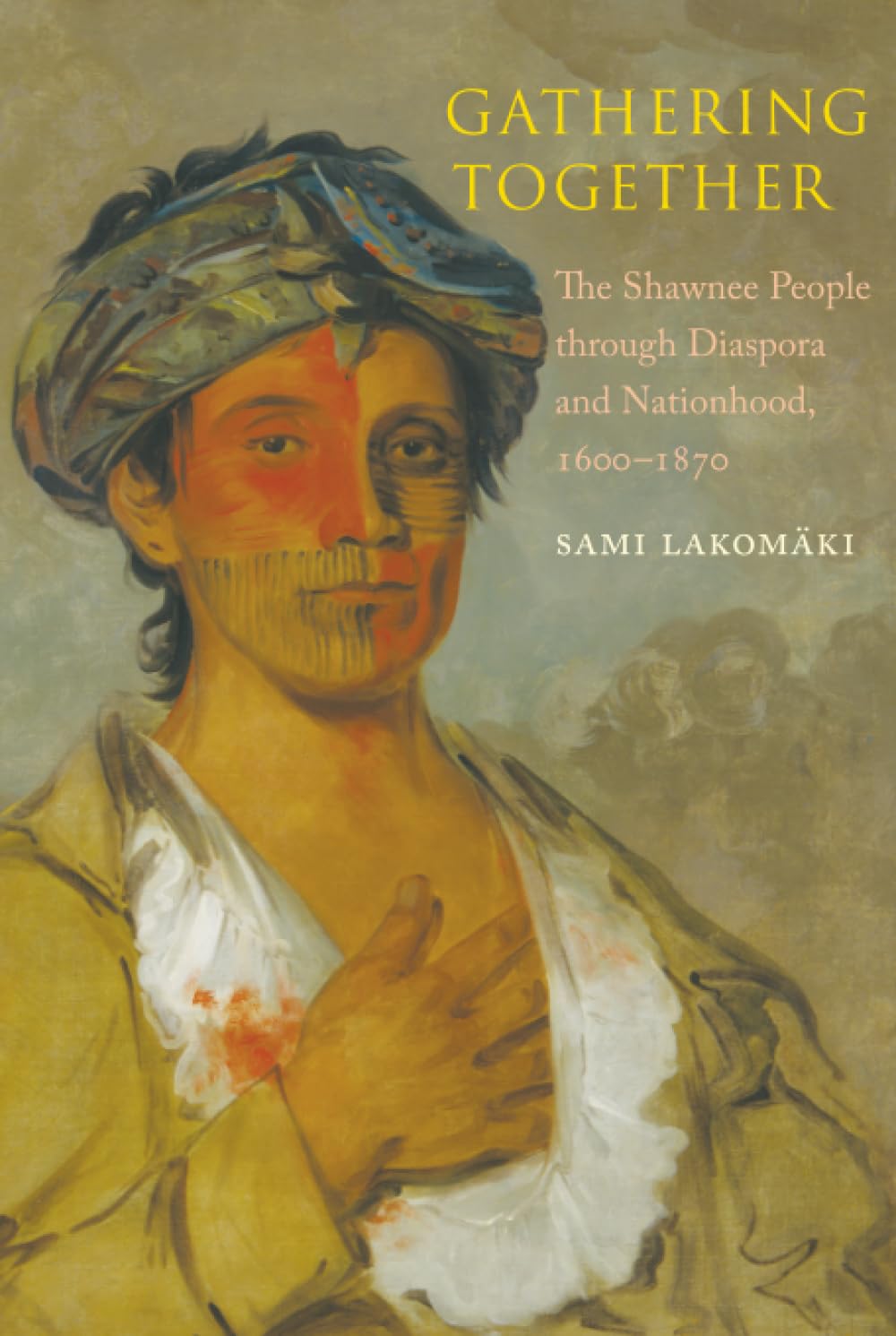
Gathering Together: The Shawnee People Through Diaspora and Nationhood, 1600-1870 (The Lamar Series in Western History)
$39.52
by Sami Lakomaki (Lakomäki



Weaving Indian and Euro-American histories together in this groundbreaking book Sami Lakomäki places the Shawnee people and Native peoples in general firmly at the center of American history. The book covers nearly three centuries from the years leading up to the Shawnees' first European contacts to the post-Civil War era and demonstrates vividly how the interactions between Natives and newcomers transformed the political realities and ideas of both groups. Examining Shawnee society and politics in new depth and introducing not only charismatic warriors like Blue Jacket and Tecumseh but also other leaders and thinkers Lakomäki explores the Shawnee people's debates and strategies for coping with colonial invasion. The author refutes the deep-seated notion that only European colonists created new nations in America showing that the Shawnees too were engaged in nation building. With a sharpened focus on the creativity and power of Native political thought Lakomäki provides an array of insights into Indian as well as American history. Published in cooperation with the William P. Clements Center for Southwest Studies Southern Methodist University Won an Honorable Mention for the 2014 American Publishers Awards for Professional and Scholarly Excellence (PROSE) in the U.S. History category. -- PROSE ― American Publishers Awards for Professional and Scholarly Excellence Published On: 2015-02-16 Winner of the 2015 Erminie Wheeler-Voeglin Book Award, given by the American Society for Ethnohistory. -- Erminie Wheeler-Voeglin Book Award ― American Society for Ethnohistory Published On: 2015-12-15 Sami Lakomäki is a university lecturer at the University of Oulu. He lives in Oulu, Finland. Gathering Together The Shawnee People through Diaspora and Nationhood, 1600–1870 By Sami Lakomäki Yale UNIVERSITY PRESS Copyright © 2014 Yale University All rights reserved. ISBN: 978-0-300-18061-9 Contents Acknowledgments, vii, Introduction: "Our Straggling Nation", 1, 1. "The Greatest Travellers in America": The Shawnee Diaspora, 1600–1725, 13, 2. "The Sheynars in General": Unity and Diversity on Imperial Borderlands, 1725–1755, 42, 3. "The Chief of All the Tribes": Nation and Empire, 1755–1775, 72, 4. "A Struggle with Death": The Twenty Years' War, 1775–1795, 102, 5. "Become an Independent People": Rebuilding the Nation, 1795–1833, 132, 6. "Dispersed like Turkeys": The Odyssey of the Western Shawnees, 1782–1840, 165, 7. "Reunion": Sovereignty and Centralization, 1833–1870, 193, Conclusion: A Living Nation, 224, List of Abbreviations, 235, Notes, 239, Bibliography, 295, Index, 323, CHAPTER 1 "The Greatest Travellers in America" The Shawnee Diaspora, 1600–1725 "They are Stout, Bold, Cunning, and the greatest Travellers in America." Thus Edmond Atkin, a seasoned British Indian trader and the future superintendent of Indian affairs, described Shawnees in 1754. Like other colonists, Atkin was baffled by the Shawnees. Since the late seventeenth century, seemingly countless bands of these people had crisscrossed the eastern third of North America, turning up now on the lower Mississippi River, next in Charles Town, Carolina, then on the streets of Albany, New York. Equally baffled by such mobility and dispersal, generations of subsequent scholars condemned the "sudden appearances and disappearances" of the Shawnees as "very obscure." More recently, historians have come to understand that the Shawnees' fragmentation and mobility were emblematic of a whole world set in motion by the immense demographic, political, and economic changes that shook North America during the seventeenth century. Scholars now conceptualize the dispersal of the Shawnees as a diaspora, a forced scattering of a people from ancestral homelands. In the seventeenth century epidemic disease, slave raiding, and globalizing economic networks spread across eastern North America with European explorers, traders, and settlers. These upheavals transformed the region into a "shatter zone," a violent and unstable territory characterized by warfare, depopulation, displacement, and community fragmentation. The diaspora of the Shawnees was a strategy for survival in this chaos, for escaping violence and exploiting new trading opportunities. It was based on Shawnee ideas and networks of alliance, kinship, and community, but the diaspora also transformed those ideas and networks. By the 1720s some Shawnees had learned to regard a mobile life within multiethnic networks of kin and allies as the normal way of life. Others concluded that dispersal was dangerous and began seeking unity and permanent homelands. THE EMERGENCE It all began, the Shawnee elders always knew, in the Upper World above the Sky. According to Shawnee oral histories recorded in the late eighteenth and early nineteenth centuries, the Creator, Meteelemelakwe, made the ancestors of twelve Shawnee divisions in the Upper World, a place of great spiritual power an