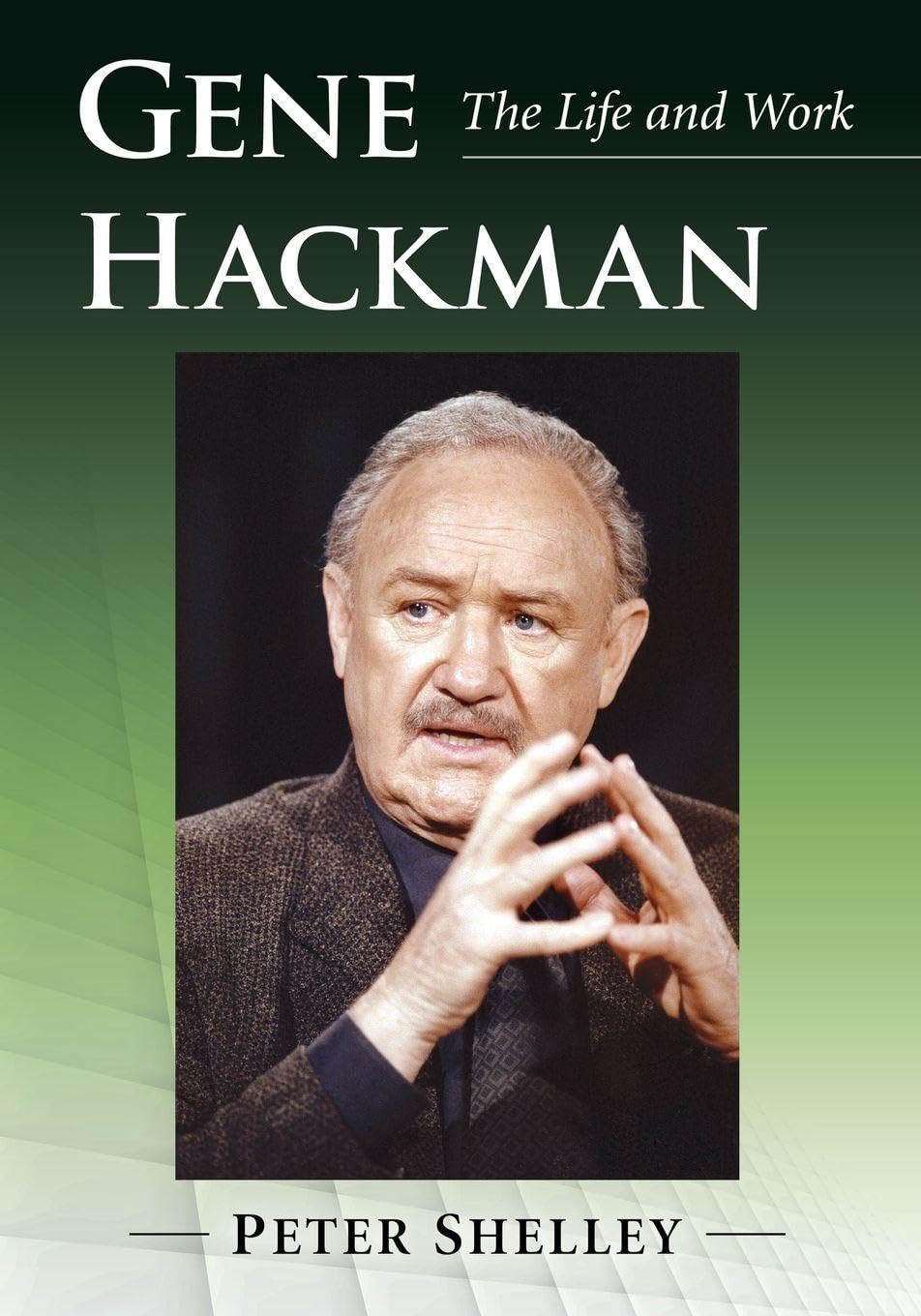



Gene Hackman (b. 1930) has been described as the best actor of his generation. During almost half a century as an American film, television and stage actor, film producer and author, he was nominated for five Academy Awards, winning the Best Actor for The French Connection (1971) and the Best Supporting Actor for Unforgiven (1992), as well as three Golden Globes and two BAFTAs. This study examines his film work in detail, with a filmography/videography included. ... It's a virtue of Shelley's work that he lets the material he's uncovered represent the chameleon identity of its subject...As readers we're left to connect the dots the biographer has made available to us, or at least come to our own conclusion based on the last Hackman film we've seen... Louis J. Wasser, Film International. "This comprehensive book will be prized by all Gene Hackman fans as well as aficionados of Hollywood film history." Bradford Lee Eden, ARBA. "Would you rather hear about my life from the horse's mouth or a horse's ass?!" Gene Hackman. I think I first saw Gene Hackman in the action adventure film The Poseidon Adventure (1972) where he played a priest but not a conventional one. He was a man who had a violent temper, and even though he turned out to be right about what to do in the situation as opposed to Arthur O'Connell's priest who was passive and drowned, there was something frightening about his intensity. Hackman played what was described as a modern priest and the actor gave his character heroic and anti-heroic qualities. This ambivalence was perhaps indicative of the heroes in 1970s' cinema, which Hackman found himself the star of. But he was an unconventional star, unlike his contemporaries Robert Redford, Al Pacino,Dustin Hoffman, and Jack Nicholson. Although at this time he played leading man roles, Hackman rarely was a romantic figure despite his masculine appearance. He had begun acting at a relatively late age, and being tall with a double chin and paunch and a receding hairline had Hackman describe himself as a "biglummox". According to playwright John Logan, Sue Mengers saw him as an "ugly potato head"and Pauline Kael wrote that he didn't have the sexiness of a movie star. While she admitted that Hackman was a superlative actor with an interesting expressive face, he was more like a character actor. His characters might have female sexual partners but his roles were more often violent ones, which is ironic since he said personally he hated violence. There was a rage in the actor that could be easily summoned, and it wasn't till later in his career that he began to also finesse that anger to comedic ends. Perhaps the turning point for Hackman was that at the height of career in the 1970s he decided to retire, and it was when he returned to films with All Night Long (1981) that he was able to play a comic and romantic role opposite Barbra Streisand. This shift in perception led to an even greater period of leading man roles, and though in the 1990s he was doing a lot of supporting ones he managed to end his career back in leading ones. Peter Shelley is a playwright, screenwriter and author of several film books. He lives in Gosford, Australia.