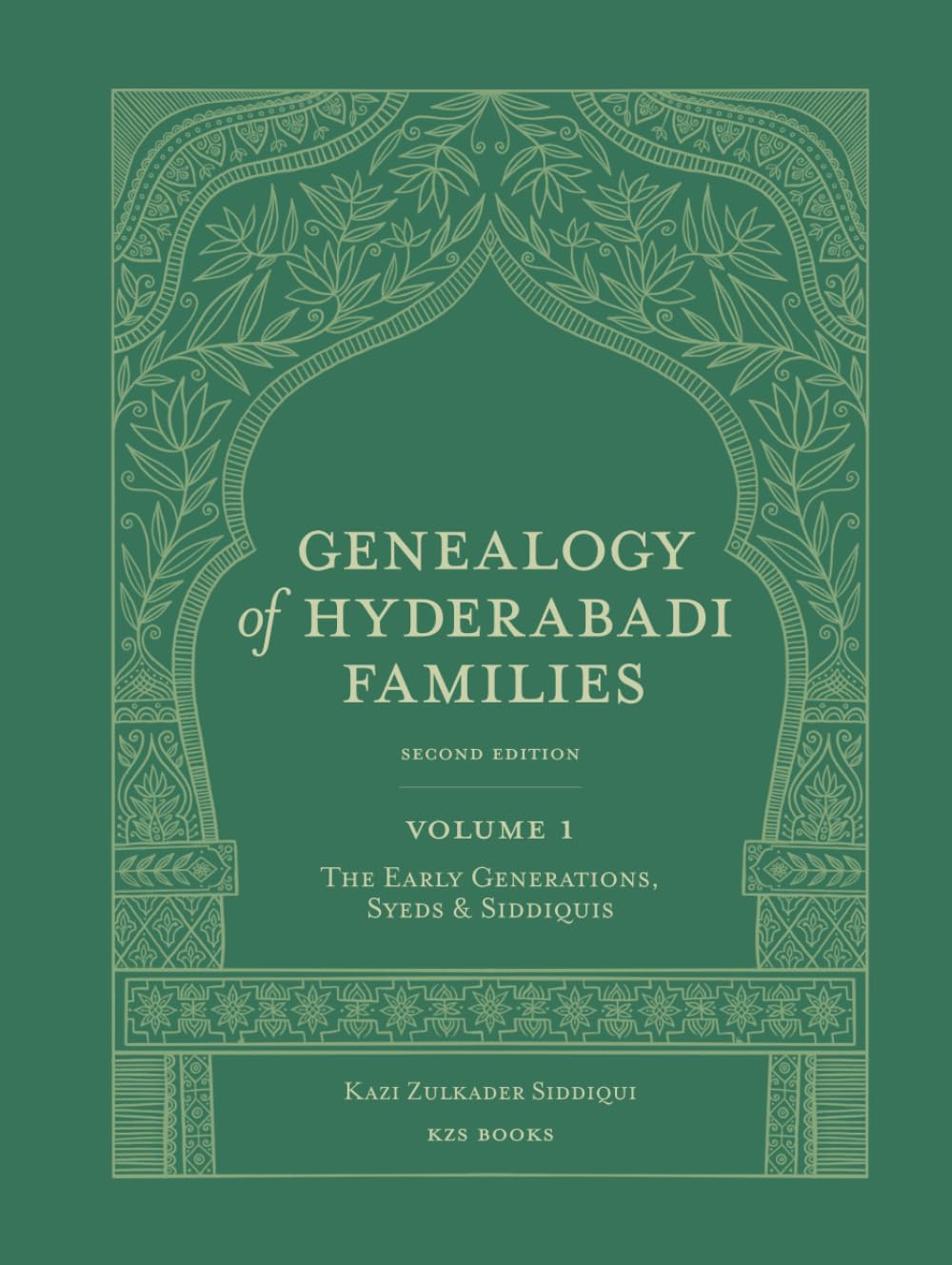
Genealogy of Hyderabadi Families, 2nd Edition, Vol.1: The Early Generations, Syeds & Siddiquis
$42.99
by Kazi Zulkader Siddiqui



THIS SECOND EDITION IS IN 3 VOLUMES. This is volume 1 only. Please ensure you obtain the other 2 volumes to have the complete set. The 2nd edition incorporates at least three times as many names and hundreds of additional branches. It also introduces a comprehensive name index in Volume 3, making it considerably easier to locate individuals and trace cross-references. The font size has been reduced allowing each chart to accommodate a greater number of names within a single visual frame. The 1st edition of the book (2020) received a response far greater than I had anticipated. Few expected that this book would weave together genealogies of so many families and reveal the connections among them. Many readers discovered previously unknown relationships – both among Hyderabadis and beyond – which in turn has helped foster new bonds of kinship. What struck me most was how many of the readers were young, expressing a strong desire to understand their roots as part of their search for identity. Many readers shared how learning about their ancestry renewed their respect for family values and deepened their sense of belonging. What resonated with most readers was the underlying idea of interconnection, showing paternal and maternal lines. In our milieu, family trees were traditionally maintained in private, often limited to patrilinear descent, and rarely illustrated how families intersected with one another. Making those connections visible gave this work broader relevance. Who is Hyderabadi? Readers often ask who qualifies as “Hyderabadi” in a book devoted to Hyderabadi genealogy. Where, exactly, should the line be drawn? Historically, many Hyderabadi Muslim families, particularly among established lineages—trace ancestry to Arabia, the Levant, Iraq, Persia (Iran), Central Asia, and Yemen. Some ancestors migrated to the Deccan region centuries ago; others arrived later, particularly after the fall of Delhi and debacle of 1857, seeking opportunity, stability, or refuge. Some families remained in Hyderabad for generations, while others stayed briefly before moving on to other parts of India or, later, to Pakistan, particularly after 1947. Even before the erosion of Muslim power in northern India, southern Muslim states had begun confronting European colonial expansion. The Battle of Ambur (1749), in which Nawab Anwaruddin Khan of Arcot fell to French-backed forces, and the fall of Seringapatam (1799) with the martyrdom of Tipu Sultan of Mysore, marked turning points in the political fortunes of southern Indian Muslims. In the decades that followed, Hyderabad increasingly became a destination for displaced communities seeking relative stability under the Nizam’s rule Drawn by Hyderabad’s administrative continuity and patronage networks, migrants found refuge, employment, and the chance to reconstitute extended family life. The Nizam’s government was benevolent and offered financial support and appointments to newcomers from across India, many of whom went on to contribute substantially to the state’s economy and administration. Some gradually adopted the local Hyderabadi dialect, customs, culture and traditions; others retained elements of their original regional identities. Over time, these blended into a shared Hyderabadi social fabric. Against this historical backdrop, the definition in this book of who is Hyderabadi deliberately inclusive, reflecting the long-standing practice of the State of Hyderabad itself. Anyone who resided within the Nizam’s dominion – whether for a lifetime or a season – qualifies as Hyderabadi for the purposes of this book. Neither length of residence nor linguistic assimilation is determinative. This definition embraces the migrants who arrived from every region of India and from distant geographies over the centuries, and whose lives intersected with Hyderabad and Deccan in meaningful ways.