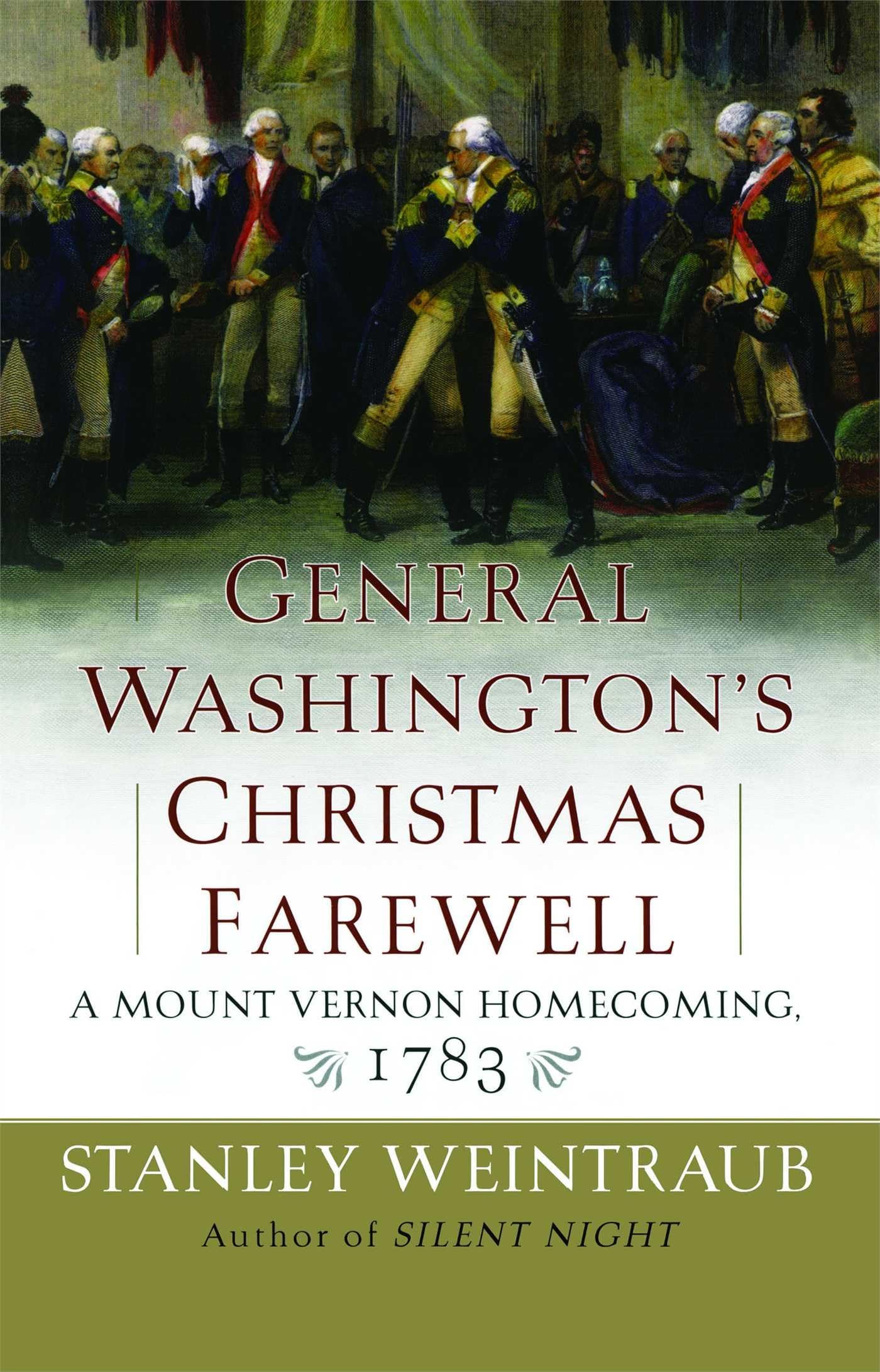
General Washington's Christmas Farewell: A Mount Vernon Homecoming, 1783
$16.95
by Stanley Weintraub



One of America's greatest Christmas stories and also one of its very first -- from the period between the end of the Revolutionary War and the ratification of the Constitution -- was a creation of none other than George Washington. The story isn't just about Washington coming home for Christmas for the first time since the war began, but about the character of our most important Founding Father and about the precedent he set for democratic leadership. It is the story of a loving husband, a beloved military leader, and above all, a humble and great man. In late November 1783 when Washington finally received formal notice of the signing of a peace treaty with England he had little more than a month to accept the transfer of power from British troops in New York; to bid farewell to his troops; and to resign his commission to Congress if he hoped to make it to Mount Vernon for Christmas. He could have remained in charge of the army and become a virtual king to the Americans who loved him. Control of the newly forming government was his to take -- yet he chose to resign. It was that decision, coupled with his later decision to step down from the presidency after two terms, that rendered him "the greatest character of the age" (according to none other than King George III). Washington's homeward journey is one of the most moving and inspiring stories from his great and eventful life. When he bade farewell to his troops at Fraunces Tavern in New York City there were no dry eyes. When he reached Congress and gave a retirement speech, it cemented his greatness more fully than had his victory over the British. When he made it to Mount Vernon, finally, on Christmas Eve, it could not have been a happier homecoming. General Washington's Christmas Farewell is a deeply moving Christmas story as well as a great American story. Jay Winik author of "April 1865: The Month that Saved America" Stanley Weintraub's "General Washington's Christmas Farewell" is an engaging rendition of a few fleeting weeks that would come to speak volumes about the young American republic. This slim book is fresh, fascinating, and delightful. Thomas Fleming author of "Liberty!: The American Revolution" This is a different George Washington from the stick figure on the dollar bill -- a man who was not only admired but loved by his fellow Americans. Mr. Weintraub has brought to vivid life a deeply meaningful and profoundly moving chapter from our past. Stanley Weintraub is Evan Pugh Professor Emeritus of Arts and Humanities at Penn State University and the author of notable histories and biographies including 11 Days in December, Silent Night: The Story of the World War I Christmas Truce, MacArthur's War, Long Day's Journey into War, and A Stillness Heard Round the World: The End of the Great War. He lives in Newark, Delaware. 1: BEGINNING THE END After more than eight years of war, General George Washington was impatient to return home. The unpretentious and unfinished country house, its wood panels shaped and covered with a sandy white paint to resemble stone, was still without a completed cupola and weather vane. Eight square wooden pillars already fronted the portico overlooking the broad waters of what was then known as the Potowmack. Mount Vernon and the postwar improvements he wanted to make to it had rarely been out of Washington's thoughts since the shooting had stopped. He had lived on the property, purchased by his father as Little Hunting Creek Plantation in 1735, since he was three years old. At nineteen, in 1751, he had inherited it from his half-brother Lawrence. Since May 4, 1775, Washington had been back only once, for a few days in October 1781, during the culminating Yorktown campaign. Nearly fifty-two, his once reddish hair was graying above a Roman profile weather-beaten by early exposure as a surveyor, planter, and frontier soldier and etched by smallpox at nineteen. He felt physically and emotionally drained. In the limbo between war and peace, his weight, on a solid six-foot-four frame, had burgeoned to 209 pounds. To his worshipers, military and civilian, to whom he symbolized the new United States, Washington embodied rocklike perseverance. He appeared even more majestic and larger than life late in 1783 than in his lean and anxious earlier years directing what seemed an unwinnable war. Even then Washington had been a commanding figure. "You had prepared me to entertain a favorable opinion of him," Abigail Adams wrote to her husband early in the rebellion, "but I thought the one half was not told me." And she quoted to John Adams "those lines of Dryden," Mark his Majestik fabrick! He's a temple Sacred by birth, and built by hands divine.... Late in 1783 the letters of the Abbé Robin, a chaplain with Count de Rochambeau's army at Yorktown, had been published, with much the same view of Washington's "tall and noble stature," that "perhaps the exterior of no man was ever better calculated to gratify these expec