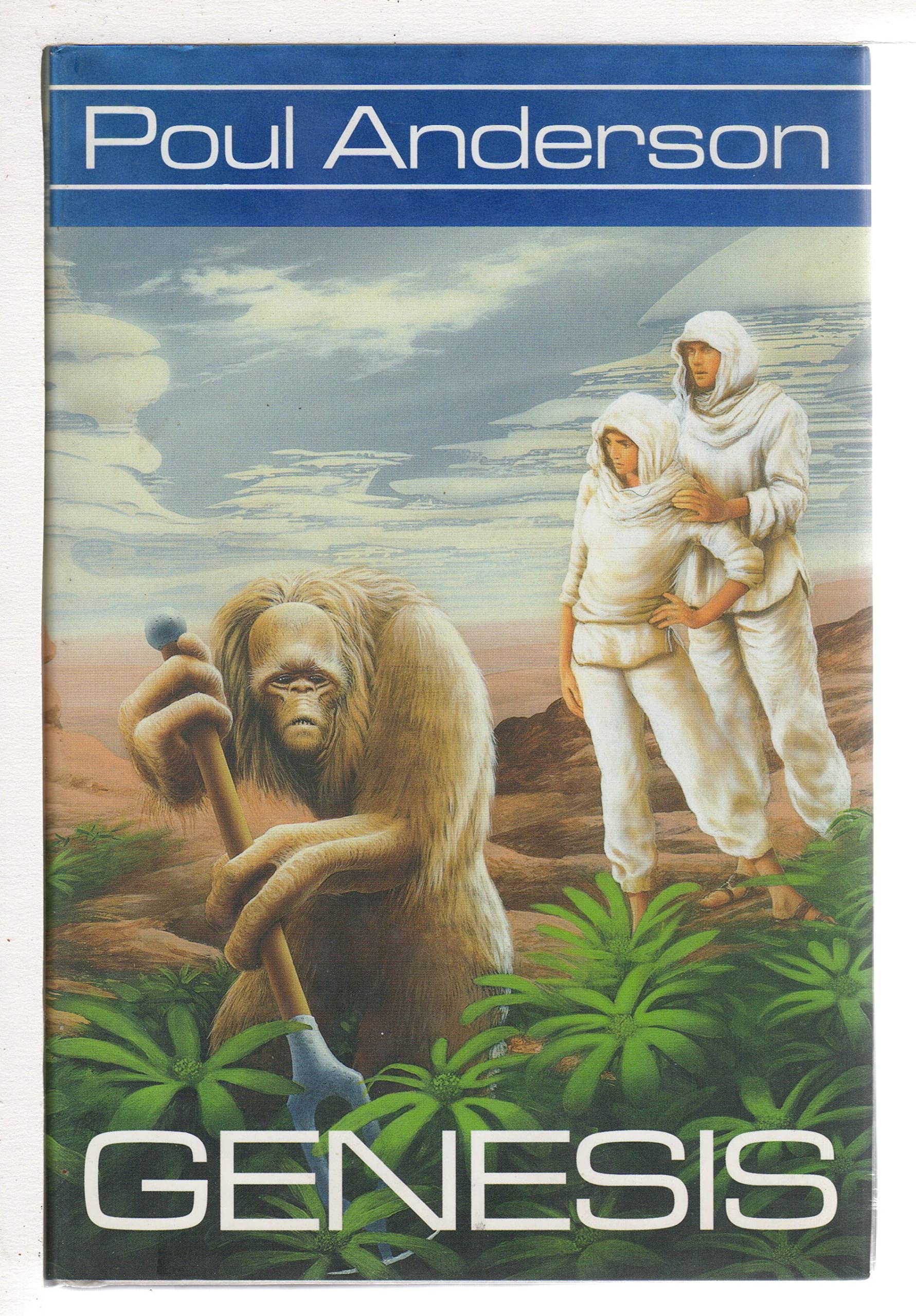



A billion years after technology frees human consciousness from the body, one man, Brannock, returns to earth to find the planet ruled by a superbeing named Laurinda Ashcroft. there. Even after nearly 40 years in the biz, Poul Anderson still cranks out the imaginative sci fi like a champ, with the idea-packed Genesis --a billion-year-spanning tale involving immortal AIs and the future of Earth itself--being just another example. A decorated hard-SF veteran from the old school (think the Amazing, Analog and Omni crew from the '50s, '60s, and '70s), Anderson has got a mantle any other writer would kill for, boasting a Nebula Grand Master award, seven Hugos, and three "regular" Nebulas. (Heck, the guy's even got whippersnapper Greg Bear for a son-in-law.) Taking on ideas that share space with Anderson's well-loved Fireball series ( Harvest of Stars et al.), Genesis follows the peculiar existence of Christian Brannock and Laurinda Ashcroft, two humans who shared such affinity with machines in their mortal lives that they went on to become uploaded consciousnesses, immortal human-robot hybrids. Anderson mines even the mundanities of this situation thoroughly, but adds in enough twists in the far-future plot to start asking some really interesting questions too: when the vast supermind inhabiting posthuman Earth (mythically named Gaia) starts simulating endless replays of humanity's chaotic evolution, the time-hopping Brannock and Ashcroft--who have been tasked with investigating exactly what Gaia's been up to--find themselves struggling over the moral complexities of free will and the very nature of reality. --Paul Hughes Christian Brannock agrees to have his personality uploaded into a computer so that his mind can explore the stars long after the death of his body. When his billion-year journey brings him back to an Earth that has undergone many cosmic changes, Brannock encounters another uploaded personality who restores to him the wonder of being "human." The lyrical approach of this sf master to the meaning of human existence gives his latest effort a surreal, allegorical feel. Recommended for most sf collections. Copyright 2000 Reed Business Information, Inc. Anderson's novel is a miniature exploration of themes he has used in other novels, most recently Starfarers (1998), concerned with individuals isolated from humanity by immortality or long voyages. Here, astronaut Christian Brannock is able, thanks to having his personality imprinted on a computer, to embark on a billion-year exploration of the stars. (The consequent travelogue element is small but descriptively well up to Anderson's high standards; plainly he was a great Norse skald in a previous existence.) Returning to Earth, Brannock finds that the planet's overmind, Gaia, hypothetical when he left, not only exists but plans to regain control through schemes inimical to what is left of humanity. With another computerized immortal, Laurinda Ashcroft, Brannock must work out a compromise with Gaia that accommodates all parties. Anderson's longer treatments of the theme may stand the test of time better, but this one, despite an ending that feels a trifle rushed, certainly provides much fine entertainment. Roland Green Episodic, far-future yarn developed from short stories, from the veteran author of Starfarers (1998), etc. Before Christian Brannock dies, he uploads his own mentality into a computer, thus achieving immortality. Copies of him spread throughout the galaxy. Huge agglomerations of AIs, or nodes, begin the development of a galactic brain. Earth's future inhabitants find they're controlled by a node, Gaia, and can't make war even if they want to. Millions of years later, Gaia severs her ties to the galactic brain. But since the solar system will soon be destroyed, the nearest galactic node, Alpha, wants to know whether it's worthwhile expending considerable effort to preserve Earth. Alpha sends Wayfarer to investigate. Gaia creates an avatar, Laurinda Ashcroft, for Wayfarer's avatar, Christian, to interact with while Gaia chats with Wayfarer. Another Wayfarer avatar, Brannock, goes exploring in a robot body. Gaia, however, is concealing things from both Wayfarer and Brannock: She's been running simulations of alternate pasts and futures, ``emulations'' that result in great suffering for untold humans. She's even re-created real humans and set them loose on the real Earth. When Brannock learns of this, Gaia attempts to subdue him. Christian and Laurinda, meanwhile, visit many emulations and become lovers. Lots of vivid vignettes but no discernible whole, with Anderson mostly struggling to define his concepts: ``No human could have shaped the thoughts or uttered them.'' Quite. -- Copyright ©2000, Kirkus Associates, LP. All rights reserved. "Anderson, far more than many newer science fiction writers, takes the trouble to envision a genuinely strange, complex future for mankind." The Washington Post The author is the winner of h