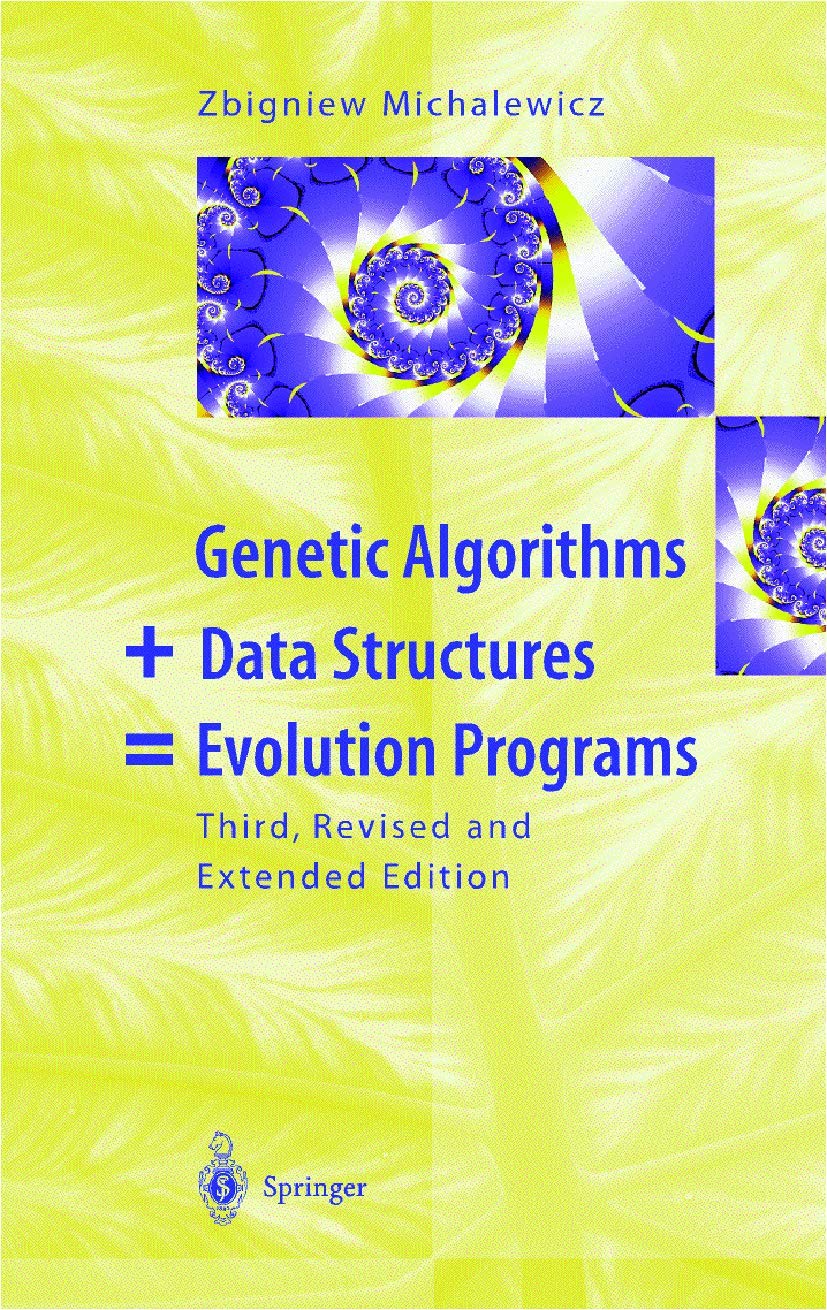



Genetic algorithms are founded upon the principle of evolution, i.e., survival of the fittest. Hence evolution programming techniques, based on genetic algorithms, are applicable to many hard optimization problems, such as optimization of functions with linear and nonlinear constraints, the traveling salesman problem, and problems of scheduling, partitioning, and control. The importance of these techniques is still growing, since evolution programs are parallel in nature, and parallelism is one of the most promising directions in computer science. The book is self-contained and the only prerequisite is basic undergraduate mathematics. This third edition has been substantially revised and extended by three new chapters and by additional appendices containing working material to cover recent developments and a change in the perception of evolutionary computation. Zbigniew Michalewicz's Genetic Algorithms + Data Structures = Evolution Programs has three sections. The first section is a straightforward introduction to genetic algorithms. In the second section, Michalewicz describes how to apply genetic algorithms to numerical optimization. Michalewicz, who is a pioneer in this field, discusses the rationale for using genetic algorithms for numerical optimization and describes several experiments that show how this new type of genetic algorithm performs. The author devotes the third section of the book to evolution programs. Genetic algorithms are founded upon the principle of evolution, i.e., survival of the fittest. Hence evolution programming techniques, based on genetic algorithms, are applicable to many hard optimization problems, such as optimization of functions with linear and nonlinear constraints, the traveling salesman problem, and problems of scheduling, partitioning, and control. The importance of these techniques is still growing, since evolution programs are parallel in nature, and parallelism is one of the most promising directions in computer science. The aim of this book is to talk about the field of evolutionary computation in simple terms, and discuss the simplicity and elegance of its methods on many interesting test cases. The book may serve as a guide to writing an evolution program, and to making this an enjoyable experience. It is self-contained and the only prerequisite is basic undergraduate mathematics. Aimed at researchers, practitioners, and graduate students, it may serve as a text for advanced courses in computer science and artificial intelligence, operations research, and engineering. This third edition has been substantially revised and extended. Three new chapters discuss the recent paradigm of genetic programming, heuristic methods and constraint handling, and current directions of research. Additional appendices contain test functions for experiments with evolutionary techniques and discuss possible projects for use in a project-oriented course. Used Book in Good Condition