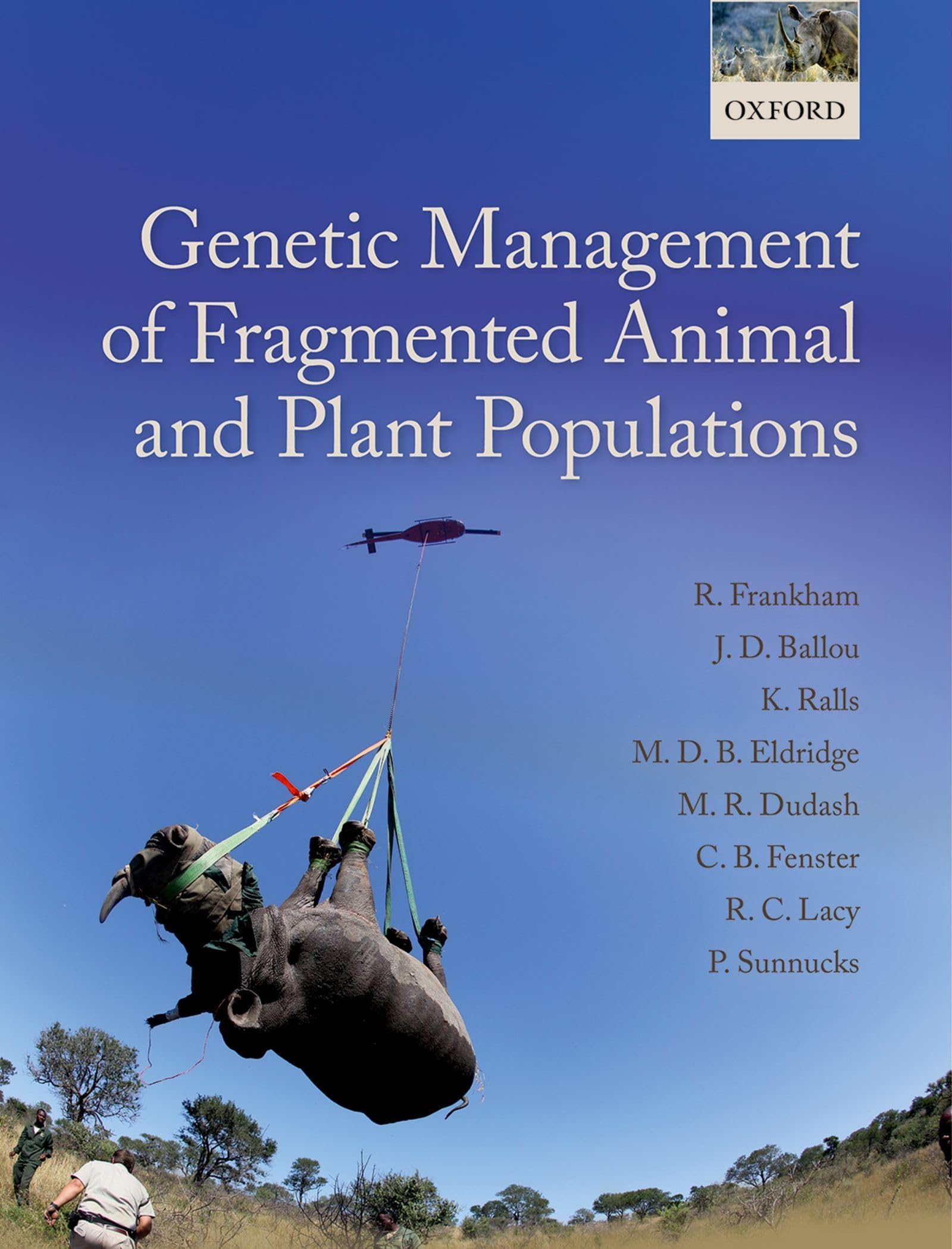



One of the greatest unmet challenges in conservation biology is the genetic management of fragmented populations of threatened animal and plant species. More than a million small, isolated, population fragments of threatened species are likely suffering inbreeding depression and loss of evolutionary potential, resulting in elevated extinction risks. Although these effects can often be reversed by re-establishing gene flow between population fragments, managers very rarely do this. On the contrary, genetic methods are used mainly to document genetic differentiation among populations, with most studies concluding that genetically differentiated populations should be managed separately, thereby isolating them yet further and dooming many to eventual extinction! Many small population fragments are going extinct principally for genetic reasons. Although the rapidly advancing field of molecular genetics is continually providing new tools to measure the extent of population fragmentation and its genetic consequences, adequate guidance on how to use these data for effective conservation is still lacking. This accessible, authoritative text is aimed at senior undergraduate and graduate students interested in conservation biology, conservation genetics, and wildlife management. It will also be of particular relevance to conservation practitioners and natural resource managers, as well as a broader academic audience of conservation biologists and evolutionary ecologists. "This is a book with a mission...the authors do a laudable job of translating conservation genetic concepts into concrete management recommendations, a translation that is often missing in wildlife management." -- Amy B. Welsh, School of Natural Resources, West Virginia University, Morgantown, West Virginia, The Journal of Wildlife Management "[This book is] very readable, often unexpected for an academic text. If you struggle with some of the more complex equations there are many practical, interesting and easily understood examples of what they mean, how they have been implemented and the outcomes." -- Derek Spielman, University of Sydney, Australian Zoologist "The book is well written, with a wealth of relevant plant and animal examples in a clear, accessible format. Particularly useful is the explanation of the various population genetics statistic approaches, as is the extensive glossary... Highly recommend this book for both academic and practising conservation managers." -- Paul Ashton, Edge Hill University, The Biologist "The book complements existing conservation genetic textbooks by delving into the specific conservation problem of loss of genetic diversity in small, isolated populations. Its foundation is a paradigm shift in conservation biology, where genetic rescue is more frequently used for the conservation of endangered populations, and it provides managers with the decision tools to effectively implement genetic rescue." -- Amy B. Welsh, School of Natural Resources, West Virginia University, The Journal of Wildlife Management "This is likely to become a standard text on the subject; it should be essential for any library serving a conservation biology program." -- C. E. Buckley, CHOICE "It provides a thorough exploration of the genetic issues faced by fragmented populations, the reasons why the use of genetic rescue has been limited to date and the theory and practicalities of re-establishing gene flow." -- Australian Museum Richard Frankham, Emeritus Professor, Department of Biological Sciences, Macquarie University, Australia ,Jonathan D. Ballou, Scientist Emeritus, Smithsonian Conservation Biology Institute, Smithsonian Institution ,Katherine Ralls, Emeritus Research Zoologist, Smithsonian Conservation Biology Institute, Smithsonian Institution ,Mark Eldridge, Principle Research Scientist, Terrestrial Vertebrates, Australian Museum ,Michele R. Dudash, Professor and Head of the Department of Natural Resource Management, South Dakota State University ,Charles B. Fenster, Professor, Department of Biology and Microbiology, South Dakota Agricultural Experiment Station ,Robert C. Lacy, Senior Conservation Scientist, Chicago Zoological Society ,Paul Sunnucks, Professor, School of Biological Sciences, Monash University Emeritus Professor Richard Frankham is one of the leading international figures in conservation genetics, having been a pioneering researcher in the discipline and senior author on the first textbooks in the field. In 2005 he was awarded a DSc by Macquarie University (Sydney, Australia), based upon his published work (now 160 publications). Throughout his career he has worked on the genetic impacts of small population sizes in the contexts of conservation and evolutionary genetics and animal breeding. His background is in agriculture (BScAgr [Hons 1] and PhD from the University of Sydney, Australia). He worked for Agriculture Canada (1967-69), followed by a postdoctoral fellowship at the University of