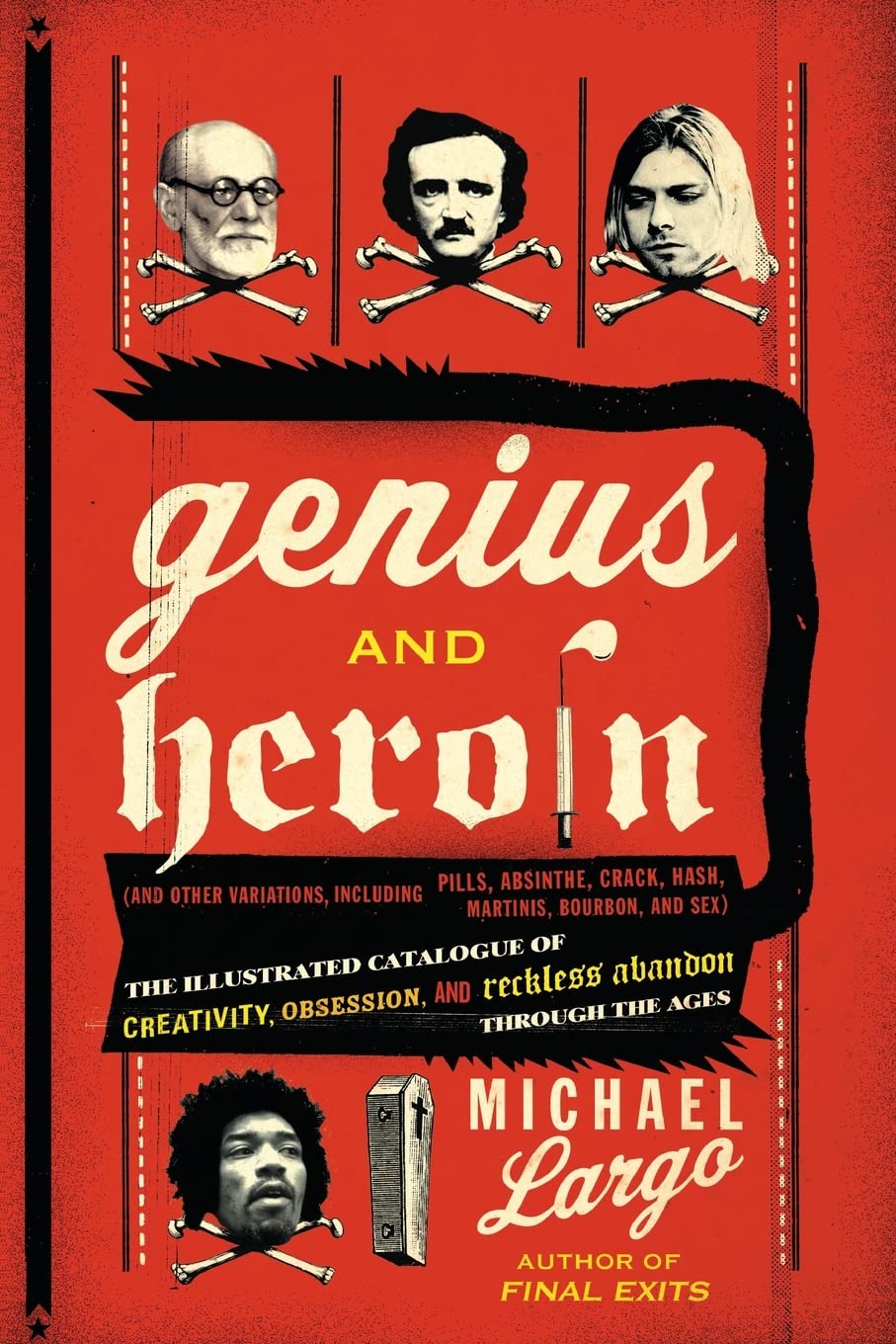
Genius and Heroin: The Illustrated Catalogue of Creativity, Obsession, and Reckless Abandon Through the Ages
$12.85
by Michael Largo



What is the price of brilliance? Why are so many creative geniuses also ruinously self-destructive? From Caravaggio to Jackson Pollack, from Arthur Rimbaud to Jack Kerouac, from Charlie Parker to Janis Joplin, to Kurt Cobain, and on and on, authors and artists throughout history have binged, pill-popped, injected, or poisoned themselves for their art. Fully illustrated and addictively readable, Genius and Heroin is the indispensable reference to the untidy lives of our greatest artists and thinkers, entertainingly chronicling how the notoriously creative lived and died—whether their ultimate downfalls were the result of opiates, alcohol, pot, absinthe, or the slow-motion suicide of obsession. “Largo reveals the secrets of the celebrated dead!” - Miami Herald “Amazingly entertaining.” - Maxim “Meticulous, fascinating, and often intriguingly bizarre . . . I am full of admiration for his achievement--just the ideal book for bathroom reading.” - Simon Winchester, author of The Professor and the Madman “Chockablock with faces, figures, and facts Michael Largo’s Genius and Heroin makes for mad good reading on the divinely inspired, hopelessly self-destructive class. Poe, Piaf, Warhol anyone?” - Elle During the '80s, I was walking through Tompkins Square Park, carrying a stack of books, and a cop pulled up and said, `Hey, genius, you better not be around here to cop heroin,' " says Michael Largo. "I'd never heard `genius' and `heroin' in the same sentence before...and I wrote it down." More than two decades after his stint as a bar owner in the then-seedy East Village in New York City, Largo (The Portable Obituary: How the Famous, Rich, and Powerful Really Died, 2007, etc.) has transformed that idea into another examination of the darker side--the stories behind the relationships that creative types often had with drinking and drugs, which often dictated how they worked. For example, F. Scott Fitzgerald only wrote about 100 words per day between hangovers; Sigmund Freud was no stranger to the charms of cocaine; and Amedeo Modigliani's philosophy of completing a painting in one sitting may well be due to his art dealer locking him in a room with a bottle and refusing to let him out--or give him more booze--until he'd finished three drawings. None of this is foreign to Largo, who witnessed many a genius-andheroin moment firsthand--Keith Richards once came into his bar and asked him where he could score some smack. "Going back to my bar days, it wasn't really fun, no one was thinking, `I'm having a party.' " says Largo. "They were doing it more to accelerate their creativity, to become a part of the long litany of artists and writers to do whatever they did to make great art...But I also admire them so much that they were able to do all that. Imagine having a hangover every day and still working?" "Meticulous, fascinating, and often intriguingly bizarre.... I am full of admiration for Michael Largo's achievement." From the dawn of civilization there has always been a fine line between creativity and self-destruction. An inherent compulsiveness is often required in art to master a level of original thought and superlative skill. It requires everything, some believe, even one's life. What is the price of brilliance? Why are so many creative geniuses also ruinously self-destructive? From Caravaggio to Jackson Pollack, from Arthur Rimbaud to Jack Kerouac, from Charlie Parker to Janis Joplin, to Kurt Cobain, and on and on, authors and artists throughout history have binged, pill-popped, injected, or poisoned themselves for their art. Fully illustrated and addictively readable, Genius and Heroin is the indispensable reference to the untidy lives of our greatest artists and thinkers, entertainingly chronicling how the notoriously creative lived and died—whether their ultimate downfalls were the result of opiates, alcohol, pot, absinthe, or the slow-motion suicide of obsession. Michael Largo is the author of The Big, Bad Book of Beasts ; God's Lunatics ; Genius and Heroin ; and the Bram Stoker Award-winning Final Exits: The Illustrated Encyclopedia of How We Die , as well as three novels. He and his family live in Florida with their dog, two turtles, a parrot, two canaries, and a tank of fish. Genius and Heroin The Illustrated Catalogue of Creativity, Obsession, and Reckless Abandon Through the Ages By Michael Largo HarperCollins Publishers, Inc. Copyright © 2008 Michael Largo All right reserved. ISBN: 9780061466410 Chapter One Art Acord Genius is more often found in a cracked pot than in a whole one. —E. B. White Artemus Acord was an authentic cowboy and rodeo champ when cast in Cecil B. DeMille's Squaw Man . Soon after, Acord shipped off to fight in World War I, where his real life rooting-tooting acts of bravery earned him medals. He returned to Hollywood and became one of the most popular actors in silent westerns, displaying a natural genius for capturing the bravado of the American c