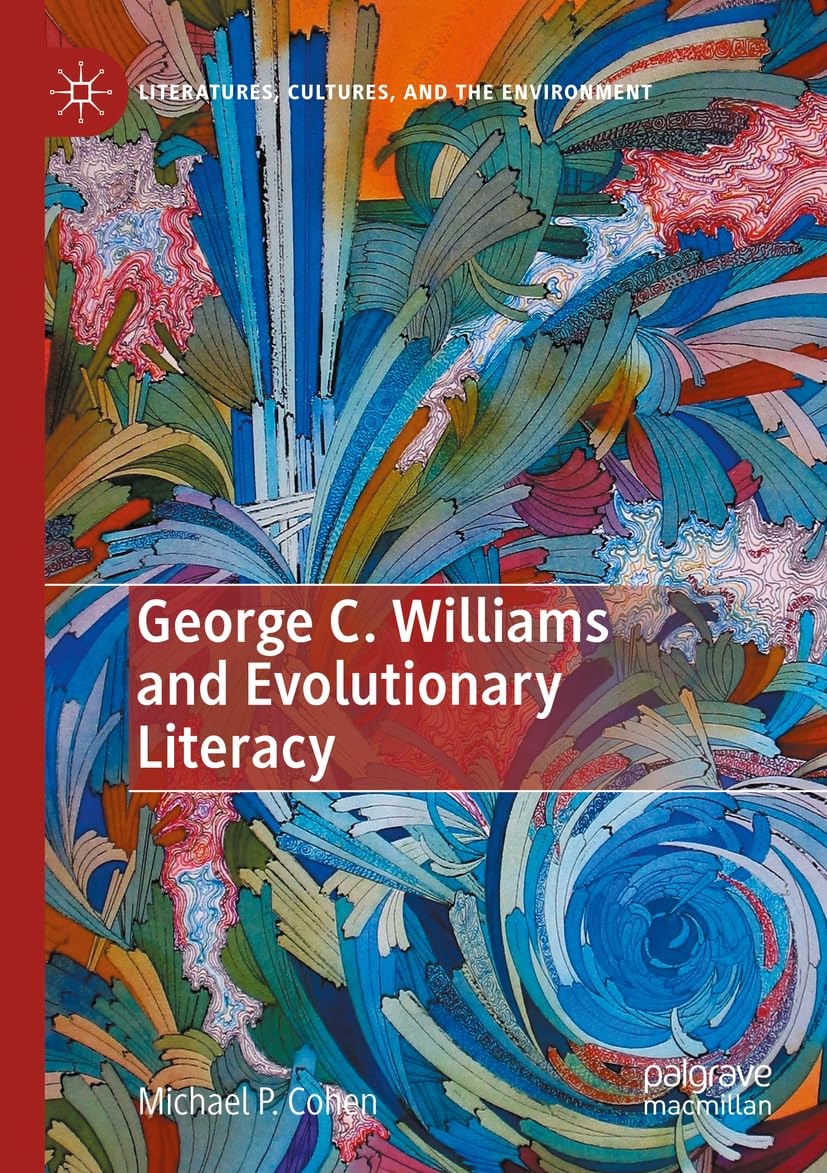
George C. Williams and Evolutionary Literacy (Literatures, Cultures, and the Environment)
$90.30
by Michael P. Cohen



In this book, a case study of a humanistic reading of an essential evolutionary theorist, George C. Williams (May 12, 1926–September 8, 2010), the author contends that certain classic works of evolutionary theory and history are the most important nature writing of recent times. What it means to be scientifically literate—is essential for humanistic scholars, who must ground themselves with literary reading of scientific texts. As the most influential American evolutionary theorist of the second half of the twentieth century, Williams masters critique, frames questions about adaptation and natural selection, and answers in a plain, aphoristic writing style. Williams aims for parsimony—to “recognize adaptation at the level necessitated by the facts and no higher”—through a minimalist writing style. This voice articulates a powerful process that operates at very low levels by blind and selfish chance at the expense of its designed products, using purely trial and error. “One cannot write clearly until one has thought clearly. George C. Williams did both. For anyone whose science, style of thought, or writing has been influenced by his, this book is well worth a read.” (Stephen C. Stearns, The Quarterly Review of Biology, Vol. 98 (4), December, 2023) “Michael Cohen's George C. Williams and Evolutionary Literacy is an enthralling and highly original work. Williams, a master of Darwinian explication, could in turn have no better explicator. This is the best kind of scientific memoir, 'focused on science itself, on the scientific life as a multi-dimensional journey'. I especially enjoyed Cohen’s unconventional treatment of Williams’ theoretical works as literary texts or 'narratives,' tracing their major themes, patterns, and use of language as he works out Williams’ underlying motives and intentions. As he writes, 'One cannot explore evolutionary theory without factoring in the style of writing about it.' Quite simply, this is not only the first book about George Williams, but the first that I am aware to focus on 'evolutionary literacy.' No one else I know of applies anything like this approach to the (increasingly influential) writings of evolutionists. No doubt Cohen’s own literary gifts and eye for apt quotes contributed to my enjoyment.” (Sarah Blaffer Hrdy, author of The Woman that Never Evolved ; Mother Nature ; and Mothers and Others: The evolutionary origins of mutual understanding) "The famous international agent, promoter, publisher, and empresario of popular science John Brockman saw that scientists could be literary stars, even celebrities. Michael P. Cohen takes this realization as seriously as it should be taken and analyzes the evolutionary scientist George C. Williams, one of Brockman’s stars, for what he was: a literary self-construction. Cohen shows how Williams helped create a literary scientific genre of austere, constructive critique, which Cohen argues we desperately need in our public realm. In respectfully, generously, constructively analyzing and critiquing Williams, Cohen himself invents a humanistic genre based on carefully reading science that gives us a useful model for the conversations that we must have between science and the humanities." (Jon Christensen, science writer, environmental journalist, documentary producer, and founder of the Laboratory for Environmental Narrative Strategies at UCLA) In this book, a case study of a humanistic reading of an essential evolutionary theorist, George C. Williams (May 12, 1926–September 8, 2010), the author contends that certain classic works of evolutionary theory and history are the most important nature writing of recent times. What it means to be scientifically literate―is essential for humanistic scholars, who must ground themselves with literary reading of scientific texts. As the most influential American evolutionary theorist of the second half of the twentieth century, Williams masters critique, frames questions about adaptation and natural selection, and answers in a plain, aphoristic writing style. Williams aims for parsimony―to “recognize adaptation at the level necessitated by the facts and no higher”―through a minimalist writing style. This voice articulates a powerful process that operates at very low levels by blind and selfish chance at the expense of its designed products, using purely trial and error. Michael P. Cohen works at the intersection of literary theory and nature writing. His books include Pathless Way: John Muir and American Wilderness (1984), A Garden of Bristlecones: Tales of Change in the Great Basin (1998) and Granite and Grace: Seeking the Heart of Yosemite (2019). Michael P. Cohen works at the intersection of literary theory and nature writing. His books include Pathless Way: John Muir and American Wilderness (1984), A Garden of Bristlecones: Tales of Change in the Great Basin (1998) and Granite and Grace: Seeking the Heart of Yosemite (2019).