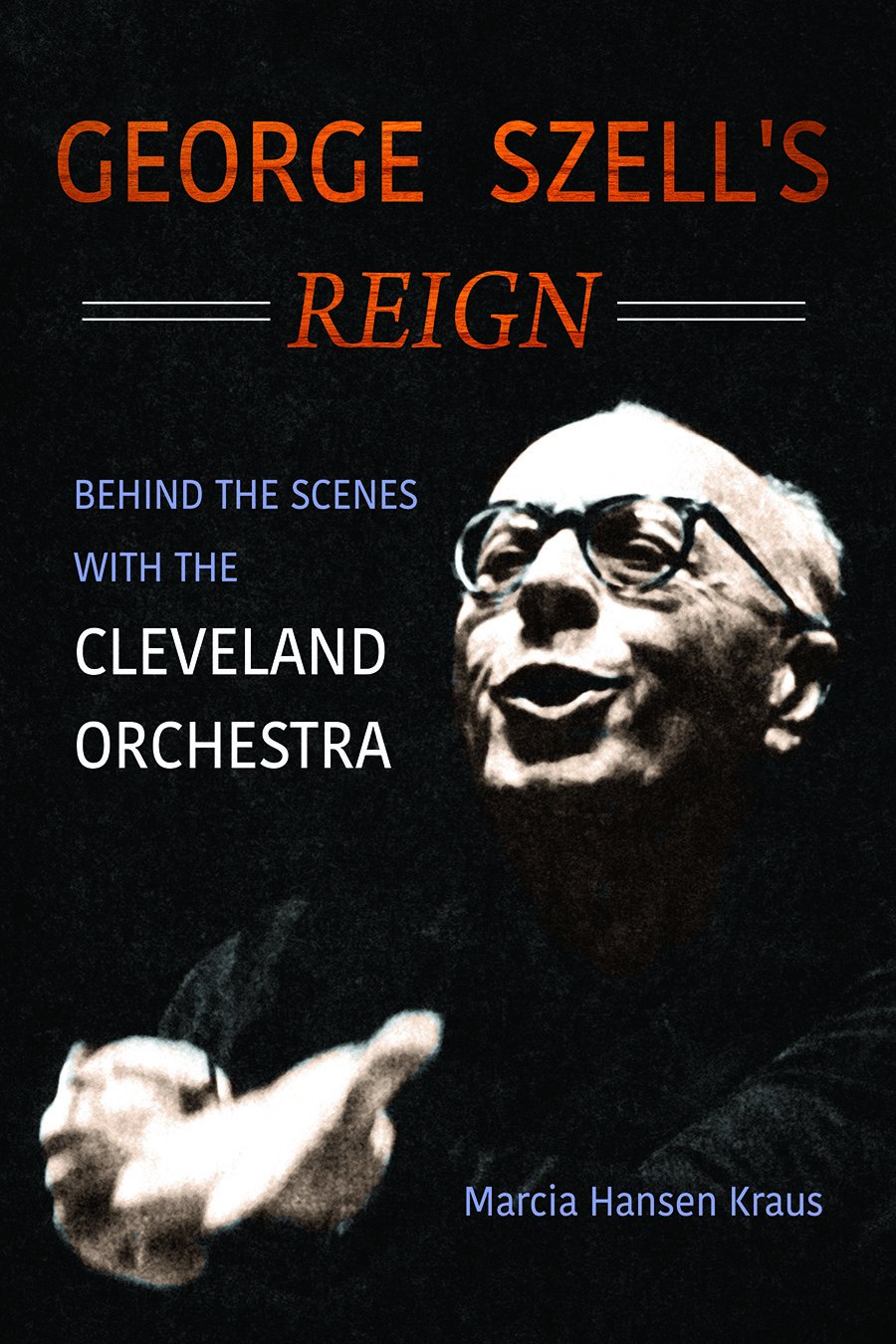
George Szell's Reign: Behind the Scenes with the Cleveland Orchestra (Music in American Life)
$34.95
by Marcia Hansen Kraus



George Szell was the Cleveland Orchestra's towering presence for over a quarter of a century. From the boardroom to the stage, Szell's powerful personality affected every aspect of a musical institution he reshaped in his own perfectionist image. Marcia Hansen Kraus's participation in Cleveland's classical musical scene allowed her an intimate view of Szell and his achievements. As a musician herself, and married to an oboist who worked under Szell, Kraus pulls back the curtain on this storied era through fascinating interviews with orchestra musicians and patrons. Their recollections combine with Kraus's own to paint a portrait of a multifaceted individual who both earned and transcended his tyrannical reputation. If some musicians hated Szell, others loved him or at the least respected his fair-minded toughness. A great many remember playing under his difficult leadership as the high point in their lives. Filled with vivid backstage stories, George Szell's Reign reveals the human side of a great orchestra ”and how one visionary built a premier classical music institution. "Kraus has collected a multitude of telling personal accounts. Charming and illuminating anecdotes that depict interactions among the players and between individual players and the maestro abound, along with sometimes humorous and sometimes harsh instances of Szell's behavior." --Mary Sue Welsh, author of One Woman in a Hundred: Edna Phillips and the Philadelphia Orchestra "The author gives us an entertaining and revealing picture of Szell working with his musicians over the years. After you read this you will know him better than if it had been a mere biography. When you finish a chapter you are eager to go on to the next, because it's a fascinating tale--and sometimes it's even rather amazing."-- American Record Guide Marcia Hansen Kraus is a musician and composer in Cleveland, Ohio. George Szell's Reign Behind the Scenes with the Cleveland Orchestra By Marcia Hansen Kraus UNIVERSITY OF ILLINOIS PRESS Copyright © 2017 The Board Of Trustees Of The University Of Illinois All rights reserved. ISBN: 978-0-252-04131-0 Contents Introduction, ix, CHAPTER 1. A Prodigy's Apprenticeship, 1, CHAPTER 2. The Orchestra's Beginnings, 9, CHAPTER 3. Szell's Improvements, 13, CHAPTER 4. The Woodwind Section, 24, CHAPTER 5. World Tour, 35, CHAPTER 6. Szell's Dictates, 40, CHAPTER 7. The String Section, 44, CHAPTER 8. The Brass Section, 54, CHAPTER 9. Auditions and Mavericks, 64, CHAPTER 10. Conductor Wannabes, 75, CHAPTER 11. The Percussion Section, 80, CHAPTER 12. Szell's Methods, Touring Travails, 86, CHAPTER 13. Prodigies, Masterpieces, Boulez, 92, CHAPTER 14. Concert Experiences, 98, CHAPTER 15. Szell's Haydn and Schumann Interpretations, 106, CHAPTER 16. Attire, Duty, Respect, Decorum, 110, CHAPTER 17. A New Chorus Conductor, 119, CHAPTER 18. The Musicians' Insurrection, 129, CHAPTER 19. Picketing and Resolution, 133, CHAPTER 20. A Suitable Summer Site, 138, CHAPTER 21. Blossom's Creators, 147, CHAPTER 22. The Blossom Triumph, 155, CHAPTER 23. The Death of the Maestro, 162, Epilogue, 169, Acknowledgments, 175, Notes, 181, Bibliography, 223, Index of Names, 229, CHAPTER 1 A Prodigy's Apprenticeship At age two and a hal f George Szell had strong musical opinions. One day his mother, noticing that her precocious son seemed musical, had put him on her lap and played a tune on the piano. She hadn't gone very far when he slapped her wrist. He didn't like the mistake she had made and wouldn't tolerate it. That was the beginning of his years as a prodigy. If that slap had been administered to an uneducated hausfrau in a remote village, George would have received a paddling and that would have been the end of the incident. But in a random stroke of luck, he was born in 1897 to upper-class parents who lived in a fine neighborhood in Budapest, cultivated the arts, and had left their Jewish roots behind when they converted to Catholicism. The elements necessary for George's future success were therefore present, including even the right city, because in 1900 his parents moved to Vienna, a center of amateur and professional music making. George was fortunate to have a music-loving father. Kalman doted on his only child and, realizing his son was exceptional, determined to do everything in his power to foster the boy's talent. He wasn't wrong in his assessment of his son's superiority because the child soon began composing. Kalman had sired a wunderkind. Six-year-old George was taken to Richard Robert, one of the city's foremost piano teachers, where he joined a class of other talented children, among them young Rudolf Serkin. That wasn't enough for the proud father. He regularly brought the child with him to opera and orchestra concerts, hired tutors so there would be no time wasted in public schools, provided a fine piano for lengthy practice sessions, and agreed with the teacher that there should