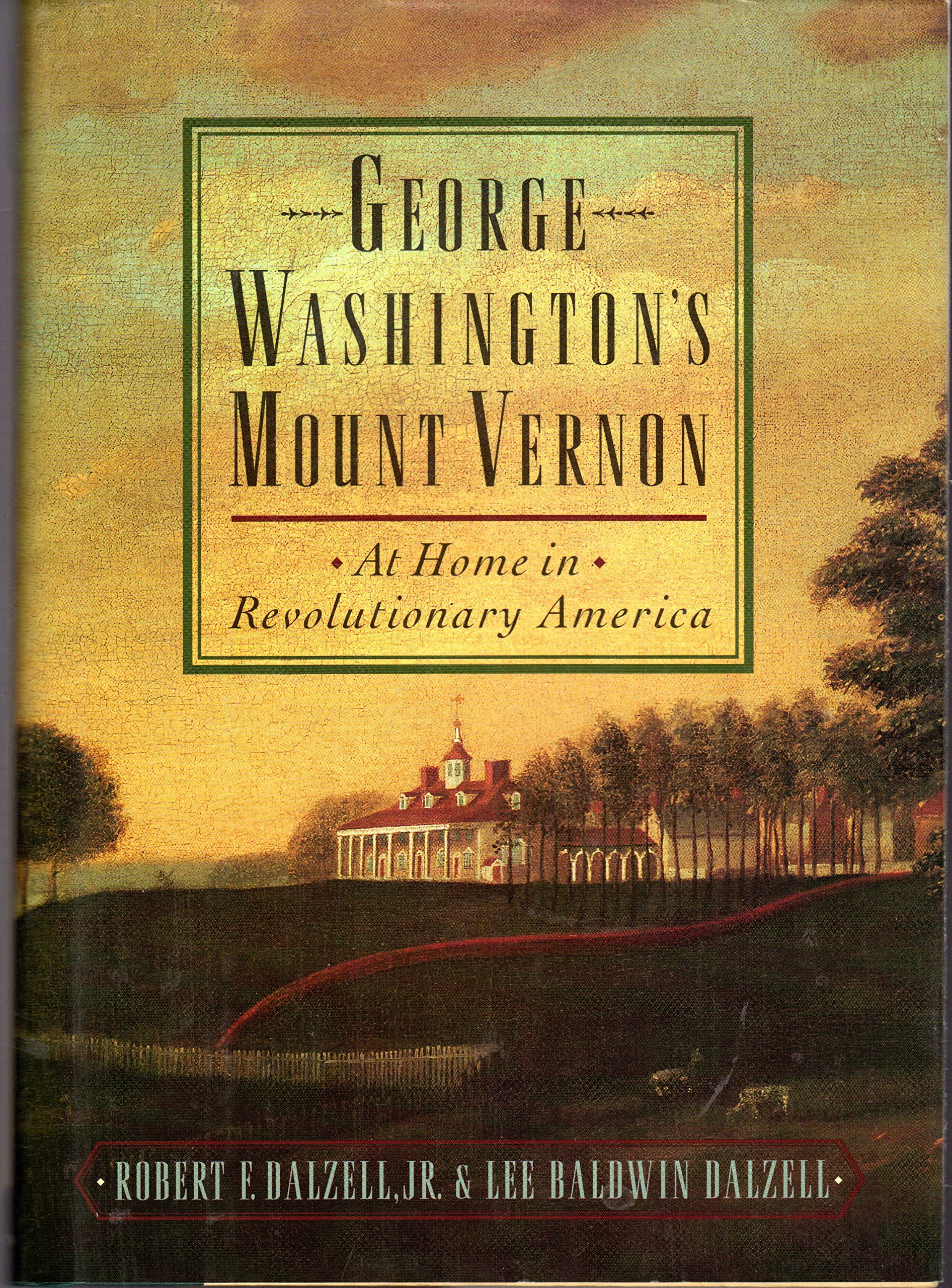
George Washington's Mount Vernon : At Home in Revolutionary America
$35.00
by Robert F. Dalzell Jr



George Washington's Mount Vernon brings together--for the first time--the details of Washington's 45-year endeavor to build and perfect Mount Vernon. In doing so it introduces us to a Washington few of his contemporaries knew, and one little noticed by historians since. Here we meet the planter/patriot who also genuinely loved building, a man passionately human in his desire to impress on his physical surroundings the stamp of his character and personal beliefs. As chief architect and planner of the countless changes made at Mount Vernon over the years, Washington began by imitating accepted models of fashionable taste, but as time passed he increasingly followed his own ideas. Hence, architecturally, as the authors show, Mount Vernon blends the orthodox and the innovative in surprising ways, just as the new American nation would. Equally interesting is the light the book sheds on the process of building at Mount Vernon, and on the people--slave and free--who did the work. Washington was a demanding master, and in their determination to preserve their own independence his workers often clashed with him. Yet, as the Dalzells argue, that experience played a vital role in shaping his hopes for the future of American society--hope that embraced in full measure the promise of the revolution in which he had led his fellow citizens. George Washington's Mount Vernon thus compellingly combines the two sides of Washington's life--the public and the private--and uses the combination to enrich our understanding of both. Gracefully written, with more than 80 photographs, maps, and engravings, the book tells a fascinating story with memorable insight. Americans seem to view historical sites either as patriotic shrines or mere vacation locales. Seldom have places such as George Washington's home at Mount Vernon been analyzed for a deeper understanding of the past. The authors use Mount Vernon to present readers with a course in Colonial and early national history. Robert F. Dalzell Jr. (history, Williams Coll.) and Lee Baldwin Dalzell (head reference librarian, Williams Coll.) accomplish a fine balancing act, integrating the story of George Washington's home with the public and private life of its longtime occupant. Mount Vernon became significant as the residence of the famed planter, general, and president?albeit with long periods of absence?but also due to his taking personal responsibility for altering and expanding the mansion. Without being overly mechanistic, the Dalzells portray Mount Vernon as a sort of metaphor for the changes in Washington's own life and career. This approach necessitates considerable attention to the social, political, and architectural context of Washington's time and provides significant insight. For larger public and academic libraries.?Charles K. Piehl, Mankato State Univ., MN Copyright 1998 Reed Business Information, Inc. If the homes of the rich and famous tend to be extensions of their self-perceptions as well as revelations of their flaws, then there is much to be learned by examining the abodes of our Founding Fathers. Certainly, Jefferson's Monticello captured his optimism and questing spirit, and its construction by slave labor indicates the tragic paradox of the man. Robert Dalzell is professor of American history at Williams College, and Lee Dalzell heads the Reference Department of the Williams College Library. In this ambitious and generally engrossing survey, they have attempted to link Washington's family home and plantation with his political evolution from an aristocratic republican to a politician whose vague democratic sentiments allowed him to keep Alexander Hamilton's elitist plans at bay. This is part family history, part biography, and part travelogue. The Dalzells are skillful writers and researchers who fluidly mesh the parts, although some scholars will undoubtedly question a few of their conclusions. Jay Freeman Washington as seen from the vantage point of his beloved creation, Mount Vernon. The Dalzells, Robert (American History/Williams Coll.; Daniel Webster and the Trial of American Nationalism, 1973) and Lee (head of the reference department at the Williams College Library) combine meticulous research and clear writing to help define the so-called ``marble man'' in a more human light as a friendly neighbor, an avowedly earnest perfectionist, and a demanding yet kind slave owner and employer among the land-seekers of colonial Virginia. Washington, according to the authors, directed managers, artisans, and other skilled workers even through his long periods away during the Revolutionary War and his presidency. We learn directly from his letters and diaries that although he meant to appear firm, calm, and aloof, he was also a creature of intense emotions, especially concerning Mount Vernon, his home for more than 40 years. There he served enthusiastically as planner, architect, and constant renovator at a time when mansions were considered and used as both p