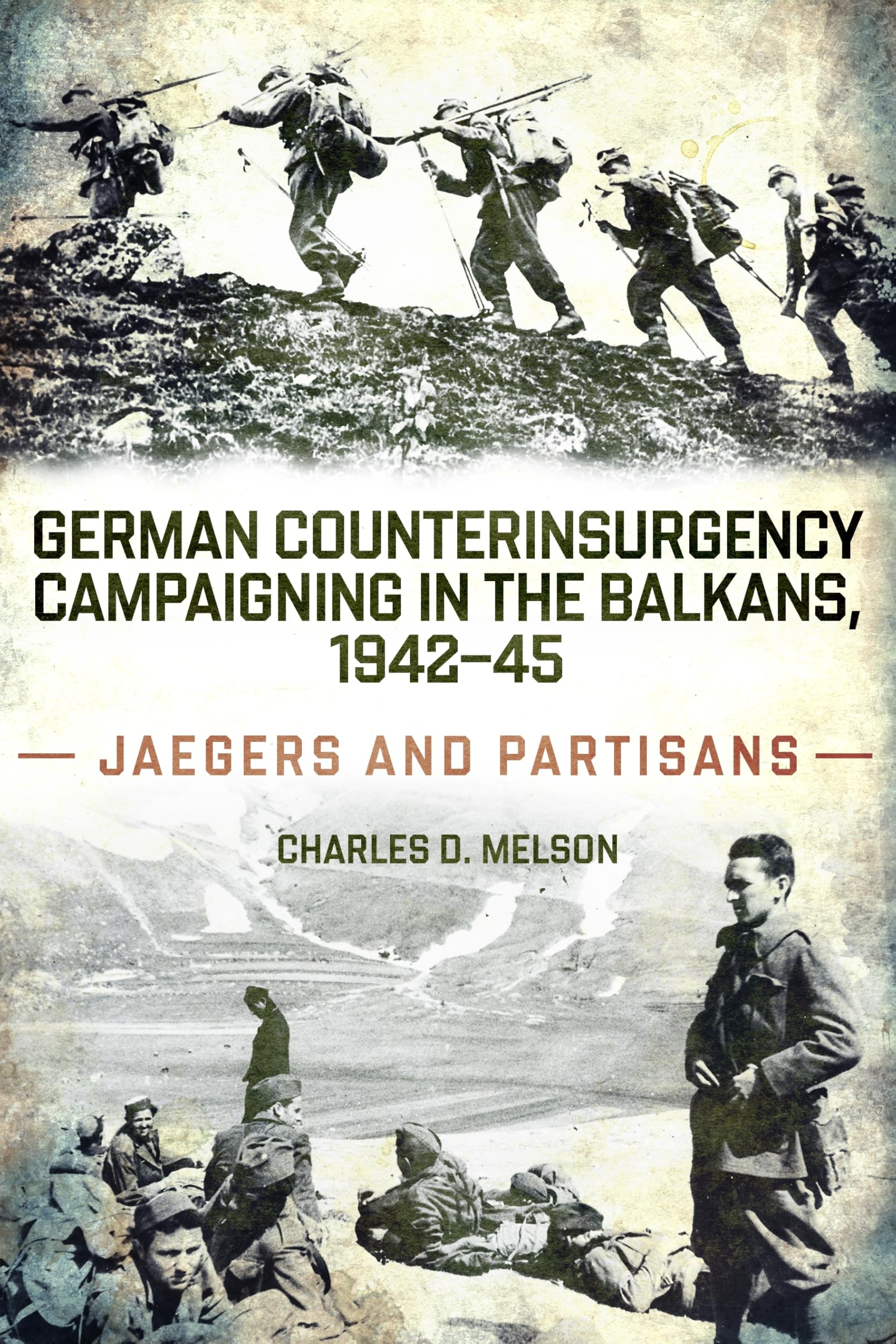
German Counterinsurgency Campaigning in the Balkans, 1942–45: Jaegers and Partisans
$37.95
by Charles Melson



"This work deserves to find a place on the bookshelf of any student of German military history, but especially of anyone seeking to understand the particular issues and imperatives that have influenced the development of the German army and its doctrine for countering guerrillas, partisans, and irregular forces since 1871." – David Stone, LTC, BA, Ret, author of Shattered Genius An examination of irregular warfare from the perspectives of the Germans and their coalition in the Balkans of Southeast Europe in World War II. This book traces the evolution of German irregular warfare doctrine from Clausewitz to the Third Reich, examining how theory was applied—and often distorted—through the brutal reality of counterinsurgency in the Balkans during World War II and beyond. Focusing on the 7. SS-Mountain Division “Prinz Eugen” as a case study, it reveals how moral, legal, and operational imperatives clashed in a campaign waged in the so-called “gray zone” of modern warfare. Drawing on a mix of German primary sources, oral testimony, and critical historiography, the book challenges familiar narratives by engaging with recent debates on Wehrmacht complicity, military ethics, and the reinterpretation of unit histories. It offers a conceptual and operational analysis that moves beyond traditional timelines, instead using a dialectical approach to examine “what” happened and “why” these actions were shaped by the doctrinal ideas of the time. More than a unit history, this is a philosophical and doctrinal inquiry into how counterinsurgency was understood, practiced, and justified—then and now. It interrogates the space between necessity and atrocity, between tactical effectiveness and moral failure. Essential reading for scholars of military history, ethics, and the long shadow cast by 20th-century counterinsurgency practices. Table of Contents Preface Part One Chapter 1. German Counterinsurgency Revisited Chapter 2. Doctrine: Reds, Jews, And Bandits Part Two Chapter 3. The Balkan Cauldron Chapter 4. A Volunteer Mountain Division Chapter 5. The First Year Chapter 6. Forward Prince Eugene Chapter 7. Knight's Cross And Expansion Chapter 8. Challenges Continue Chapter 9. Twenty-Four Hours In May Chapter 10. Open Season Chapter 11. Annihilation Part Three Chapter 12. Counterinsurgency Or Criminality Chapter 13. The Wrong Side Of History Appendices Sources Acknowledgments Index “The German attitude to guerrilla war is far more complex than stereotypical brutality for the sake of brutality.” Stephen G. Fritz, PhD, author of "Ostkrieg" and "The First Soldier" “Though the study of counterinsurgency in its various modern forms may not be in vogue at the moment, as the various U.S. Armed Services seek to regain traditional warfighting competency, this book deserves to be on the bookshelf of anyone interested in the subject.” Douglas E. Nash, Col, USA, Ret, author of "The Defeat of the Damned" “A highly accessible introduction to an important, but frequently neglected, aspect of German military history as well as for those interested in guerrilla warfare.” Bruce I. Gudmundsson, PhD, author of "Storm Troop Tactics" “The nature of ‘small wars’ has remained constant since Clausewitz taught the subject at the Kriegsakademie.” Wray R. Johnson, PhD, Col, USAF, Ret, author of "Airpower in Small Wars" "This work deserves to find a place on the bookshelf of any student of German military history, but especially of anyone seeking to understand the particular issues and imperatives that have influenced the development of the German army and its doctrine for countering guerrillas, partisans, and irregular forces since 1871." David Stone, LTC, BA, Ret, author of "Shattered Genius" Charles D. “Chuck” Melson served as the Chief Historian for the U.S. Marine Corps, at Headquarters, U.S. Marine Corps in Washington, DC, and the Marine Corps University in Quantico, Virginia. For some 23 years he wrote, co-authored, or edited official publications and series. Chuck was also a joint historian with the U.S. Central Command and U.S. Special Operations Command. His military service included 25 years as a U.S. Marine. He received the General Edwin Simmons-Henry Shaw Award for public historians and the General Leonard Chapman Medal for professional military educators.