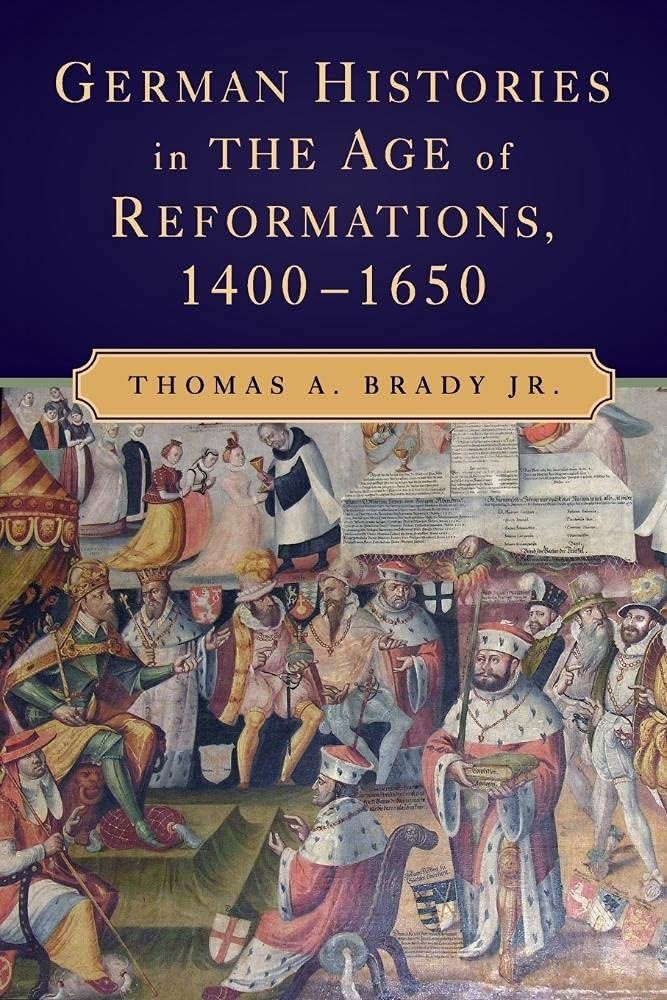



This book studies the connections between the political reform of the Holy Roman Empire and the German lands around 1500 and the sixteenth-century religious reformations, both Protestant and Catholic. It argues that the character of the political changes (dispersed sovereignty, local autonomy) prevented both a general reformation of the Church before 1520 and a national reformation thereafter. The resulting settlement maintained the public peace through politically structured religious communities (confessions), thereby avoiding further religious strife and fixing the confessions into the Empire’s constitution. The Germans’ emergence into the modern era as a people having two national religions was the reformation’s principal legacy to modern Germany. “This extraordinary book provides the reader with the best account of late medieval and early modern German history available in any language. Covering 250 years, Brady has transcended the tired controversies about whether the Lutheran Reformation was good for the German nation or for ‘us,’ about whether the emerging territorial states within the empire subverted the supposedly common purpose of a more unified German state, and about whether these two processes contributed to the emergence of an illiberal Germany that differed fatefully from a more liberal West. In these ways Brady's study overcomes the surprisingly tenacious Rankean model for the history of ‘Germany in the age of the Reformation’; and by insisting that the Germanies experienced Reformations, he contributes to our understanding that one of the permanent legacies of the early modern period has been a Germany that was and is fairly evenly divided between Catholics and Protestants: the only country in Europe for which that is true. Brady's prose is sober, muscular, thoughtful, and occasionally witty, representing decades of careful reflection and a massive erudition. By concentrating on the problems of reforming the Holy Roman Empire and the Church, Brady also analyzes two intertwined and crucial processes that link the fifteenth century to all that came afterwards, and in this respect, too, his book blazes a new trail. This is a post-confessional history in which religion retains its centrality but not its polemical edge, a modern history that has been released from the shackles of modernization, and a history in which ordinary villagers and townsmen take their places in a story that was most often dictated by princes and nobles. And it is a story with a powerful narrative arc. What an achievement.” -H. C. Erik Midelfort, University of Virginia “A commanding and brilliant view of the Reformation era. This masterful book is the new starting point for anyone seeking a fresh and up-to-date understanding of the Germanies, the reformations in religion, and the religious confessions linking the early modern and modern worlds. Setting aside a host of myths and misconceptions, Brady deftly shows how the reforms of the Holy Roman Empire and the religious reformations formed two phases of a single transformation of the early modern German world. Extending the narrative of the Reformation era back to 1400 and forward to 1648, Brady shows why the Empire mattered so much and how it developed an unusually durable dispersed form of governance while accommodating two rival religious confessions. Along the way he offers sharp insights into the nature of politics, the reformations, the making of religious confessions, war and society. No one understands the volatile mix of politics, public life and religion better than Tom Brady.” - Tom Robisheaux, Duke University “This is a quite extraordinary manuscript; one of those few books which can truly be termed a masterpiece. Tom Brady is the foremost senior scholar of the Reformation, and he has devoted his career to reshaping the way German Reformation history is understood, by bringing social and political history to bear on a terrain that used to be primarily that of ecclesiastical history. This book is the summation of his life’s work. No other scholar could command a similar range and depth of scholarship, and combine it with a completely original, mature vision of the entire period 1400 to 1650.” -Lyndal Roper, Balliol College, Oxford University "This book is a tour de force by one of the leading historians of early modern Germany. Thomas A. Brady Jr. has written a history of the German lands in a grand narrative style, tracing political, religious, and social developments over two and a half centuries. Brady's writing is gripping, his scholarship deeply erudite, and his arguments are strongly and persuasively presented." -Marc R. Forster, H-German "Scholars and students of early modern Germany history have long been without a scholarly, one-volume narrative of the history of the German lands that includes the century before the Protestant Reformations and continues through to the formation of the confessions and the Thirty Years' War. Thomas A Brady, Jr., ha