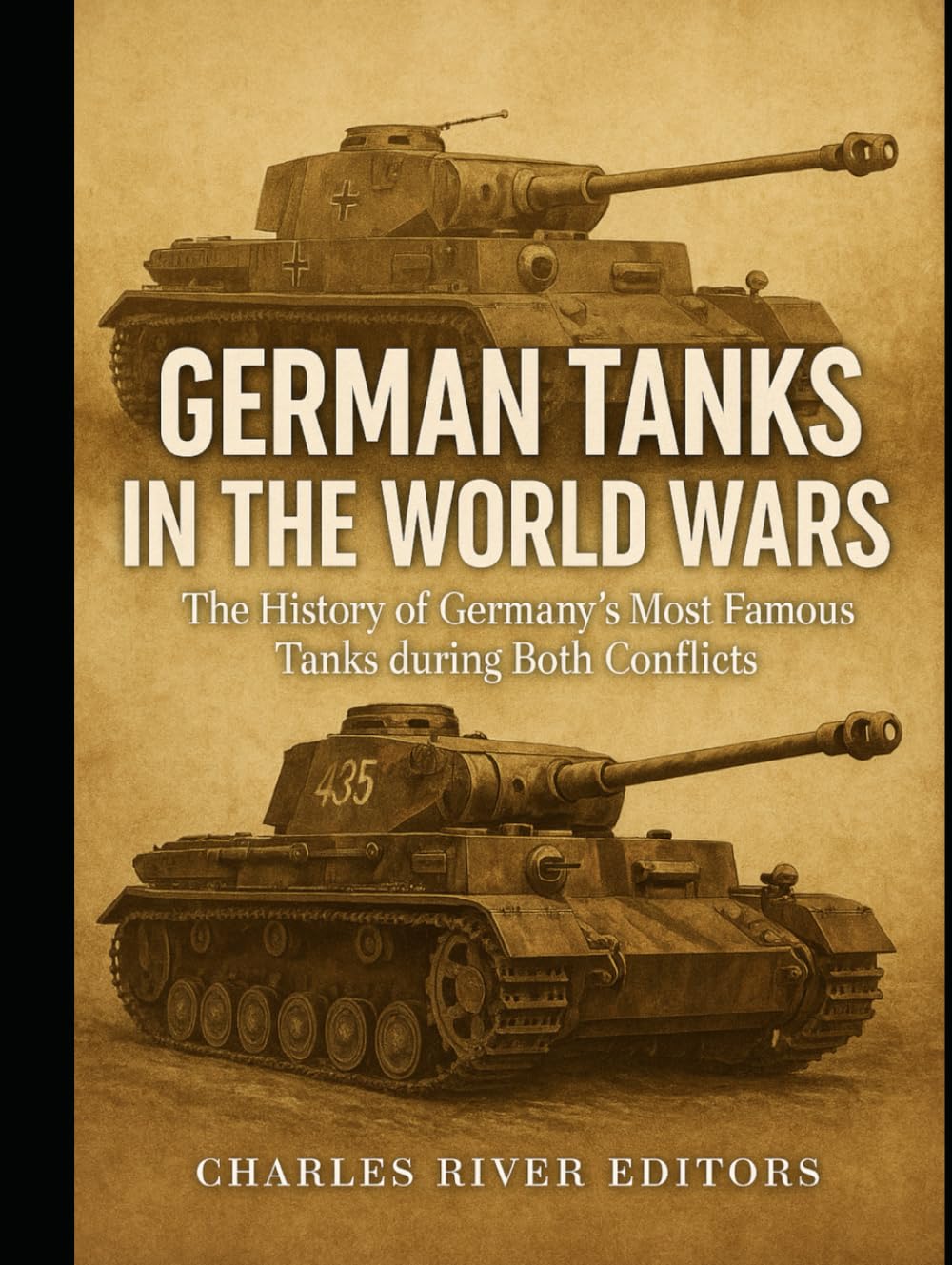
German Tanks in the World Wars: The History of Germany’s Most Famous Tanks during Both Conflicts
$16.99
by Charles River Editors



One of the most important breakthroughs in military technology associated with World War I, and certainly the one that continues to capture the public imagination, was the introduction of a war machine that came to dominate the face of land battles throughout most of the 20th century: the tank. As a concept, it was not revolutionary; in fact, it harkened back to classical antiquity and to the Middle Ages, such as the covered battering rams and testudos which had made frequent appearances on ancient battlefields. In essence, it was designed to solve the age-old problem of protecting infantry from enemy projectiles while remaining mobile. Various armies had flirted with the concept of a tank prior to World War I, but advances in metallurgical techniques (allowing for suitably solid and relatively lightweight armor) and in mechanical engineering (which allowed for the construction of a powerful engine capable of driving such a mass) finally made its development and deployment possible, as did the development of treaded track (initially for agricultural use in tractors). It was the British (at the instigation of Winston Churchill) who pioneered the “landship”, but the French soon followed suit with their own designs. Ironically, Germany, which would subsequently become famous for panzers and blitzkrieg warfare, was late in taking up the idea. During World War I, the Germans continued to rely on other techniques, and they produced less than two dozen models for battlefield use. The tanks of World War I, revolutionary (and initially terrifying) as they were, had their limitations. A standard tank would literally consume its own weight in spare parts, and they were painfully slow compared to more modern iterations. They were also lightly armed – usually with machine guns or light guns at most – and some poorly designed models tended to “ditch” themselves, sometimes irretrievably, in wider trenches. Unlike the remarkable advances the Germans made developing zeppelins, aircraft, heavy artillery and machine guns, they were reluctant to develop tanks and never considered doing so until they found themselves on the receiving end of tank assaults at the Somme. The final product of their efforts was the A7V, envisioned more as an armored troop transport than as an offensive vehicle. Only 20 were eventually produced for battlefield service, but the Germans also employed captured Allied tanks. They saw action on the Western Front at Villers-Bretonneux, where they faced off Against allied tanks in the first tank-on-tank battle, and in other engagements, including the Battles of Aisne and the Marne. The beginning of World War II found the major powers developing tanks to some extent, but lingering ideas from World War I affected the development of tanks during the Interwar period. As a result, aside from the blitzkrieg doctrine developed by the Nazis, tanks were still used in terms of infantry support, and there were few wars during this period to give strategists the chance to develop better uses for the new armored vehicles before World War II started. Commanders soon found that many of the tanks fielded in the campaigns of 1939-1941 lacked the necessary armor, guns, and designs. One problem with the early models was that their armor was not steeply sloped, which was important because sloped armor helped deflect shells and gave a practical thickness greater than the actual thickness. It took some time for tank designers to appreciate this, and the leaders in this field were the Soviets and their T-34, arguably the best all-around tank of the war. Early German encounters with the T-34 during the opening phases of Operation Barbarossa in 1941 made them realize that sloping armor was vital, and their later models' armor, such as that of the Panzer V, had a steeper slope.