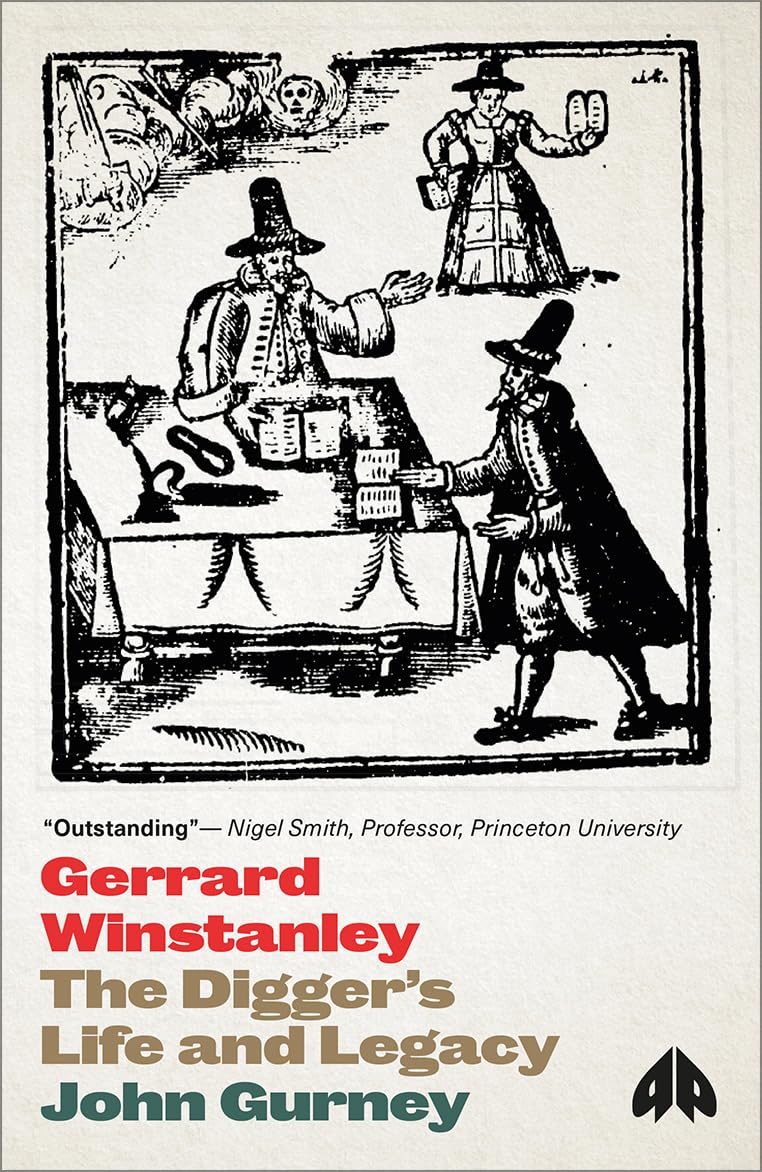
Gerrard Winstanley: The Digger's Life and Legacy: The Digger's Life and Legacy (Revolutionary Lives)
$20.69
by John Gurney



'The power of property was brought into creation by the sword', so wrote Gerrard Winstanley (1609-1676) – Christian Communist, leader of the Diggers movement and bête noire of the landed aristocracy. Despite being one of the great English radicals, Winstanley remains unmentioned in today's lists of 'great Britons'. John Gurney reveals the hidden history of Winstanley and his movement. As part of the radical ferment which swept England at the time of the civil war, Winstanley led the Diggers in taking over land and running it as 'a common treasury for all' – provoking violent opposition from landowners. Gurney also guides us through Winstanley's writings, which are among the most remarkable prose writings of his age. Gerrard Winstanley: The Digger's Life and Legacy is a must read for students of English history and all those seeking to re-claim the commons today. Outstanding. An exciting and extremely well-written account of Winstanley's development as thinker and experimental communist' Nigel Smith, William and Annie S. Paton Foundation Professor of Ancient and Modern Literature, Princeton University 'Years of painstaking research have been condensed into a clear, lively, and informative discussion. Indeed, even for specialists there is a fair amount of new material here ... an excellent introduction' Ariel Hessayon, The Historian 'Outstanding. An exciting and extremely well-written account of Winstanley's development as thinker and experimental communist' 'This is a clear-eyed yet sympathetic account of one of the most baffling figures of the English Revolution' 'An admirably succinct and clear guide to the complex career andthought of Gerrard Winstanley - a fascinating commentary on the complex and shifting world of radical thought during the revolutionary decades' 'Years of painstaking research have been condensed into a clear, lively, and informative discussion. Indeed, even for specialists there is a fair amount of new material here ... an excellent introduction' John Gurney (1960-2014) was a Visiting Fellow in the School of Historical Studies, Newcastle University and author of Brave Community: The Digger Movement in the English Revolution (2007). Gerrard Winstanley The Digger's Life and Legacy By John Gurney Pluto Press Copyright © 2013 John Gurney All rights reserved. ISBN: 978-0-7453-3183-6 Contents Acknowledgements, viii, 1 Introduction, 1, 2 The Making of the Digger, 9, 3 Winstanley the Digger, 47, 4 A New Beginning?, 86, 5 Winstanley's Legacy, 111, A Note on Sources and Further Reading, 129, Notes, 130, Index, 157, CHAPTER 1 Introduction In the summer of 1918, as the first anniversary of the October Revolution approached, steps were taken in Moscow to implement one of Lenin's pet projects, his plan for monumental propaganda. According to a decree that had been issued on 12 April, surviving symbols of the Tsarist regime were to be systematically removed, and monuments to past revolutionary thinkers and activists set up along major routes in the metropolis. Similar plans were laid for Petrograd. Among the old Tsarist symbols which faced destruction was a large granite obelisk standing prominently in the Alexander Gardens by the Kremlin, and which had been erected as recently as 1913 to commemorate 300 years of Romanov rule. It was Lenin who took the decision to save the obelisk, when it became clear that re-use might be preferable to demolition. As civil war in Russia intensified, work on new monuments had proved much more difficult than expected, and it was apparent that few would be ready for the first anniversary celebrations. It made good sense to recycle an older monument, even at the risk of upsetting Moscow's avant-garde artists and sculptors. The Romanov two-headed eagle was removed from the Alexander Gardens obelisk, and the names of tsars were effaced; in their place the names of 19 leading revolutionary thinkers were inscribed. As might be expected, Karl Marx and Friedrich Engels headed the list, but the eighth name was that of 'Uinstenli', or Gerrard Winstanley (1609–76), best known as leader of the seventeenth-century English Diggers, who in April 1649 had occupied waste land at St George's Hill in Surrey, sowed the ground with parsnips, carrots and beans, and declared their hope that the Earth would soon become 'a common treasury for all, without respect of persons'. Why should Lenin and his associates have chosen Winstanley as one of the thinkers whose work might be seen to have helped pave the way for the massive upheavals of October 1917? What was it that brought Winstanley into this Pantheon of great revolutionaries, and provided a link, however tenuous, between the English and Russian revolutions? At first sight, the presence of Winstanley's name seems puzzling. Winstanley was not particularly well known even in his own time, and he was certainly not one of the dominant figures of his age. His period of public activity lasted