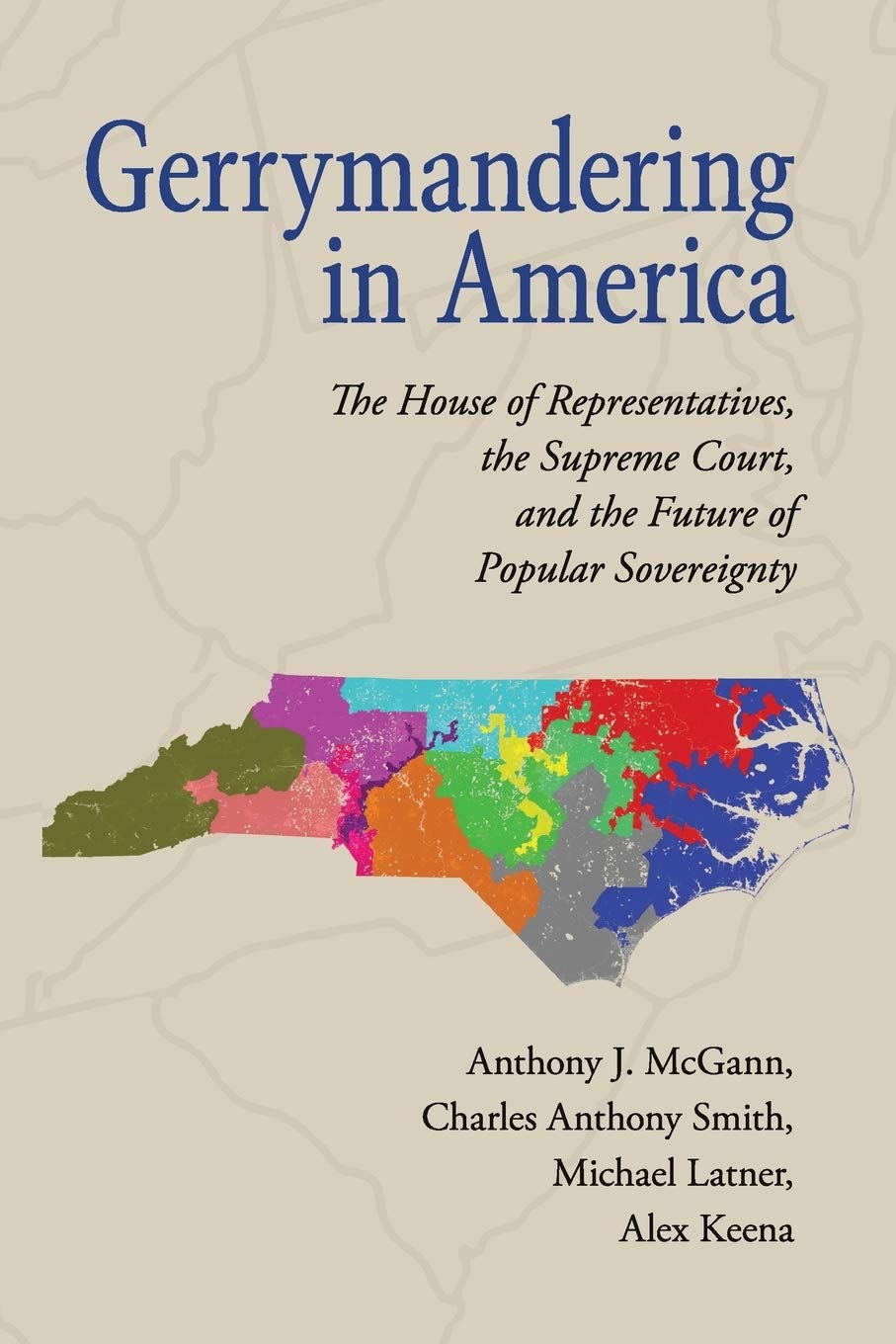
Gerrymandering in America: The House of Representatives, the Supreme Court, and the Future of Popular Sovereignty
$24.73
by Anthony J. McGann



This book considers the causes and consequences of partisan gerrymandering in the U.S. House. The Supreme Court's decision in Vieth v. Jubelirer (2004) made challenging a district plan on ground of partisan gerrymandering practically impossible. Through a rigorous scientific analysis of US House district maps, the authors argue that partisan bias increased dramatically in the 2010 redistricting round after the Vieth decision, both at the national and state level. From a constitutional perspective, unrestrained partisan gerrymandering poses a critical threat to a central pillar of American democracy -- popular sovereignty. State legislatures now effectively determine the political composition of the US House. The book answers the Court's challenge to find a new standard for gerrymandering that is both constitutionally grounded and legally manageable. It argues that the scientifically rigorous partisan symmetry measure is an appropriate legal standard for partisan gerrymandering, as it is a necessary condition of individual equality and can be practically applied. "Under what circumstances can minorities defeat majorities in American democracy? Blending incisive legal analysis, with insights from social choice theory, McGann, Smith, Latner, and Keena explain how a largely unnoticed court case has allowed the Republican Party to violate the fundamental democratic principle of one man one vote to ensure their control of the House of Representatives. Employing rigorous empirical analysis, the authors provide a death-blow to political scientists' prevailing wisdom that, when it comes to redistricting, demography is destiny … Important, accessible, and timely, this book will generate controversy among scholars of redistricting. It is essential reading for students of American politics, as well as anyone who wants to better understand today’s political climate." Benjamin G. Bishin, University of California, Riverside "[This book] makes a rigorously argued case that partisan gerrymandering - unrestricted after Vieth v. Jubelirer (2004) - has emerged as a serious problem for democratic representation and proposes to solve it through an innovative legal strategy, rooted in social choice theory, designed to persuade courts to reconsider the issue from a new perspective. It is easily the most original and important work on partisan gerrymandering to appear since the Court's ruling." Gary Jacobson, University of California, San Diego "Translating votes into a fair division of seats is a fundamental challenge of democracy. The authors powerfully demonstrate how the Supreme Court's 5-4 decision in Vieth v. Jubelirer (2004) set the stage for at least a decade of partisan gerrymanders and systematic bias in favor of Republicans." Matthew Lebo, Stony Brook University "McGann et al. explain how partisan gerrymandering allowed a minority of voters to elect a majority of the US House of Representatives in 2012 and created a virtual Republican lock on the institution until 2020. The authors make a provocative argument about the signal sent by the Supreme Court’s Vieth v. Jubelirer decision, which they claim encouraged state legislatures to maximize partisan advantage in competitive states … This book represents the best of social science research by addressing a relevant topic, embracing normative implications for democratic theory, and offering guidelines to ensure popular sovereignty." T. Lynch, Choice '… this is an excellent book. The authors do a tremendous job covering the legal background and political implications of gerrymandering and explaining the data analysis required for the book. … I highly recommend this book to students and scholars of representation and redistricting.' Thomas L. Brunell, Congress and the Presidency This book provides a standard to gauge partisan gerrymandering, which increased after the Supreme Court ruled it a non-justiciable issue. Anthony J. McGann is a Professor in the School of Government and Public Policy at the University of Strathclyde. His research examines the theory and practice of democratic institutions with a focus on electoral systems and the behavior of political parties. He has published The Logic of Democracy and The Radical Right in Western Europe (with Herbert Kitschelt). His articles have been featured in the American Journal of Political Science, the British Journal of Political Science, the Journal of Theoretical Politics, Public Choice, Comparative Political Studies, International Studies Quarterly, Electoral Studies, the Journal of Conflict Resolution, Party Politics, and Legislative Studies Quarterly, among others. Charles Anthony Smith is an Associate Professor at the University of California, Irvine. His books include The Rise and Fall of War Crimes Trials: From Charles I to Bush II (Cambridge, 2012) and Understanding the Political World, 12th edition (with James Danziger). He has published articles in the American Journal of Political Science, Law and Soc