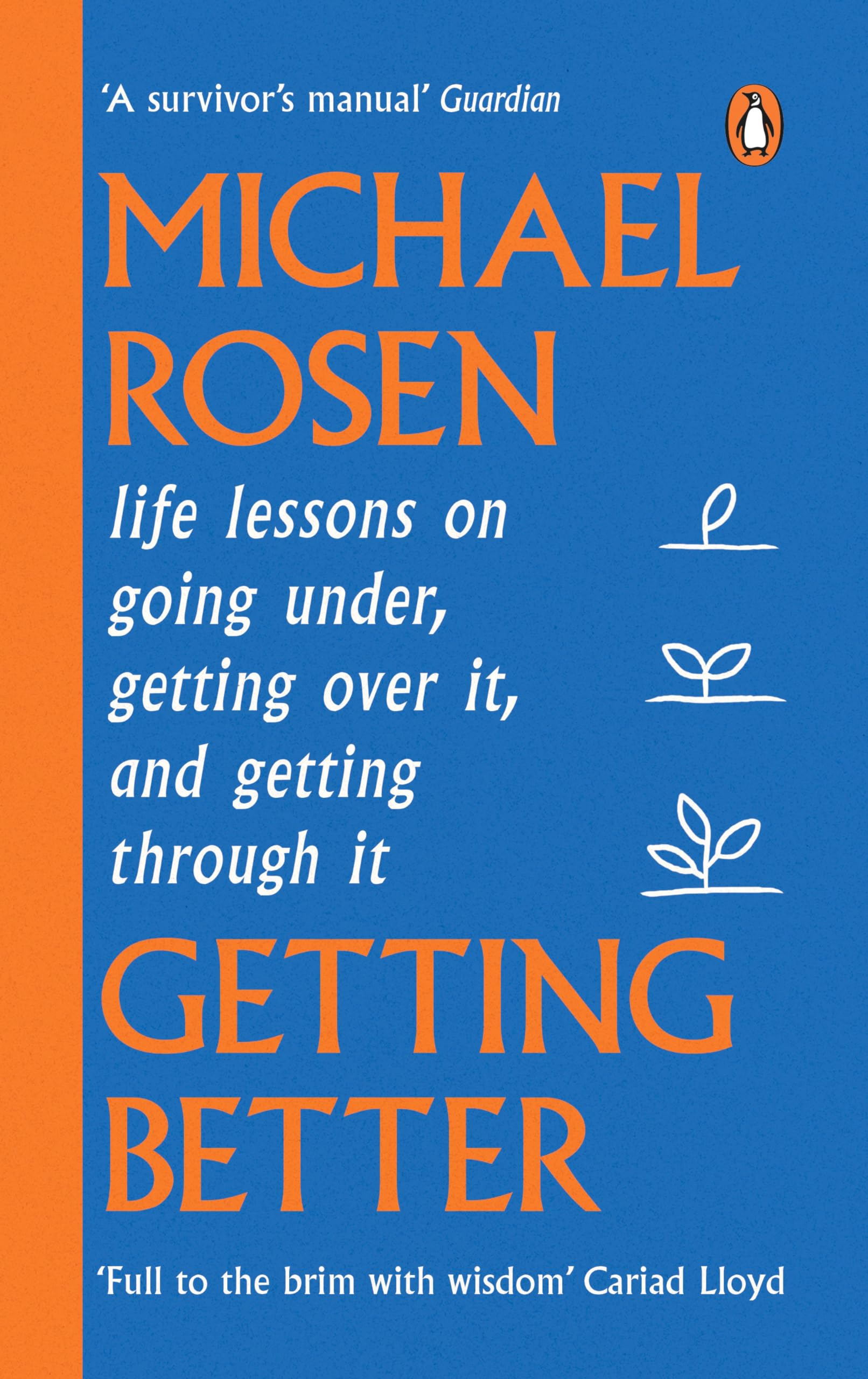
Getting Better: Life lessons on going under, getting over it, and getting through it
$19.00
by Michael Rosen



A stunning new memoir from beloved children's author Michael Rosen, exploring the role trauma - from chronic illness to the loss of a child - has played in his life, and how we can learn to live again in the aftermath of tragedy "He offers readers a lifeline.' — Guardian In our lives, terrible things may happen. Michael Rosen has grieved the loss of a child, lived with debilitating chronic illness, and faced death itself when seriously unwell in hospital. In spite of this he has survived, and has even learned to find joy in life in the aftermath of tragedy. In Getting Better , he shares his story and the lessons he has learned along the way. Exploring the roles that trauma and grief have played in his own life, Michael investigates the road to recovery, asking how we can find it within ourselves to live well again after - or even during - the darkest times of our lives. Moving and insightful, Getting Better is an essential companion for anyone who has loved and lost, or struggled and survived. "Moving and insightful, Getting Better is an essential companion for anyone who has loved and lost, or struggled and survived." — LitHub "This is as much a book about finding the words to express our troubles as it is about the author’s life and Rosen . . . is a generous teacher. We feel his doubts, his uncertainty and his curiosity. . . . He offers readers a lifeline, and shows them they are not going through it alone." — Guardian Michael Rosen is the author of We're Going on a Bear Hunt , and one of the best-known figures in the children's book world. He is renowned for his work as a poet, performer, broadcaster and scriptwriter. He visits schools with his one-man show to enthuse children with his passion for books and poetry. In 2007 he was appointed Children's Laureate, a role which he held until 2009. While Laureate, he set up The Roald Dahl Funny Prize. He currently lives in London with his wife and children. I'll start by telling you a story. I’m telling it to you so you know what happened. I’m also telling it to you because it helps me to tell it. And because it helps me, I am saying that if anything like this has happened to you, it may well help you to do the same: to tell your story. You can do this in any way you like. The important thing is to tell it. The story begins at Paddington Station in 1999. From there, I ring home to see if my son Eddie is in. He’s nearly 19. Sometimes he’s there and sometimes he stays with his girlfriend. If he’s not there, I might go and visit someone else. If he is there, I’ll go home and we can have a chat. It turns out that he is at home. But he’s not feeling too good, he says. A bit of a headache. I tell him to take some paracetamol and I’ll be home in about an hour. Sure enough, I’m home in about an hour. He doesn’t seem too bad. Must be one of those things my mother used to call “a chill”, I think. I tell him that I’ve worked a thing into my show for children where I tell them a story about when he was a funny, naughty toddler, then, I say, I follow it with a story about how he grew and grew and grew until, as he is now, he became bigger than me. And something else: now he can pick me up and whirl me round and round until I shout, “Put me down, Eddie! Put me down, Eddie!” It works. To little children, as I mime the contrast between chasing after the naughty little toddler Eddie and being swung through the air by the giant Eddie, it seems miraculous that one day they could be bigger than me. I think it’s a miracle too. Eddie seems to enjoy the story. He doesn’t go to bed. We sit in the living room. He’s written a play and we talk about how we could get some people together to do a kind of acted-out reading. He stretches out on the sofa – he really is bigger than me – and says that he feels a bit weird. I feel his head. It’s hot. I remind him that he can alternate between paracetamol and ibuprofen and line up the boxes for him, warning him not to overdo the dose. He says he’s going to bed now, but he’ll have some ice-cream first. I ask him if his neck is stiff. It’s something I’ve done with the children for the previous few years since meningitis has come up on the radar. No, he says, he doesn’t have a stiff neck. Someone’s sent me a book of riddles that’s just come out. I’ve got it because a riddle I’ve written is in the book. I read it to him. He gets it. It’s daft. The answer, he says, is “your bum”. Those are the last words that I ever heard him say. When I go to bed, I put my head round the door. He’s lying on his back in bed. “You OK?” I ask. He nods without making a sound. I check that he’s got the paracetamol, ibuprofen and a glass of water by his bed and then I go to my room and turn in. In the night, I hear him get up and go to the loo. I have a feeling of irritation that I’m awake. I’ve got to get up early and I don’t want to feel tired. I fall back asleep. I’ve got to get on the road pretty early so I’m up at six. I pop my head