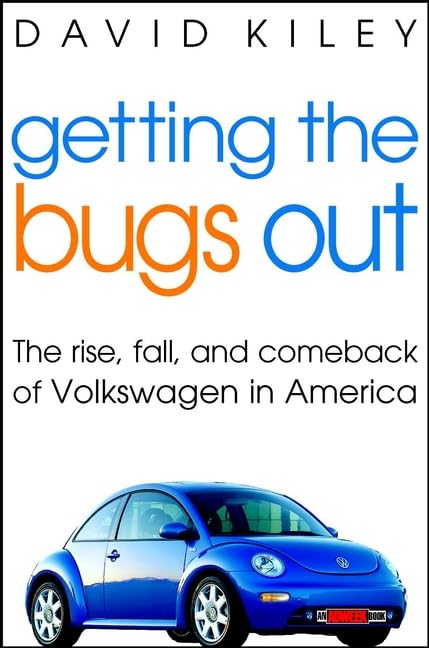
Getting the Bugs Out: The Rise, Fall, and Comeback of Volkswagen in America
$21.60
by David Kiley



The fascinating story of Volkswagen's raging success and near collapse in America After a wild ride of ups and downs for almost three decades, Volkswagen has regained its stature as one of America's most beloved auto makers. In Getting the Bugs Out, journalist and auto industry expert David Kiley tells the complete story of the rise, fall, and comeback of Volkswagen. Kiley traces the company's rise from Ferdinand Porsche's original design for the Beetle, through the Nazi era, and up to the Beetle's ascendancy during the flower-power 1960s. He explores the reasons for VW's downward spiral through the 1970s and 1980s, including the devastating management blunders that led to such failed efforts as the Rabbit, Dasher, Thing, and Scirocco, and equally catastrophic marketing initiatives, culminating in the notorious "Fahrfegnugen" series of ads. Finally, drawing upon his unique access to company insiders, Kiley tells the story of how Volkswagen achieved its phenomenal comeback beginning in the late 1990s through a combination of visionary management, cutting-edge product development, and brilliant marketing and advertising strategies. David Kiley (Anne Arbor, MI), the Detroit Bureau Chief at USA Today, is a journalist with fifteen years of experience, ten of which have been devoted to covering the auto industry. He has written extensively for Adweek and Brandweek magazines. How did Adolf Hitler's "people's car" shake off its Nazi roots to become the best-selling import of the 1960s, beloved amongst hippies, adventurers, and other independent thinkers? Journalist Kiley traces the rise and fall of the enigmatic Beetle in the U.S., beginning with Ferdinand Porsche's design prior to World War II. An immediate commercial flop, the Type 1 chassis was adapted for use as a military vehicle, and these early models, assembled by forced labor, proved to be superior transportation in any terrain. With the factory nearly destroyed, Volkswagen made a almost miraculous recovery to commercial success. Years ahead of its time, the first economy car became a hit because of superior workmanship, reliability, and simplicity of repair. An ingenious ad campaign in the U.S. really set the brand apart from Detroit's Big Three, but by the 1980s a flood of Japanese rivals and a failed attempt at a U.S. plant sent VW's quality and sales plummeting. The recent rerelease of the Bug begs the question, Is this just a nostalgia fad or is VW back? David Siegfried Copyright © American Library Association. All rights reserved The story of how a rigid German automaker stormed the American market with its lovable Beetle, virtually disappeared, then came roaring back is told here by USA Today's Detroit bureau chief. Part skeptic, part admirer, Kiley details the car's roots in Nazi Germany, suggesting it grew out of Hitler's obsession with creating an autobahn and giving German citizens the chance to have their own cheap cars to drive on it. When VW infiltrated America in the 1950s, it found itself fighting Detroit's lumbering giants, who believed Americans simply desired a steady stream of gas-guzzling, chrome-plated behemoths. By remedying the almost complete lack of affordable cars with good mileage, the Beetle was able to overcome its strange appearance, weak engine and reputation of being "Hitler's car" and quickly developed a dedicated following, thanks to whimsical, innocent ads. But in the 1970s, cheap, reliable, Japanese compacts began eating away at the Beetle's lead, and through the '80s, the company was mostly dormant in America, with Beetles supplying only collectors. Then, in 1994, VW bowled over the press with its presentation of the new Beetle. Another series of engaging ads helped put it into the limelight and return to a prominent position. Kiley is realistic about VW's future, noting that Beetle sales have been dropping off and other brands like Passat are not picking up the slack. Although Kiley pays too much attention to the advertising end of things-this is an Adweek Book, after all-he deftly reports on the mystique and the reality of one of the auto world's enduring legends. (Nov.) (Publishers Weekly, October 1, 2001) "a well-researched tale." (USA Today, December 10, 2001) "...Kiley has written an entertaining insight into one of the more interesting corners of the car industry..." (Irish Times (Dublin), 14 December 2001) "...engaging and informative...essential reading for anyone involved in promoting a brand " (Visions, The Peugeot Marque Magazine, January 2002) "..it is a fascinating and sometimes inspiring read.." (Sunday Business Post, 27 January 2002) "..offers a fascinating insight..a riveting read.." (Engineering Management Journal, February 2002) "A fascinating read for anyone connected to the automotive industry. And for those of us who create car advertising and who owe VW a debt of gratitude for raising the bar--and our pay scale--Kiley's insights into the historic Beetle ad campaign of the l