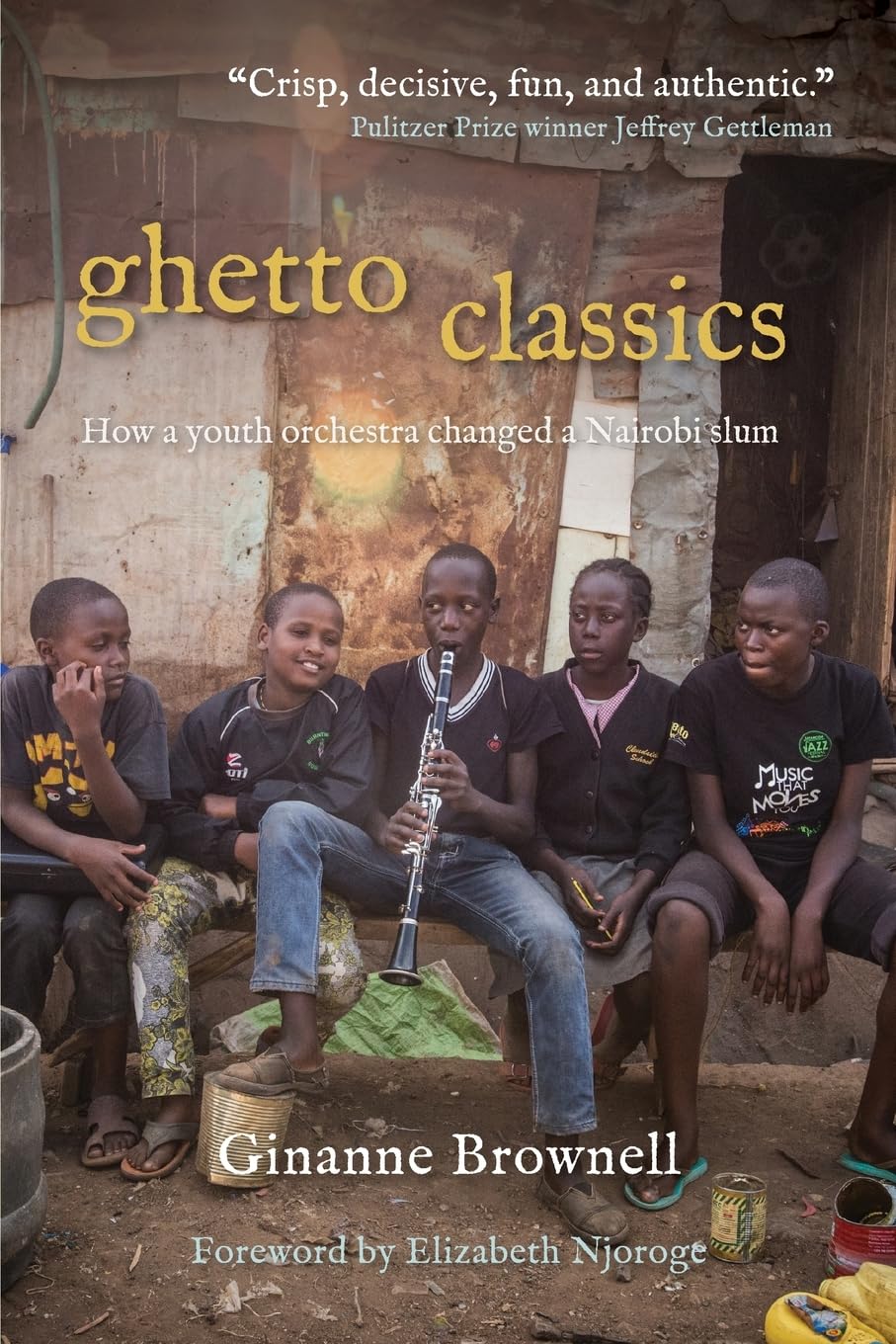



Ghetto Classics is an award-winning biography of a youth music program in one of Nairobi’s most dangerous communities. Situated next to the Kenyan capital’s largest garbage dump, the Nairobi slum of Korogocho might seem like one of the least likely places on the planet where a youth orchestra has found itself a home. And yet, the classical strains of Mozart and Vivaldi, along with more contemporary fare, can be heard gently wafting through Korogocho on a weekly basis. Since its founding in 2008, Ghetto Classics—so named by the initial cohort of students—has been inspiring local kids who learn firsthand how the arts can uplift and change lives. Ghetto Classics: How a Youth Orchestra Changed a Nairobi Slum , which was awarded the Independent Publisher Book Award's Silver Medal in Performing Arts (2024), is the story of how an initially motley crew of young people has morphed over time into a semi-professional orchestra that has played with some of the world’s top classical and jazz musicians like Branford Marsalis, David Sanborn and Hugh Masekela, and performed for the likes of Pope Francis, President Barack Obama and Belgium's Queen Mathilde. They have also helped to encourage their local community and bring a sense of possibility and promise to a place where it was much needed. ____________ Ginanne Brownell’s book transports us to the fence between despondency and enduring hope, and asks us to choose. Not just for the deserving but at-risk children of this slum, but for all of Kenya. And more importantly, she asks us to choose what kind of world we want. And her work—based on her own deep experiences there—reminds us that it actually is our decision to make. — Kirk Whalum, Grammy-winning American saxophonist and songwriter Ginanne Brownell is up to something wonderful. Her book on ghetto kids in Kenya producing beautiful classical music has all the right elements for an incredibly moving story that will appeal to lots of people. The Kenyan slums are such rich repositories of all the good and bad in the world. The poverty is as depressing as anywhere on Earth, but so many people in these places do shockingly kind things for each other. I’m always moved by the spirit and warmth, and a book set here is not glorifying poverty but understanding it. Her book lifts spirits and makes us feel connected to others in a way that few stories do. Ginanne’s language is crisp, decisive, fun, and authentic. — Jeffrey Gettleman, New York Times correspondent, Pulitzer Prize winner, and author of Love, Africa For nearly twenty years, I’ve followed Ginanne Brownell’s forays into foreign cultures with huge interest. Every time she leaps on a plane and delves into the society she studies on arriving there, she finds fascinating, complex scenarios. Particularly at a time of roiling unease and political hand-wringing in the West, the story of how classical music can transform the lives of poor Kenyans is a much-needed window on hope, grit and change. — Carla Power, two-time Pulitzer finalist and author of If the Oceans Were Ink and Home, Land, Security ____________ GINANNE BROWNELL is a London-based American journalist who has written extensively on education, development, travel, and the arts. She has worked on staff for CNN, Newsweek, Financial Times, The Wall Street Journal , and UNICEF. Her writing has been published in outlets including The New York Times, The Washington Post, Foreign Policy, Scientific American, Condé Nast Traveller , and National Public Radio . Born and raised in Michigan, she has a BA from Albion College and a MSc in history from the London School of Economics. www.ginannebrownell.com Ginanne Brownell's book transports us to the fence between despondency and enduring hope, and asks us to choose. Not just for the deserving but at-risk children of this slum, but for all of Kenya. And more importantly, she asks us to choose what kind of world we want. And her work-based on her own deep experiences there-reminds us that it actually is our decision to make. -Kirk Whalum, Grammy-winning American saxophonist and songwriter Ginanne Brownell is up to something wonderful. Her book on ghetto kids in Kenya producing beautiful classical music has all the right elements for an incredibly moving story that will appeal to lots of people. The Kenyan slums are such rich repositories of all the good and bad in the world. The poverty is as depressing as anywhere on Earth, but so many people in these places do shockingly kind things for each other. I'm always moved by the spirit and warmth, and a book set here is not glorifying poverty but understanding it. Her book lifts spirits and makes us feel connected to others in a way that few stories do. Ginanne's language is crisp, decisive, fun, and authentic. -Jeffrey Gettleman, New York Times correspondent, Pulitzer Prize winner, and author of Love, Africa Ginanne Brownell's book is an inspiration, a hope, a voyage into a way we can make the wo