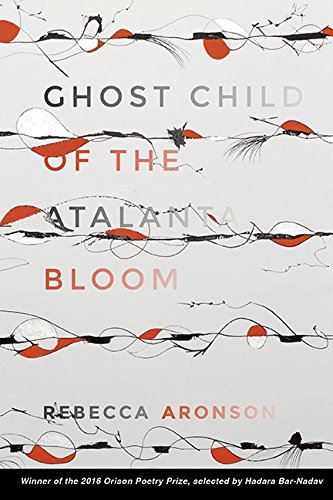



In Ghost Child of the Atalanta Bloom Rebecca Aronson combines myth and memory, history and landscape, dream and the everyday in arresting, painterly poems that sweep the reader beyond the ordinary. With a practiced hand Aronson crafts shapely poems in which no word is wasted. In fact, nothing is wasted, and Aronson's poems redeem all manner of powerful images and experiences from time's grasp, forming a new mythology out of the raw material of her life and imagination. ''Rife with hunger and volatility, these poems, rooted in the dry heat of the American Southwest, circle an unnamed longing, and seek release. [. . .] Through the heat of fire or the joy and fear of new motherhood, [Aronson] follows that trail of want, searching endlessly for 'a reason and a reason and a reason for joy.''' -- Booklist ''Explosive, turbulent, haunting, magnetic, Rebecca Aronson's Ghost Child of the Atalanta Bloom begins with a girl who sets a field on fire, an apt metaphor for poems that are themselves fiery. Mortality and death undergird Aronson's fantastical visions, where a child becomes a seagull, a woman turns tarantula, and a house threatens to fill with blood. Fierce vulnerability and brutality excite the perceptions of the ill and the grief-stricken, the child and the new mother who claims: 'With teeth I guard the home, and with breathing.' Details are vaulted to life, wild with electricity--from a canoe to a pearl to a bobbin, 'even the grass / could be an engine of desire.' An acute and visceral brightness--an aliveness--reaches under the eyelids, floating the reader across startling landscapes and dreamscapes, from Pompeii to Jersey City. I could stare all day at the riot of gasping colors, enthralled by Aronson's poems and her 'Ravenous god of little things.''' -- Hadara Bar-Nadav, judge of the 2016 Orison Poetry Prize ''The poems in Rebecca Aronson's collection achieve a longed-for but near-impossible mark--they change the very shape and length of the momentary to make time last longer. How does the present, each held breath, bloom and stretch and become an ever-ness, a sustained cherishing? This poet infuses more life into a line than almost any of her peers. This book belongs in a canon with the works of Brigit Pegeen Kelly, Naomi Shihab Nye, James Richardson, and Rita Dove--we have always needed new paths into that deep, attentive, porous and mindful way of being that only poetry can offer. Aronson's is a new route into our oldest and most familiar paradoxes and mysteries, those of love, beauty, connection, (im)materiality and consciousness. Nobody but Rebecca Aronson turns a reality inside out just by the way she looks at it, the way she listens, to reveal ever deeper colors and music than we could have suspected were all around us, and in us.'' -- Brenda Shaughnessy ''Her lines storm out of the gate and maintain a thrilling, cogent sense of direction, as if Rebecca Aronson has only recently been given permission to communicate and she is eager to share.'' -- Foreword Reviews "Explosive, turbulent, haunting, magnetic, Rebecca Aronson's Ghost Child of the Atalanta Bloom begins with a girl who sets a field on fire, an apt metaphor for poems that are themselves fiery. Mortality and death undergird Aronson's fantastical visions, where a child becomes a seagull, a woman turns tarantula, and a house threatens to fill with blood. Fierce vulnerability and brutality excite the perceptions of the ill and the grief-stricken, the child and the new mother who claims: 'With teeth I guard the home, and with breathing.' Details are vaulted to life, wild with electricity--from a canoe to a pearl to a bobbin, 'even the grass / could be an engine of desire.' An acute and visceral brightness--an aliveness--reaches under the eyelids, floating the reader across startling landscapes and dreamscapes, from Pompeii to Jersey City. I could stare all day at the riot of gasping colors, enthralled by Aronson's poems and her 'Ravenous god of little things.'"--Hadara Bar-Nadav, judge of the 2016 Orison Poetry Prize "The poems in Rebecca Aronson's collection achieve a longed-for but near-impossible mark--they change the very shape and length of the momentary to make time last longer. How does the present, each held breath, bloom and stretch and become an ever-ness, a sustained cherishing? This poet infuses more life into a line than almost any of her peers. This book belongs in a canon with the works of Brigit Pegeen Kelly, Naomi Shihab Nye, James Richardson, and Rita Dove--we have always needed new paths into that deep, attentive, porous and mindful way of being that only poetry can offer. Aronson's is a new route into our oldest and most familiar paradoxes and mysteries, those of love, beauty, connection, (im)materiality and consciousness. Nobody but Rebecca Aronson turns a reality inside out just by the way she looks at it, the way she listens, to reveal ever deeper colors and music than we could have suspected were all around us,