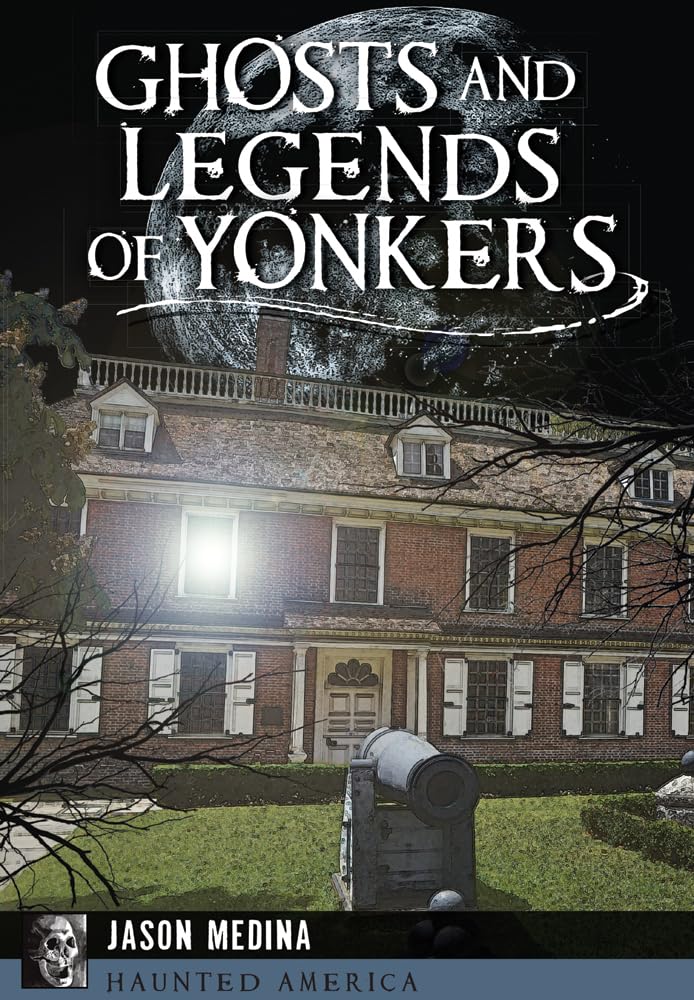



The quiet New York suburb of Yonkers hides a history of hauntings. Now converted into apartments, old Public School 13 is the site of strange apparitions that may be ghosts of former students and teachers who died in a tragic fire. The Boyce Thompson Institute's lofty goal of solving world hunger was never met, and unfulfilled spirits are said to lurk in its abandoned laboratory. Wealthy colonial landowners still watch over stately historic homes like Philipse Manor Hall. Even the iconic Untermeyer Park is a playground for the otherworldly. Local ghost investigator Jason Medina reveals these and other ghosts of Yonkers. Jason Medina owns and operates Yonkers Ghost Investigators. He is retired from the NYPD after more than twenty years' service. He has been conducting ghost investigations and haunted research since 2006. He is a member of the Kings Park Heritage Museum, where he volunteers as a researcher, photographer and blogger; a member of the Yonkers Historical Society where he volunteers as a researcher, photographer and writer; and a volunteer at Sherwood House in Yonkers. Ghosts and Legends of Yonkers By Jason Medina The History Press Copyright © 2015 Jason Medina of Tribal Publications, Inc. All rights reserved. ISBN: 978-1-62619-519-6 Contents Acknowledgements, Introduction, PART I. RESIDENTIAL HAUNTINGS, Iroquois Road Haunted House, Lee Avenue Hauntings, Montague Place Haunted House, Nepperhan Avenue Haunted House, Old Public School 13, Van Cortlandt Park Avenue Hauntings, Walnut Street Haunted Boarding House, PART II. NON-RESIDENTIAL LOCATIONS, Alder Manor and the Boyce Thompson Institute, Copcutt Mansion, Glenwood Power Plant, aka the Gates of Hell, Hudson River Ghosts and Legends, Oakland and Saint John's Cemeteries, Otis Elevator Company, Philipse Manor Hall, Public School 6, Saint Joseph's Cemetery, Saint Joseph's Seminary, Untermyer Park, Van Cortlandt Park, Conclusion, Bibliography, About the Author, CHAPTER 1 PART I RESIDENTIAL HAUNTINGS IROQUOIS ROAD HAUNTED HOUSE Long ago, before the United States was a nation, the members of the Native American Iroquois Confederacy made their home in what was known as Mohawk Valley. Located in the north-central region of New York, it was the only true home to the five tribes of this confederation. They never really settled in Westchester County nor had any interest in doing so. However, they often crossed into the land, which at the time was occupied by the Algonquin people. They did so for the purpose of trading, fishing and hunting. For many years, both groups were at war, until the Iroquois defeated the Algonquin. Regardless of this victory, the Iroquois still did not try to claim the land of their enemy. They were perfectly content where they were. This allowed the Algonquin to continue to thrive on the lands they called the Aquehung, which included the Tuckahoe Hills and the regions surrounding the Sprain Brook extending to the west banks of the Bronx River. Along the western shore of the Bronx River once stood a great village also called Aquehung, located somewhere around where Tuckahoe and Bronxville currently meet. The term Aquehung has been interpreted to mean "high bluff," "a river that runs along a high bluff" or simply "a place on the river." It is pronounced ah-kwa-hung. In the time when the Weckquaeskeck, a tribe of the Algonquin, settled in the Aquehung, the residential communities, parkways and railroads that exist today did not surround them. Instead, there was only the unaltered beauty of nature. There were lush forests, dazzling rivers and brooks, rolling hills and pleasant valleys. Wild animals roamed freely and were hunted for food and clothing. The rivers were alive with trout and other freshwater fish. It seemed the Weckquaeskeck had everything they needed in this paradise. These ancient tribes have forever left their mark in so many ways. By reading books, visiting museums and through Internet searches, we can learn how they lived. Fortunately, some of their legends have survived the ages and are still passed on today. Throughout Westchester County, there are many streets, towns, rivers and lakes that have retained their original Native American name or are named after a tribe that called New York its home before the land was known as New York. The Mohegan Heights Section of Yonkers is one such location. Prior to the 1900s, some of the roads that go through the area today did not exist. The area was mostly covered by farmland, which was gradually in development. In time, new roads and homes were built, until one such home was erected on a quiet little corner of a new street called Iroquois Road. It seems this particular house has a rather interesting past that longs to be told. For one family, a haunting occurred here that was so terrifying that it caused them to move away from New York, never to return. I came about this account from an anonymous woman who contacted me d