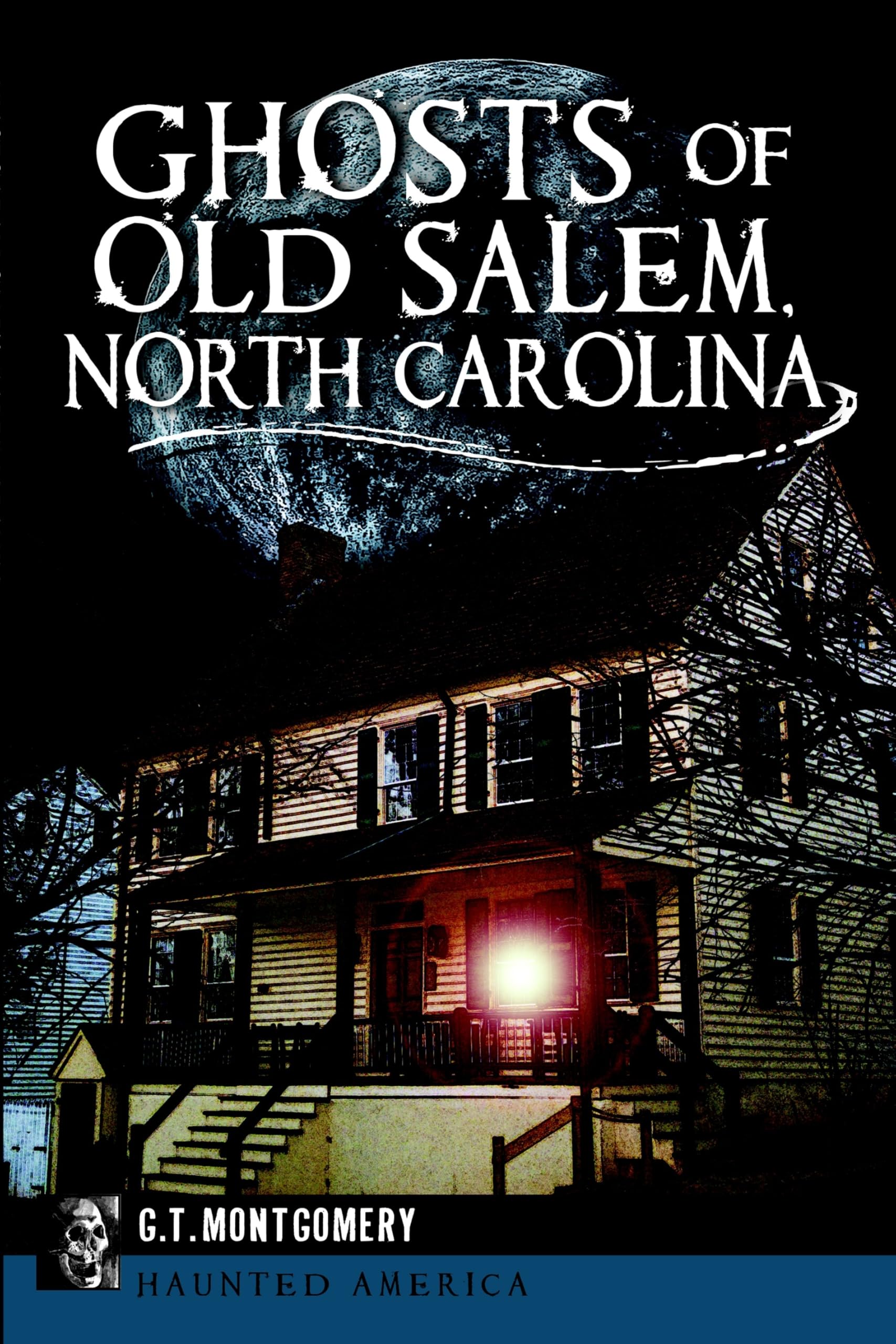



Hidden behind the preserved eighteenth-century colonial buildings of the Old Salem Historic District in Winston-Salem is a haunted history of spine-tingling tales. Find the harrowing stories of Salem Cemetery and the anonymous headstones of the Strangers' Graveyard. Learn the origins of the inexplicable sounds at Salem College. Meet the tavern traveler who refuses to check out. Follow the story of Andreas Kresmer's tragic death and the subsequent appearance of the Little Red Man. Join author G.T. Montgomery on a frightening journey to discover the most notorious haunts to wander Salem's streets. G.T. Montgomery is a graduate of Wake Forest University. He worked for Old Salem Museums and Gardens from 2009 through 2012. Ghosts of Old Salem is his first book. Ghosts of Old Salem, North Carolina By G.T. Montgomery The History Press Copyright © 2014 G.T. Montgomery All rights reserved. ISBN: 978-1-62619-465-6 Contents In Memoriam, Preface, Acknowledgements, A Letter from the Author, Introduction, PART I: AN INTRODUCTION TO OLD SALEM, 1. Old Salem, North Carolina, versus Salem, Massachusetts, 2. A Brief History of the Town, 3. Where to Begin a Visit, PART II: HAUNTINGS IN THE HISTORIC DISTRICT, 4. Upon Entering Old Salem, 5. Chill of a Child, 6. Lingering of the "Little Red Man", 7. Mary's Stare, 8. Gramley's Ghost, 9. Staub's Spirit, 10. Specter in the Salem Tavern, PART III: ADDENDUM, 11. Another Mysterious Shooting, 12. Another Hotel Blaze, 13. The Moravian Star, Afterword, Bibliography, About the Author, CHAPTER 1 OLD SALEM, NORTH CAROLINA, VERSUS SALEM, MASSACHUSETTS In the interest of full disclosure, I do want to clarify one thing from the outset of this book. In January 1692, Dr. William Griggs of Salem, Massachusetts, was summoned to examine both the daughter and niece of a local minister, Reverend Samuel Parris. The girls had fallen ill, and their health failed to improve on its own. Instead of providing a simple remedy, however, Dr. Griggs diagnosed the girls as being "bewitched." The diagnosis would prove to instigate a dark period of time in American history known today as the Salem witch trials. At that time in Massachusetts, the authorities maintained a strong belief in God, not to mention a healthy fear of Satan, and — as history would tell — the combination of those beliefs would claim several lives. Practicing witchcraft was considered a capital offense, and those found guilty were not spared: in total, nineteen men and women were hanged, while several others died in prison awaiting their punishment. When the hysteria subsided, the town of Salem, Massachusetts, would never be the same. Indeed, to this day, the town still serves as a lure to Halloween enthusiasts, either seeking to find new bewitched souls or, perhaps, the souls of those executed at the hands of hysteric fanatics. That having been mentioned, the Salem covered in this book is not that Salem. Rather, the "Old Salem" mentioned time and again in the pages to come refers to the colonial town established by Moravian missionaries in northwest North Carolina. The Salem covered in this book has no history of witchcraft. To avoid any further confusion, it may also be helpful to mention that in addition to Old Salem in Forsyth County, North Carolina, there is also a town in Burke County, North Carolina, called Salem and a town in Union County, North Carolina, called New Salem. As best can be determined, the latter two communities also lack histories of witchcraft. CHAPTER 2 A BRIEF HISTORY Of THE TOWN The region of Moravia is located far from northwest North Carolina: the area occupies central and eastern Czech Republic. Like various other Protestant groups in Europe, Moravia's Protestant sect (called the Moravians) experienced persecution for their religion, and by the start of 1792, a group of the Unitas Fratrum, as they called themselves, had made their way to Pennsylvania and founded the town of Bethlehem. It was from Bethlehem, Pennsylvania, that a select group of Moravians made a journey south into North Carolina, establishing a number of communities in the vicinity of present-day Winston-Salem. The first was Bethabara in 1753, the second was Bethania in 1759 and the third was Salem in 1766. Before the Moravian settlers arrived, the land where Old Salem now stands was undeveloped wilderness. Once established, Salem flourished. It came to serve as the central hub on which other nearby Moravian settlements relied. Settlers began practicing a number of trades from within Salem, and the town developed a reputation as a source of food, tools and other essentials needed by those living in the area. The engineering ability of the Moravians was also unquestionable, as their buildings withstood not only the foundational years of Salem but, in fact, still stand in place to this day. In that the Moravians also meant Salem to be an outpost for their missionaries, it is no surprise that t