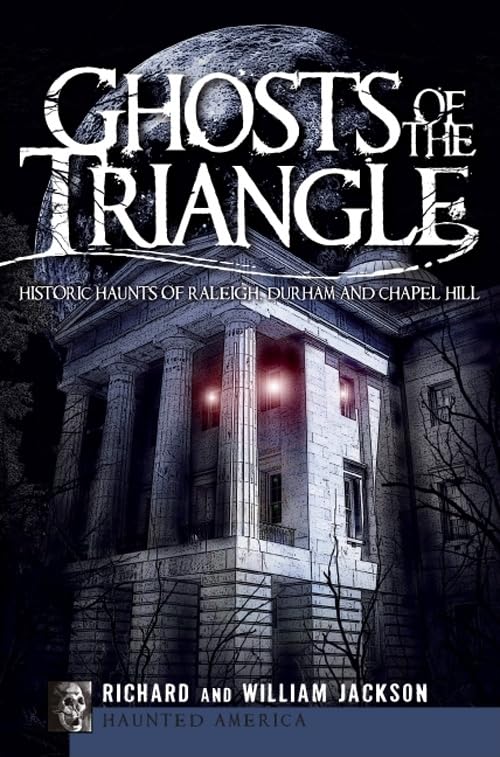
Ghosts of the Triangle: Historic Haunts of Raleigh, Durham and Chapel Hill (Haunted America)
$15.63
by Rick Jackson



The Research Triangle is a place of renowned progress and technology, but its three cities also boast a long and rich heritage, complete with many important historic sites where the past lingers a little too closely. From the otherworldly music at the Carolina Inn to the sound of laughter echoing in the old morgue at Watts Hospital to the image of men swinging from ropes in Hannah's Creek Swamp, the ghosts of the Triangle continue to make their presence known throughout the region. Join local brothers Richard and William Jackson as they trace the history behind these spine-tingling tales. Richard and William Jackson were both born in Durham, North Carolina. Both men are graduates of Campbell University, and live in Raleigh, North Carolina, with their families. Richard and William are amateur historians and have spent countless hours immersing themselves in local history and folklore. Ghosts of the Triangle Historic Haunts of Raleigh, Durham and Chapel Hill By Richard Jackson, William Jackson The History Press Copyright © 2009 Richard Jackson and William Jackson All rights reserved. ISBN: 978-1-59629-833-0 Contents Introduction, Part I. Chapel Hill, The Horace Williams House, The Legend of Peter Droomgoole, The Carolina Inn, Memorial Hall, Caldwell Hall, The Forest Theatre, The DuBose House, Part II. Durham, Watts Hospital, Cabe Family Cemetery, The Haunted Farmhouse, Country Church, Holloway Street, Stagville Plantation, The Phantom Hitchhiker, Pettigrew Street, Erwin Cotton Mill, Duke Hospital, The Haunted Wood, Part III. Raleigh, Mordecai Historical Park, North Carolina State Capitol, Executive Mansion, Poole Road Ghost, North Carolina State University, Crybaby Lane, The Lost Boy, Old Grocery Store, Dorothea Dix Hospital, White-Holman House, Hannah's Creek Swamp, Mill Creek Bridge, The Devil's Tramping Ground, Bentonville, CHAPTER 1 PART I CHAPEL HILL The history of Chapel Hill and the history of the University of North Carolina at Chapel Hill are one and the same. In 1789, the North Carolina General Assembly charted the creation of the University of North Carolina, which was to be the first public university to admit students in the United States. The University of Georgia had been chartered by the Georgia General Assembly in 1785 but did not admit students until 1801. Near an old Anglican church, the cornerstone was laid for the East Building on October 12, 1793. In February 1795, a young man named Hinton James, having walked all the way from Wilmington, North Carolina, arrived at the university as its first student. He was alone for two weeks before other students began to arrive. The university grew and prospered over the years and survived the dark days during and after the Civil War. The doors were closed briefly during Reconstruction, due to political and financial strife, but the school survived these times and again reopened its doors to students. In 1932, the process of consolidating the universities in North Carolina into one system began. The system became fully coeducational in 1965, as the Women's College of North Carolina became the University of North Carolina at Greensboro. It was during this period that the original campus became known as the University of North Carolina at Chapel Hill. Today, the school has one of the most beautiful campuses in the United States and boasts traditions that rival any other university in the nation. The campus at UNC is made up of quads, the two main being Polk Place and the "Pit." Polk Place is named after President James K. Polk, who was a native of North Carolina and an alumnus of the university. The Pit does not have a great namesake, but it is the central part of the campus for the students. The bookstore and dining halls are located at the Pit, and it is close to the library. When the weather is nice, the Pit becomes a melting pot of students, talking and relaxing during the time that one could only hope is between classes. Close to this hot spot, across the street between the Pit and Keenan Stadium, where the Carolina football team plays, is the Morehead- Patterson Bell Tower. The bell tower is a stunning sight, especially in the fall as the sun slowly sets, and the tower is illuminated against the autumn sky. Across the campus, between the Old East and Old West Buildings, is the Old Well. Modeled after the Temple of Love in the Garden of Versailles, the Old Well was built on the spot of the original working well at the university. It is said that if incoming freshmen drink from the well, they will receive straight As for their first semester of classes. This myth can be discredited by an ungodly number of people. Across McCorkle Place, near the infamous Franklin Street — the staging ground for the many celebrations for national titles and other big basketball game victories — stands the most controversial student at the school. Silent Sam is a monument that was built to honor the