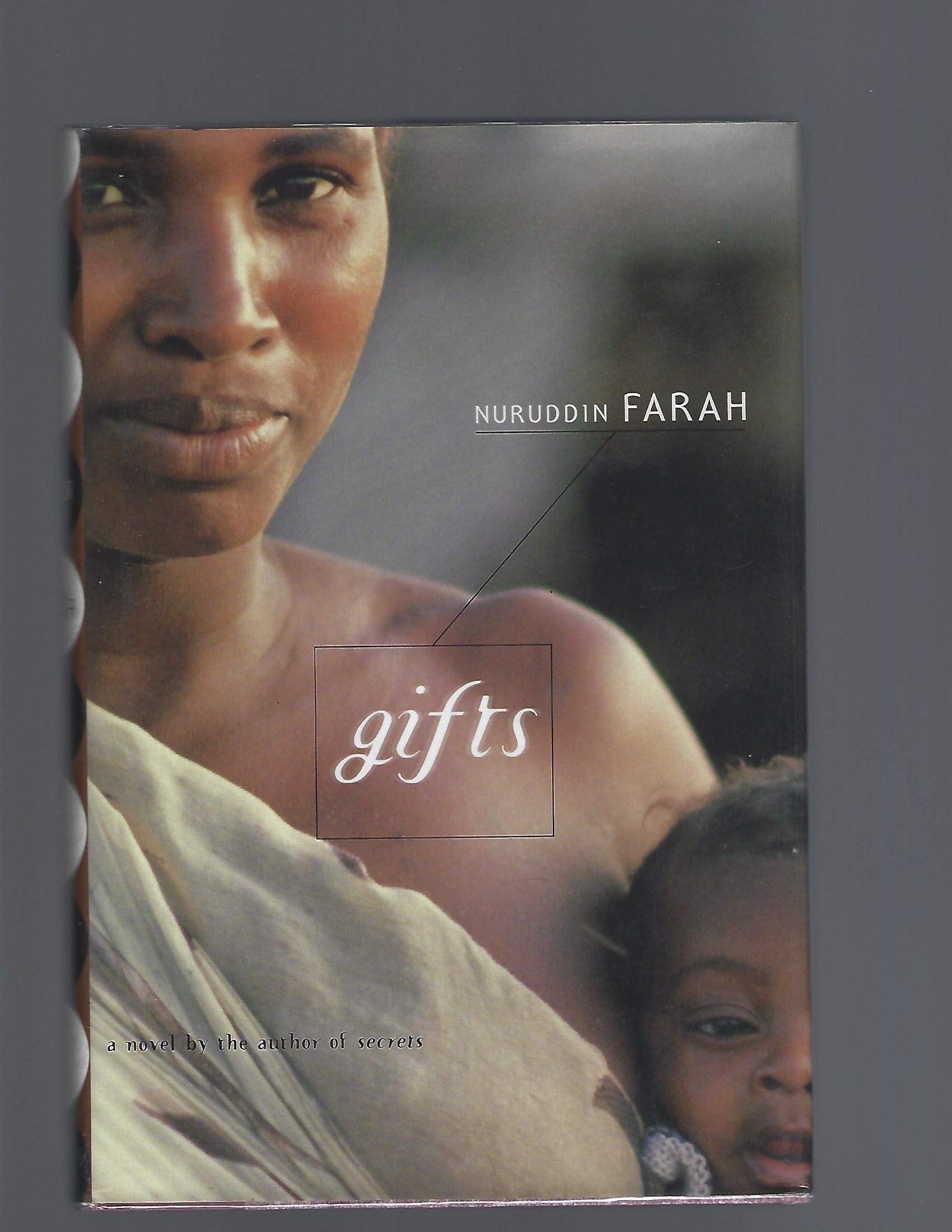



The second in the author's Blood in the Sun trilogy, the novel explores life in Somolia through two decades of civil strife. Though he has lived in exile for the last 20 years, Nuruddin Farah's eye never strays far from his native Somalia. In Maps and Secrets , the first and third volumes in his Blood in the Sun trilogy, he explored the devastating effects of tribal hatred and civil war on his society; the middle volume, Gifts , however, is of a different stripe altogether. Though also set in Somalia, it is a sunnier, more optimistic novel, and a love story, to boot. The protagonist is Duniya, a nurse at a maternity hospital in Mogadishu. Once widowed and once divorced, she has experienced the injustices heaped upon women in her culture--as a young girl Duniya was given by her father to an elderly man to be his wife; after his death she remarried, only to have her child taken from her by her alcoholic husband's family when they divorced. Free at last, she has no intentions of getting entangled again--until she meets Bosaaso, an American-educated economist who has returned to Somalia to help his country during its economic crisis: Duniya thought that marriage was a place she had been to twice already, but love was a palace she hadn't had the opportunity to set foot in before now. If what she and Bosaaso were doing was the beginning of a long courtship that might eventually lead to such a many-roomed mansion of love, so be it. So far she had only seen glimpses of it, in a rear-view mirror, in the eyes of a driver who wasn't a taxi driver. But love is not all Nuruddin has on his mind. He constantly reexamines the theme of gifts, from the personal gifting of one's body or heart to the impersonal "aid" bestowed by wealthy nations upon the poorer ones. But Gifts is hardly a political tract, for it consistently eschews the general in favor of the particular. In tracing Duniya's budding relationship with Bosaaso, Nuruddin not only tells the love story of two individuals but also etches a remarkable portrait of women in Somalia. The relationship between Duniya and Bosaaso is sweet, funny, and tender, but it is in her ties to her women friends and daughters that the book shines. As she learns to swim and drive, to stand up to her overbearing former in-laws and to trust her heart, it is within the context of an extended web of friends and family. Maps and Secrets expose the uglier aspects of war-torn Somalia; Gifts , on the other hand, offers its hidden strengths. --Alix Wilber Intended as the first two books in the author's "Blood in the Sun" trilogyAthe third being Secrets (LJ 5/1/98)Athese novels are a moving study of life in Somalia before the civil war. Maps is the story of Askar, found as a newborn beside his mother's dead body and raised by Misra, an outcast in the village because of her Ethiopian heritage. Years later, during the war with Ethiopia, Askar must choose between his country and the woman who raised him when Misra is accused of betraying their village to the enemy. Gifts tells the story of Duniya, a nurse trying to raise three children alone in the capital city of Mogadishu. When she decides to accept responsibility for an abandoned baby, she must confront the patriarchs of her family, Somalia's male-dominated bureaucracy, and her own fierce independence. In both novels, Farah has eloquently woven dreams, memories, and folklore into modern tales of ordinary people trying to live their lives with dignity in the midst of famine, colonialism, and longstanding ethnic hatreds. With their own unique styles and engaging characters, each novel easily stands on its own. Recommended for all libraries, even those that do not own the third novel.AEllen Flexman, Indianapolis-Marion Cty. P.L. Copyright 1999 Reed Business Information, Inc. Gifts is an ambitious, well-executed novel examining the subtle nuances of giving and receiving, on both the personal and the political level. Interweaving an impassioned discussion of the politics of foreign aid to Third World countries and the story of Duniya, a Somali nurse, and her new-found love for her husband-to-be, Bosaaso, Farah draws parallels between the intimate and the social realms, exposing the ways in which gifts create bonds between the giver and the recipient. When does a gift make the recipient dependent on the giver? (Politically, how does foreign aid effect economic and political stability in the recipient country?) When should a gift be accepted, and when should it be refused? Farah tackles these questions from a variety of angles, illuminating their significance for nations--and for individuals wishing to maintain the integrity of their own lives. Skillfully bringing to life Duniya and her family, Farah addresses philosophical questions without preaching; instead, he simply demonstrates the practical consequences of acts of giving. Bonnie Johnston Gifts ($23.95; Aug.; 256 pp.; 1-55970-484-5). The second in the eminent Somalian writers Bloo