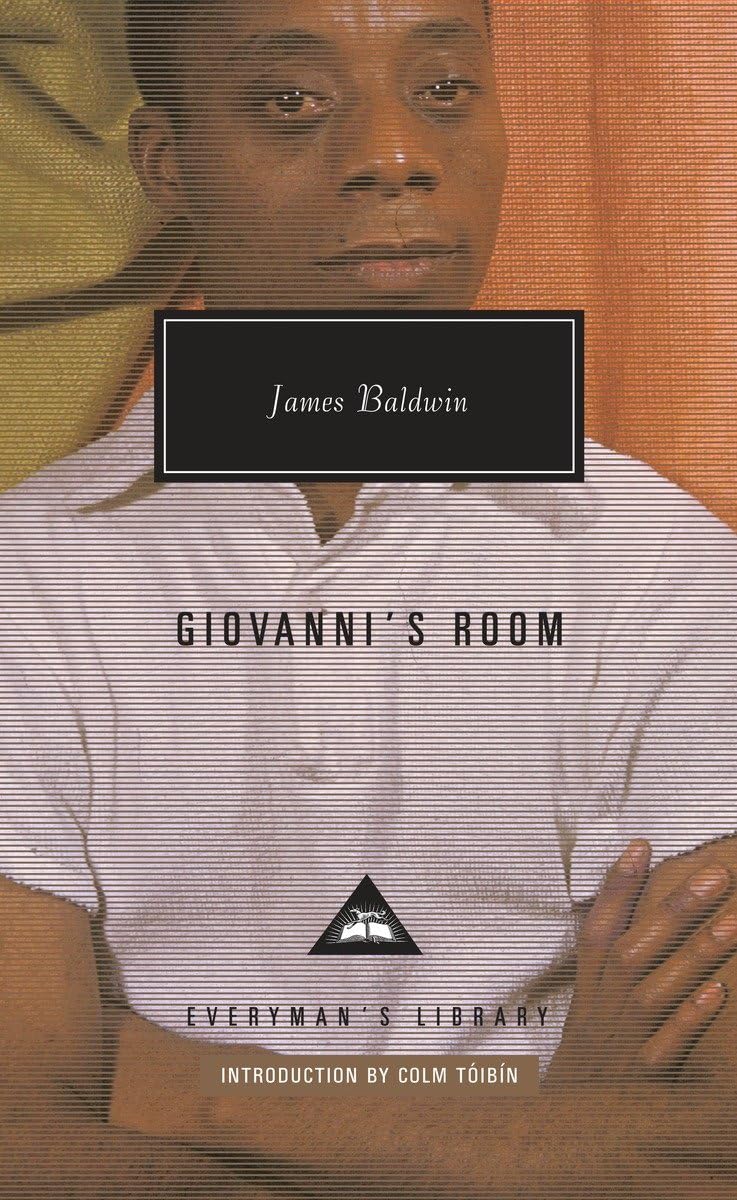
Giovanni's Room: Introduction by Colm Tóibín (Everyman's Library Contemporary Classics Series)
$19.10
by James Baldwin



Set among the bohemian bars and nightclubs of 1950s Paris, this groundbreaking novel about love and the fear of love is "a book that belongs in the top rank of fiction" ( The Atlantic ). • Presented here in stunning hardcover and with an Introduction by Colm Tóibín, New York Times bestselling author of The Master. David is a young American expatriate who has just proposed marriage to his girlfriend, Hella. While she is away on a trip, David meets a bartender named Giovanni to whom he is drawn in spite of himself. Soon the two are spending the night in Giovanni’s curtainless room, which he keeps dark to protect their privacy. But Hella’s return to Paris brings the affair to a crisis, one that rapidly spirals into tragedy. Caught between his repressed desires and conventional morality, David struggles for self-knowledge during one long, dark night—“the night which is leading me to the most terrible morning of my life.” With sharp, probing insight, Giovanni's Room tells an impassioned, deeply moving story that lays bare the unspoken complexities of the human heart. Everyman's Library pursues the highest production standards, printing on acid-free cream-colored paper, with full-cloth cases with two-color foil stamping, decorative endpapers, silk ribbon markers, European-style half-round spines, and a full-color illustrated jacket. Contemporary Classics include an introduction, a select bibliography, and a chronology of the author's life and times. “If Van Gogh was our nineteenth-century artist-saint, James Baldwin is our twentieth-century one.” —Michael Ondaatje “Baldwin writes...with unusual candor and yet with such dignity and intensity.” — The New York Times “Absorbing...[with] immediate emotional impact.” — The Washington Post “Violent, excruciating beauty.” — San Francisco Chronicle “Exciting.... A book that belongs in the top rank of fiction.” — The Atlantic “Baldwin, in this novel, made clear that he could work wonders with the light and shade of intimacy.... The tone continues to shift back and forth from pure eloquence to soaring sequences to simple description.... But he can follow this soon with passages that are pure Baldwin, that have a gorgeous, fearless sound, tempered by dark knowledge and pain, that make clear that Baldwin was ready to become the greatest American prose stylist of his generation.” —from the new Introduction by Colm Tóibín JAMES BALDWIN (1924–1987) was a novelist, essayist, playwright, poet, and social critic. His first novel, Go Tell It on the Mountain, appeared in 1953 to excellent reviews, and his essay collections Notes of a Native Son and The Fire Next Time were best sellers that made him an influential figure in the growing civil rights movement. Baldwin spent much of his life in France, where he moved to escape the racism and homophobia of the United States. He died in France in 1987, a year after being made a Commander of the French Legion of Honor. COLM TÓIBÍN is an internationally acclaimed, award-winning author. His novels include The Master, winner of the International IMPAC Dublin Literary Award, Le prix du meilleur livre étranger, and the Los Angeles Times Book Prize for Fiction; and Brooklyn, winner of the Costa Novel Award. He lives in Dublin, Ireland. I stand at the window of this great house in the south of France as night falls, the night which is leading me to the most terrible morning of my life. I have a drink in my hand, there is a bottle at my elbow. I watch my reflection in the darkening gleam of the window pane. My reflection is tall, perhaps rather like an arrow, my blond hair gleams. My face is like a face you have seen many times. My ancestors conquered a continent, pushing across death-laden plains, until they came to an ocean which faced away from Europe into a darker past. I may be drunk by morning but that will not do any good. I shall take the train to Paris anyway. The train will be the same, the people, struggling for comfort and, even, dignity on the straight-backed, wooden, third-class seats will be the same, and I will be the same. We will ride through the same changing countryside northward, leaving behind the olive trees and the sea and all of the glory of the stormy southern sky, into the mist and rain of Paris. Someone will offer to share a sandwich with me, someone will offer me a sip of wine, someone will ask me for a match. People will be roaming the corridors outside, looking out of windows, looking in at us. At each stop, recruits in their baggy brown uniforms and colored hats will open the compartment door to ask Complet? We will all nod Yes, like conspirators, smiling faintly at each other as they continue through the train. Two or three of them will end up before our compartment door, shouting at each other in their heavy, ribald voices, smoking their dreadful army cigarettes. There will be a girl sitting opposite me who will wonder why I have not been flirting with her, who will be set on ed