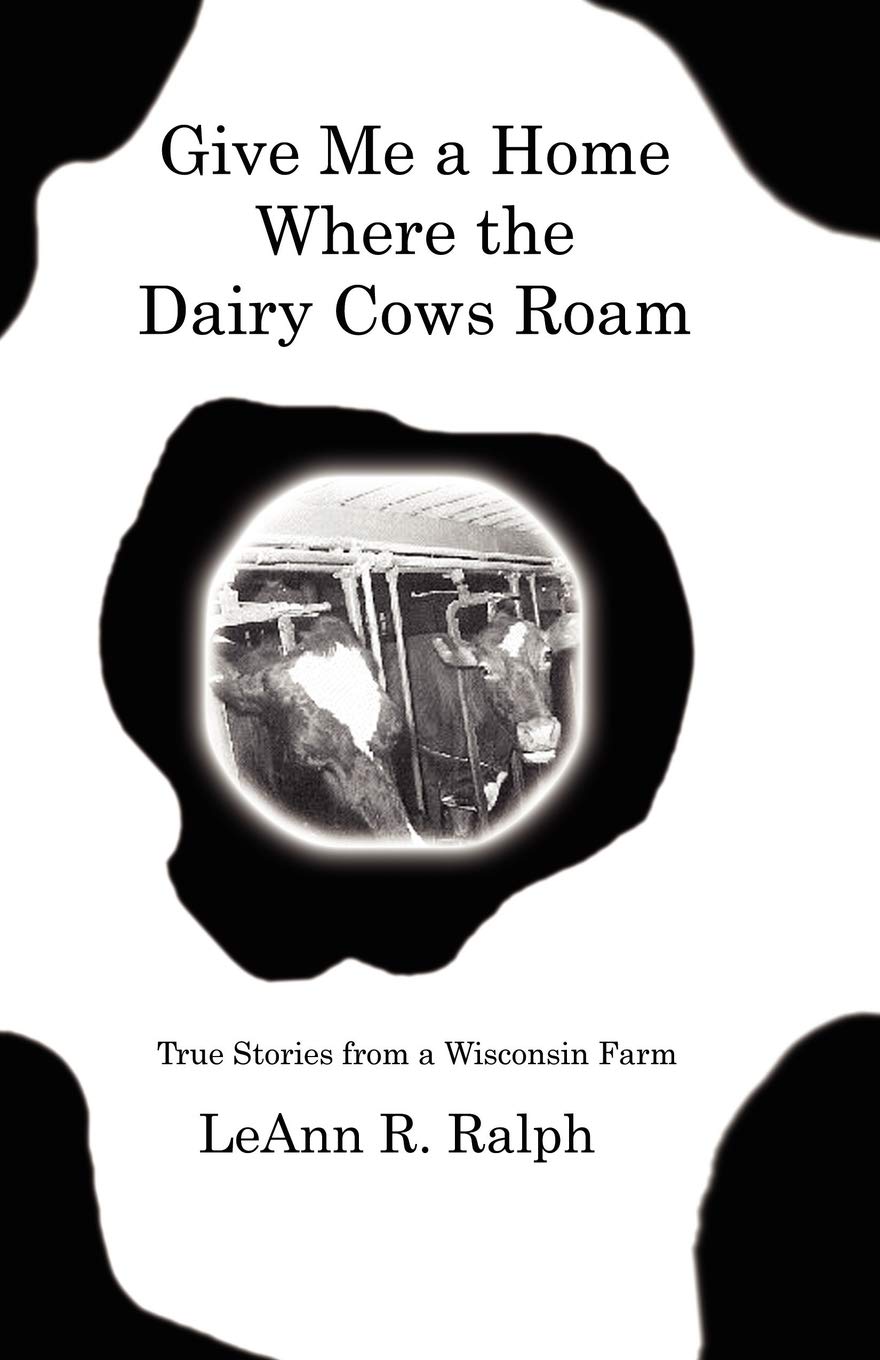
Give Me a Home Where the Dairy Cows Roam: True Stories from a Wisconsin Farm
$14.48
by Leann R Ralph



Since 1969, the United States has lost 85 percent of its dairy farms. Join the author on her family's farm in Wisconsin 40 years ago when dairy farms still dotted the countryside. Twenty true stories appropriate for all ages. I enjoyed every word. . .I wish your book went on forever . . . -- A Reader's Review, November 2004 Many kudos to you for putting it all together for me. . .thanks for some wonderful memories. -- A Reader's Review, December 2004 This is my life between the covers of your book . . .the good life we had growing up -- A Reader's Review, November 2004 What a wonderful writer you are, as I feel like I'm right there with you on all of your adventures! -- A Reader's Review, December 2004 You know how to make the reader feel like we are right there. When is your next book coming out? -- A Reader's Review, December 2004 Forty years ago when I was growing up on our dairy farm in Wis-consin, I would walk around the buildings yelling for my father. I'd wait for an answering "Hi!" and then I would go in that direction. Dad (who was forty-four when I was born) usually was doing some-thing interesting. One time when I was about four or five, I helped him grease the hay baler. Well, all right, what really happened is that Dad didn't notice I had gotten into the grease until it was much too late. I ended up with gobs of the dark purple stuff all over myself, from my hands up to my elbows, on my clothes and on my face. Another time, the sound of a hammer attracted me to the machine shed where I found Dad in the middle of building a hay rack. He drew lines where he wanted the nails to go, made sure I knew how to drive a nail in straight, and then he gave me the ham-mer. I went to work pounding nails. When we were finished building the rack, Dad let me help paint it too. A nice bright red. Then, while the paint was wet, we threw sand on it. "That will help keep it from being so slippery when we bale hay," Dad had explained. I helped my father with many tasks around the farm. Cows in labor sometimes needed a little assistance, so Dad showed me how to apply gentle tension on a rope tied to the calf's front feet. After a while, there would be the calf, all wet and shaking its head. As I grew older still, Dad taught me how to drive a tractor and how to load a hay wagon, how to change oil and how to turn a wrench. I lived away from my hometown for fifteen years. I worked on a thoroughbred farm in Kentucky and a Tennessee walking horse farm in the southern part of Wisconsin. I earned a bachelor's degree and a master's degree in English. I wrote for a newspaper. I taught English at a boys' boarding school. Eleven years after my mother died and two years after Dad passed away, my husband and I moved back to west central Wisconsin to live in the house my parents had built when they retired from farming. Before I returned to my hometown, I fully expected to be living in a farming community again. Instead, I discovered that while I was gone, many of the small fam-ily dairy farms had disappeared, farms like the one where I grew up when my dad milked twenty cows and knew each of them by name. According to statistics from the United States Census of Agricul-ture, during the last three decades of the twentieth century, Wisconsin lost two-thirds of its dairy farms. In 1969--when I was 11 years old--there were 66,000 dairy farms in the state. In 1980, there were 44,000. By the year 2000, the number had fallen to 22,000. Nationwide statistics show the same trend. Figures from the Census of Agriculture and from the American Farm Bureau Federation indicate that since 1969, the United States has lost 85 percent of its dairy farms. In 1969, more than a half million dairy farms operated in the United States, but by 1988, less than a quarter of a million remained. (Census of Agriculture). And by the year 2000, the numbers had fallen farther yet to only 83,000 dairy farms (American Farm Bureau Federation). So, considering the circumstances, if I happen to drive down a country road and spy a herd of dairy cattle turned out to pasture, I feel like I should stop and take a picture. A few times, too, I have rounded a curve or topped a hill, and was surprised to find houses and garages where there used to be pastures, cornfields and hayfields. Then there's the feed mill in my hometown. Not so long ago, a half-dozen pickup trucks would be waiting to have their loads of corn and oats ground into feed for dairy cattle. In 2003, the fire department burned the feed mill to the ground as a training exercise for firefighters. A parking lot now occupies the space where I used to spend summer afternoons with my dad while we waited for our corn and oats to be made into feed for the dairy cows. LeAnn R. Ralph Colfax, Wisconsin LeAnn R. Ralph earned an undergraduate degree in English with a writing emphasis from the University of Wisconsin-Whitewater and also earned a Master of Arts in Teaching from UW-Whitewater. S