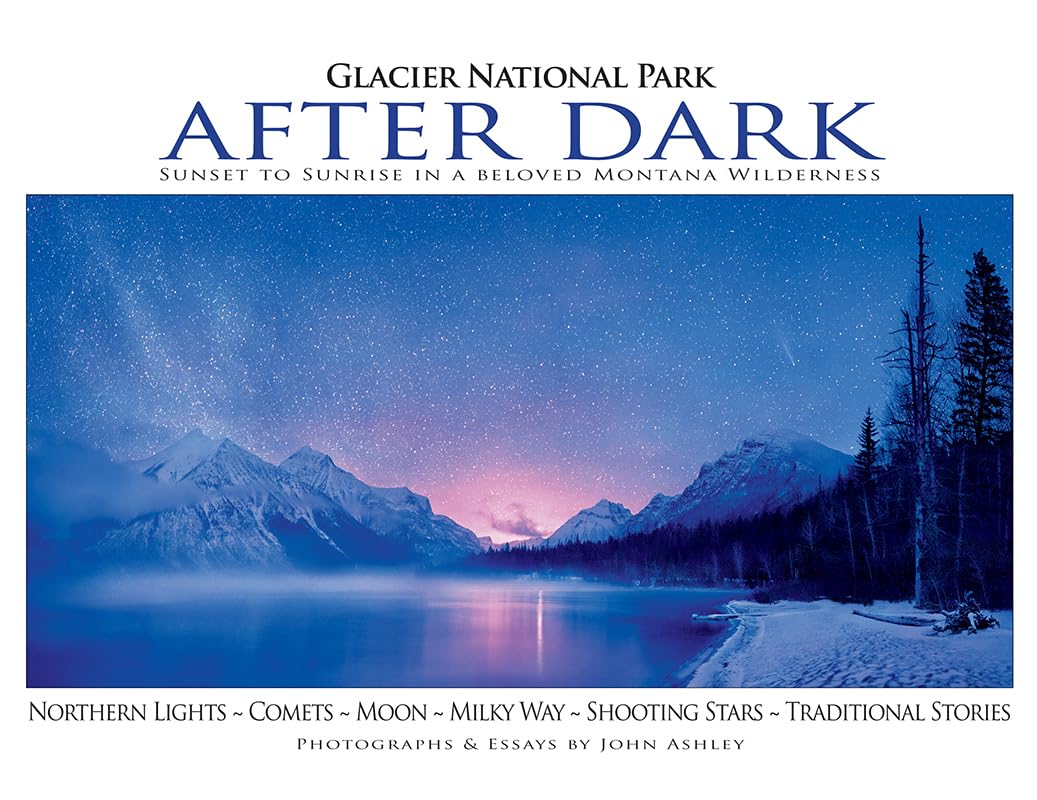
Glacier National Park After Dark: Sunset to Sunrise in a Beloved Montana Wilderness
$17.95
by John Ashley



Glacier National Park After Dark is a book like no other. With feet firmly planted in Montana's most-loved national park, these original essays and breathtaking photographs walk you through a universe of cultural history and native traditions, astronomy and philosophy, vision and photography, natural history and modern conservation. Like the book's author, it's very different. The photographs within these pages were gathered from more than 100 nights spent standing in the darkness of Glacier National Park, spanning almost three decades. This lightly-populated corner of Montana still harbors skies dark enough for the summer Milky Way to knock your socks off. It's a place where you can still see faint comet tails and shooting stars, northern lights and crescent moons. It's a wilderness where you can rediscover why the night sky inspired legends and religions in human cultures throughout recorded history. Just 136 years after Edison's first light bulb patent, we are losing or dark, night skies all across the globe. Without realizing it, we are trading the Milky Way for an alien orange glow that smothers the stars. After evolving with darkness for millennia, this relatively sudden shift to lighter nights is causing human health issue and ecological problems for many of the plants and animals that we share this little planet with. Too much light, too little real darkness. It's a modern problem that's easy to fix. Mostly what's missing is an awareness. Glacier National Part After Dark is a gentle nudge to help you wake up. And, just maybe, you'll rise up to rediscover the night sky. " Glacier National Park After Dark is magical realism where the mythic world of stars, sacred geography and Blackfeet lore are brought alive in stunning photographs. The reader is given the sense of an ancient world where the Wolf Trail leads to the netherworld and Morning Star guides the vision of every maiden. It's almost like being there with the old Niitsitapi elders at night, telling their stories from time immemorial." - Dr. Jay Hansford C. Vest., Professor of American Indian Studies, University of North Carolina at Pembroke "I knew John had photographed Glacier Park's night skies for decades, hauling his heavy gear up brushy ridges in the middle of the night. But—as one who wandered Glacier for two decades looking for bears—I'd never seen anything like these pictures; they shimmer with life and live in the dimension of time. Ashley's sky work reaches for a spiritual tether and touches the sacred world of the Blackfeet. The book's text is lively, appropriately scientific and informative. Above all, Ashley shows us how we are losing the heavens that we humans have watched and that have informed our kind for millennia; artificial light pollution is erasing the night sky. And, on our radically changing planet, we will need that stellar anchor." - Doug Peacock, Author of Grizzly Years and In the Shadow of the Sabertooth "Glacier National Park has rightfully been called a geologic park. John Ashley's spectacular book provides even the casual observer with a sense of awe and views of "other" worlds, the living cosmos within which our speck of dust — the Earth — and we not-so-humble humans are bit players. There is so much to enjoy and appreciate in this beautiful magnum opus — not the least of which would be a strong dose of humility and gratitude. Thank you, John." - Dr. Lex Blood, Educator, Geologist, Community Activist, and Mother Earth Admirer "John Ashley's Glacier National Park After Dark , is like exploring our galaxy with Earth as the starship. Glacier-Waterton Peace Park provides a visually eloquent framework for celestial theatre. This masterpiece earned John Ashley his Blackfeet name, Matakiu-kah-kait-too-siks, 'He Who Takes the Stars.'" - Jack W. Gladstone, Montana's Troubadour John Ashley is a Montana photographer, writer, biologist and educator. Suffering from an incurable curiosity, John finds himself attracted to career fields that, individually, are unlikely to earn a living wage. As an award-winning journalist in Montana and Florida, John has photographed presidents and homeless people, space shuttle launches and airplane crashes, beauty queens and murder suspects. He cut his night photography teeth in dimly-lit stadiums, hand-developing thin negatives deep into the night after high school, college and NFL football games. John also worked seasonally as a field biologist for the U.S. Fish & Wildlife Service and National Park Service. He has helped to conserve California condors, bald eagles and common loons. Around Glacier National Park the old-time rangers call him "Duck Boy" for the years he spent studying harlequin ducks. The artist-formerly-known-as-Duck-Boy now lives at the end of the road near Kila, about an hour west of Glacier National Park. He and his wife, Tracy, share a home that obviously belongs to their two rescue dogs, Gracie and Magpie.