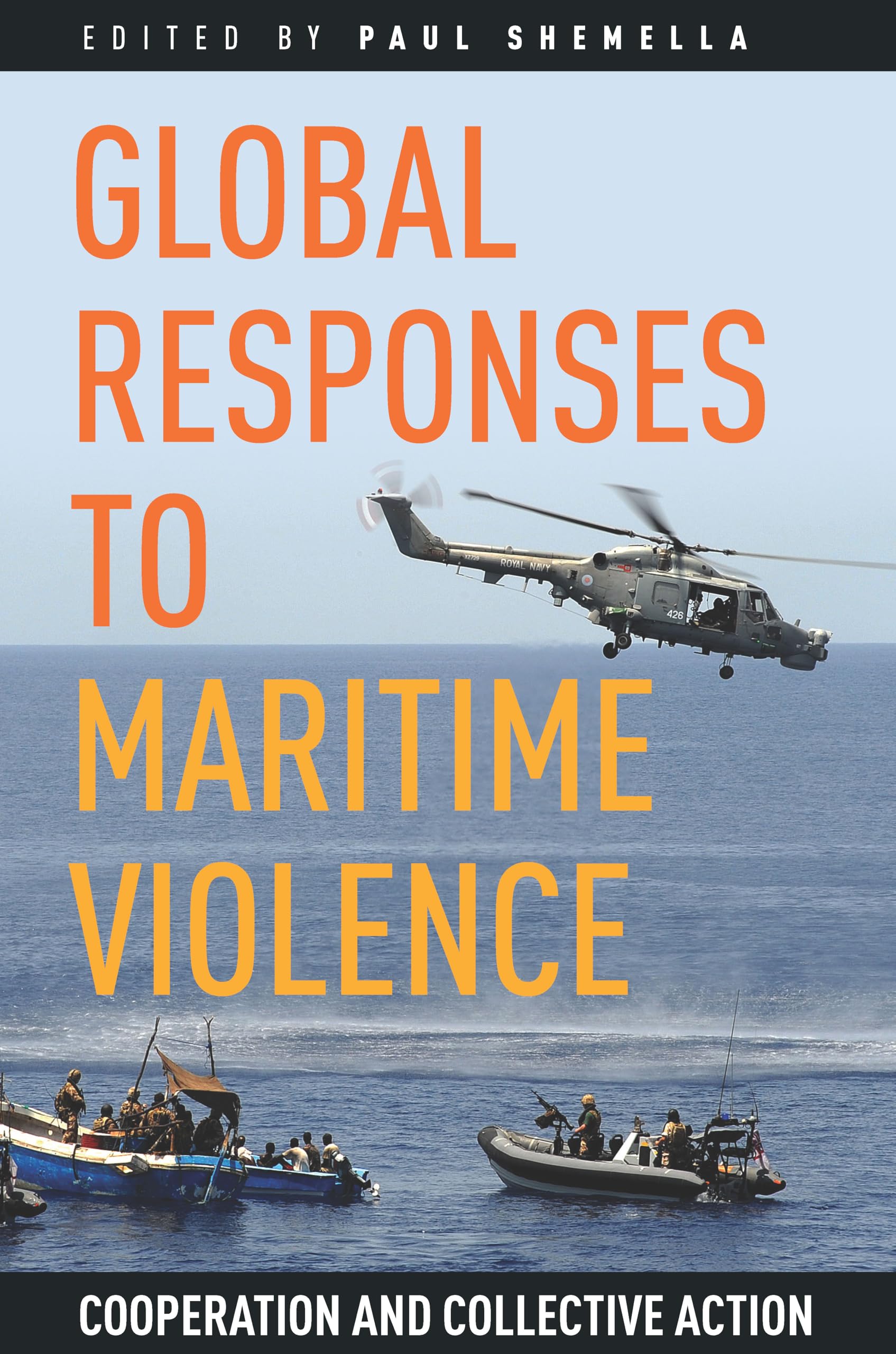
Global Responses to Maritime Violence: Cooperation and Collective Action
$28.80
by Paul Shemella



Global Responses to Maritime Violence is a full discussion of maritime security short of war that goes beyond the current literature in both scope and perspective. The chapters in this volume examine terrorism, piracy, armed robbery at sea, illegal maritime trafficking, illegal fishing, and other maritime crimes. Contributors uncover both threats and responses as a complex ecosystem that challenges even the strongest national and regional institutions. Managing this system is a "wicked problem" that has no ultimate solution. But the book offers strategic precepts to guide the efforts of any government that seeks to improve its responses to maritime violence. The bottom line is that maritime violence can be managed effectively enough to protect citizens and national economies that depend on the sea. Comprehensive in scope, the volume coheres around the premise that good governance in the maritime domain, though difficult, is worth the considerable resources required. "The essays are well written, describing their subjects in coherent, easy-to-understand concepts....By the end of the book, the reader has acquired a broad knowledge of the issues, complexities, and options associated with this diverse and complex area of the world....I recommend Global Responses to Maritime Violence to any individual―academic or otherwise―interested in the subject of terrorism or violent crime in the maritime environment." -- John L. Mahaffey ― Air and Space Power Journal Paul Shemella retired from the Navy at the rank of Captain after a career in Special Operations and lectures at The Center for Civil-Military Relations (CCMR) at The Naval Postgraduate School in Monterey, California. Global Responses to Maritime Violence Cooperation and Collective Action By Paul Shemella STANFORD UNIVERSITY PRESS Copyright © 2016 Board of Trustees of the Leland Stanford Junior University All rights reserved. ISBN: 978-0-8047-9841-9 Contents Preface, Contributors, 1. Introduction Paul Shemella, PART I: Examining Maritime Violence, 2. Maritime Terrorism: An Evolving Threat Peter Chalk, 3. Terrorist Targeting Paul Shemella, 4. Armed Maritime Crime Peter Chalk, PART II: Riding the Storm, 5. Integrated Strategies Against Maritime Violence Paul Shemella, 6. Assessing Maritime Governance Paul Shemella, 7. Global Port Security Charles J. Reinhardt, 8. Maritime Domain Awareness Timothy J. Doorey, 9. The Role of Institutional Leadership Robert Schoultz, 10. The Maritime Legal Framework Aubrey Bogle, 11. Managing Maritime Incidents James Petroni, PART III: Case Studies, 12. Defeating the Sea Tigers of LTTE Rohan Gunaratna, 13. Suppressing Piracy in the Strait of Malacca Lawrence E. Cline, 14. Maritime Violence in the Sulu Sea Thomas R. Mockaitis, 15. Maritime Crime in the Gulf of Guinea Peter Chalk, 16. Yemen: The Case for a Coast Guard Aubrey Bogle, 17. Conclusion Paul Shemella, Index, CHAPTER 1 Introduction Paul Shemella WITH THIS BOOK WE OFFER CONTEXT-BASED ANALYSIS OF maritime security imperatives, as well as practical approaches to facing some of the world's most challenging threats. The authors use the collective noun maritime violence, reviving the title of a Jane's Special Report on the subject published almost twenty years ago. That rubric did not "stick" in the literature but, having explored combinations of violence in the maritime domain for years, we think it should have. We understand maritime violence to be a set of threats short of war, occurring in or at the edge of the maritime domain, that includes terrorism, insurgency, piracy, armed robbery at sea, and maritime smuggling, along with other crimes such as oil bunkering and illegal fishing. Given that all these threats are closely related, scholars need an umbrella term that links them together. We offer a typology in Figure 1.1 that describes what we think of as an ecosystem of related threats. As in biological ecosystems, the activities listed — as well as the remedies — are interconnected. The sea itself has always been a violent place, and man's activities on the sea have taken a similar turn. If political and business leaders, acting together, wish to create a climate of security within which all citizens can thrive, they will have to tame the "outlaw sea" that laps at their shores. There is no shortage of evidence regarding the rise of global maritime violence. At the terrorism end of the spectrum, it was reported during the writing of this book that al-Qaeda in the Islamic Maghreb (AQIM) is preparing a maritime suicide unit to carry out attacks against shipping in and around the Mediterranean Sea. At the opposite end of our continuum, the navy of the Ivory Coast seized two Chinese fishing vessels, operating illegally in the country's waters during November 2014. The ships were impounded until the Chinese government paid a fine of US $200K. While Ivory Coast managed to send a message to governments that would steal