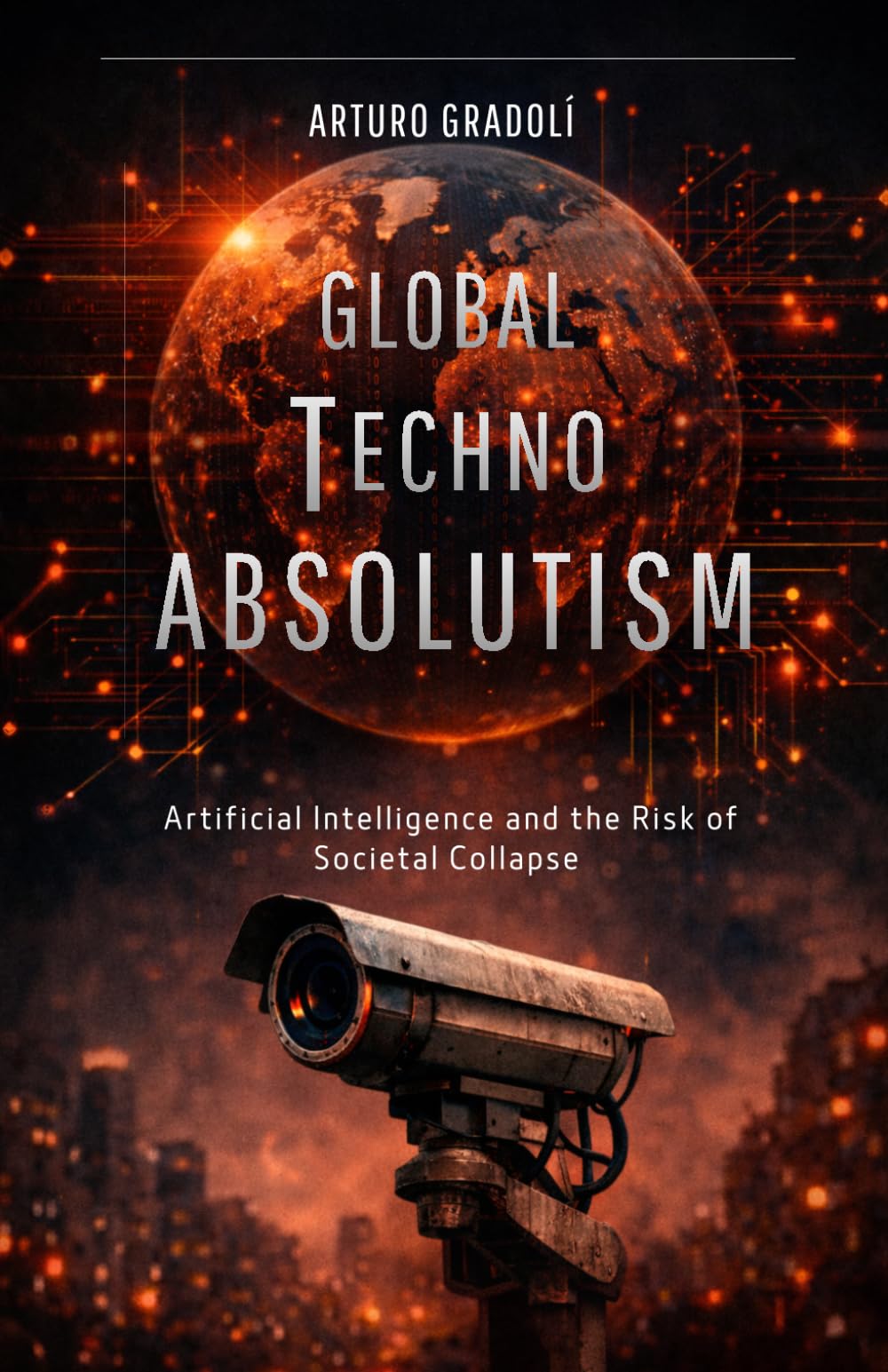
Global Techno-Absolutism: Artificial Intelligence and the Risk of Societal Collapse
$17.80
by Dr. Arturo Gradoli



Dystopia is already real: this is the new architecture of power. Democracy does not always die by force. Sometimes it disappears in silence, wrapped in promises of efficiency, security, and technological progress. Global Techno-Absolutism names an emerging political model that brings together authoritarianism, economic libertarianism, social ultraconservatism, and an almost messianic faith in technology—especially artificial intelligence—as a tool of governance and social re-engineering. The book explores the genealogy of this dystopia: from radical individualism and the philosophies of rational egoism, metapolitics, hyperstition, and the Dark Enlightenment to their practical translation into corporate and political power. It shows how a form of technocratic authoritarianism is emerging that does not need to formally abolish democracy to empty it of substance. In this context, the European Union becomes a primary target—not because of its weaknesses, but because it represents a legal brake on unchecked technological power and a commitment to liberal democracy, the social market economy, and human rights. Global Techno-Absolutism is a study of dynamics already operating in the present and, at the same time, a call for pro-European democratic resistance, grounded in the conviction that the future is not inevitable . ABOUT THE AUTHOR Arturo Gradolí Sandemetrio holds a PhD in Historical and Social Studies of Science and Scientific Communication. His academic background combines computer science (UPV), philosophy (UV), history of science (UV) and, currently, political science (UOC). This gives him a critical, diverse perspective and a strong awareness of the complexity of the world. His thinking is not confined to the academic sphere but is enriched by direct contact with social, economic and cultural realities. A commitment to human rights, diversity, social modernity, and sustainable development runs through his work and his life trajectory, and it guides a reflection that conceives knowledge as a factor of responsibility, inclusion, and the construction of the future. His blog is: neurofilosofia.com