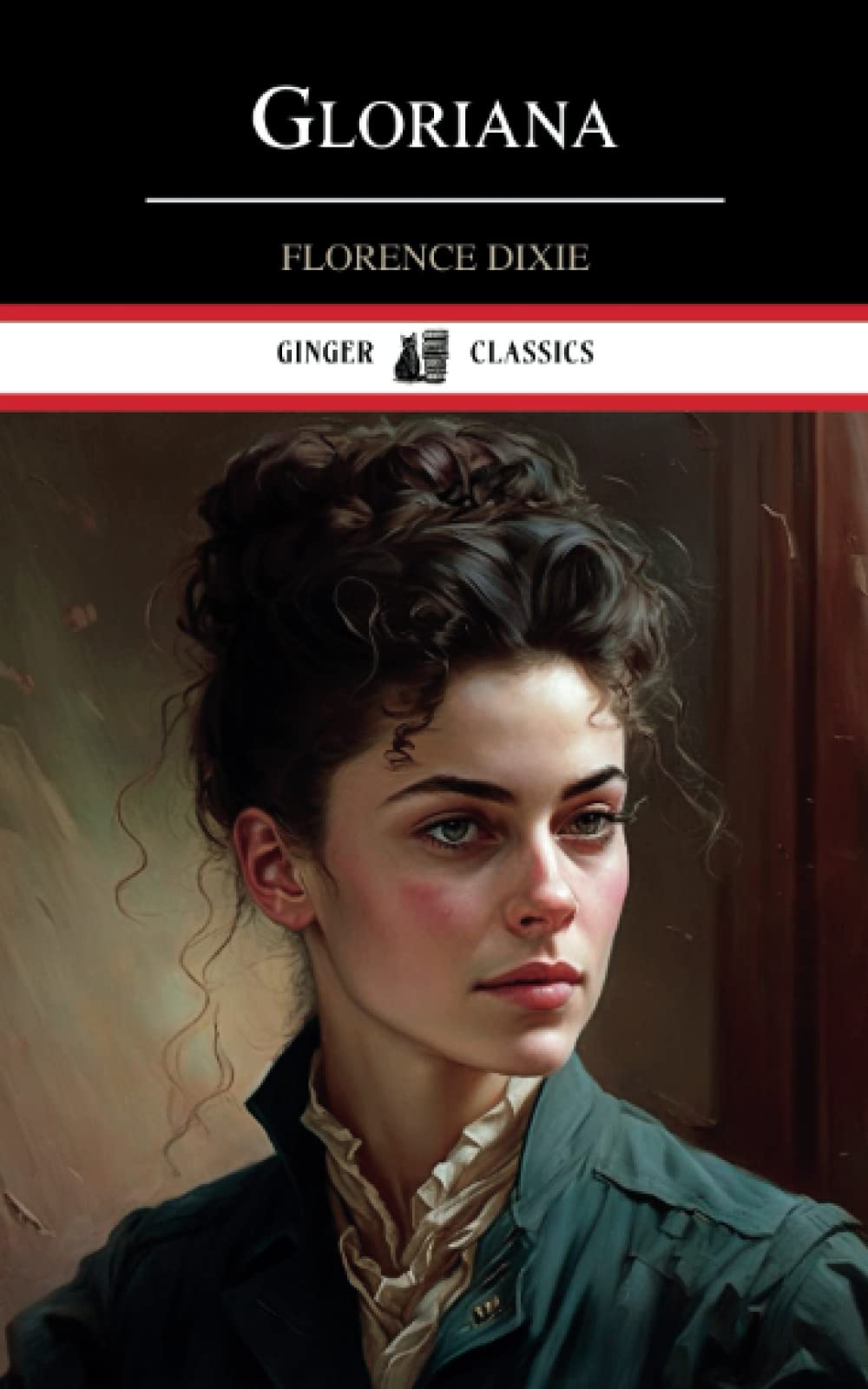



Unique Elements Detailed 19th Century Historical Map A treasured women’s rights classic! Synopsis: Gloriana: The Revolution of 1900 by Scottish author Florence Dixie is a masterpiece in women’s literature first published in 1890. Gloriana de Lara is a brilliant and energetic young woman who, upon seeing that girls and women are mistreated, assumes the identity of a man named Hector d'Estrange in order to attend Eton and Oxford. She later becomes elected to the parliament. Gloria/Hector is the leader of the Woman's Volunteer Company, a revolutionary group of women who engage in violent altercations with authorities. Hector/Gloriana is exposed as a cross-dresser, wrongfully accused of murder, and forced to flee. In the end, Gloriana's effort is successful, and she is hailed as a hero. In 1999, when the story's ending takes place, people are looking back on Gloriana with nostalgia, considering her to be the embodiment of their now-utopian, peaceful, and equitable society. Excerpt: ‘Far out beyond is the gleaming sea, and on its sparkling, silvery sheen the woman’s eyes are absently fixed as she hearkens to the complaining prattle of the child by her side. She is a beautiful woman is Speranza de Lara, one upon whom Dame Nature has showered her favours freely. As the stranger, looking upon her for the first time, would deem her but a girl in years, and exclaim admiringly at her beauty, it would be difficult to convince him that her age is thirty-five, as in effect it is. Speranza’s eyes are blue, with the turquoise shade lighting up their clear depths, and a fringe of silky auburn eyelashes confining them within bounds. Her magnificent hair is of a slightly lighter hue, and as the sun plays on the heavy coil that is twisted gracefully upon her noble head, the golden sparks dance merrily around it, like an aureole of gold. And the child? We must look nearer still at her, for she not only is beautiful, but there is writ upon her face the glowing sign of genius. Like her mother, Gloriana, or, as we shall prefer to call her, Gloria, has blue eyes, but they are the blue of the sapphire, deep in contradistinction to the turquoise shade, which characterises those of Speranza. Auburn eyelashes, too, fringe the child’s wonderful eyes, but again these are many shades darker than the mother’s, while masses of auburn curls play negligently and unconfined, covering the girl’s back like a veil of old-gold. Such is Gloriana de Lara at the age of twelve.’