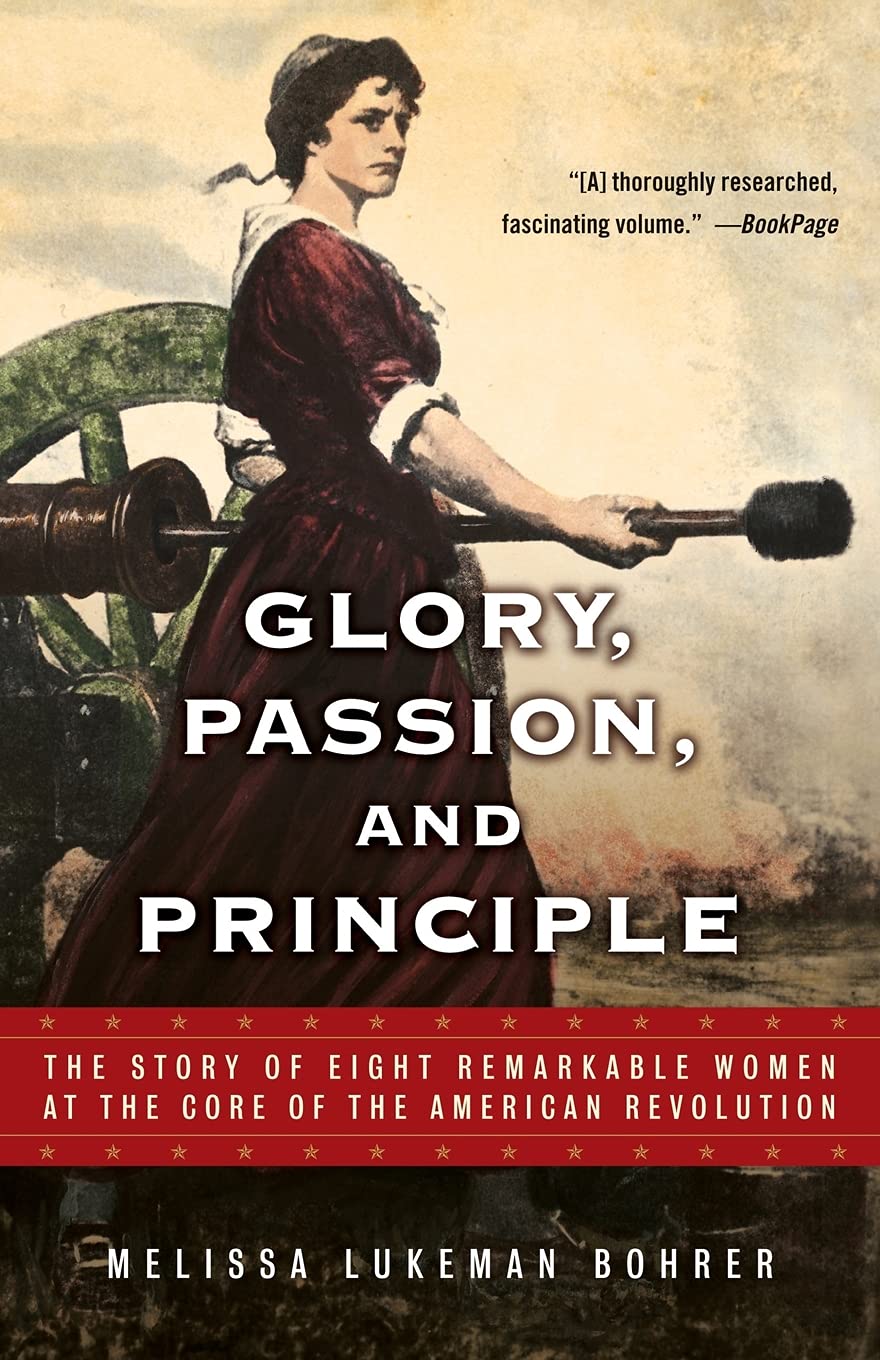
Glory, Passion, and Principle: The Story of Eight Remarkable Women at the Core of the American Revolution
$10.97
by Melissa Lukeman Bohrer



The heroism of the females of the American Revolution has gone from memory with the generation that witnessed it, and nothing, absolutely nothing, remains upon the ear of the young of the present day. -- Charles Francis Adams John Adams, Thomas Jefferson, Benjamin Franklin -- these are the names we typically associate with the American Revolution. But was American History solely written by men? Were there no influential women? No women who had an impact on the founding of America in its crucial, formative years, in its fight for independence? Indeed, there were -- although their contributions have been overlooked or ignored for over two hundred years. Until now. Glory, Passion, and Principle is an extraordinary journey through revolutionary America as seen from a woman's perspective. Here are the lesser-known stories of eight influential females who fought for freedom -- for their country and themselves -- at all costs. Whether advising prominent male leaders in political theory (Abigail Adams), using their pens as swords (Phillis Wheatley, Mercy Otis Warren), acting as military spies (Sybil Ludington, Lydia Darragh), or going to battle (Molly Pitcher, Deborah Sampson, Nancy Ward), these women broke free of the limitations imposed upon them, much as our forefathers did by resisting British rule upon American soil...and laying the groundwork for the United States as we know it today. BookPage [A] thoroughly researched, fascinating volume. Boston Herald Conventional histories of the American Revolution feature the drumbeat of the founding fathers....[ Glory, Passion, and Principle ] rectifies the oversight with eight spirited narratives about women who played inspirational roles in the birth of the nation. Jennifer Lee Carrell, Ph.D. author of The Speckled Monster Evoking passion as fierce as that of its heroines, Glory, Passion, and Principle sings out history far too long left silent....An inspiring read! Publishers Weekly Each chapter...drop[s] the reader right into the action. Bohrer portray[s] a culturally diverse group of women, offering a valuable perspective on the efforts and achievements of some minority women during that era. Melissa Lukeman Bohrer 's ancestors were founders of Massachussetts in the 1630s, distinguished soldiers, and aides-de-camp to General George Washington. A graduate of Columbia University and Brooklyn Law School, and a former columnist for The Brooklyn Heights Press , she lives in Westchester, New York, with her husband and three children. Chapter 1: With the Wind in Her Hair : Sybil Ludington But she was too tired when she got home, to realize the worth of the deed she had done. -- Marjorie Barstow Greenbie Putnam County, New York 1777 On a cold and cloudless winter night, Sybil Ludington blew out the candle in her brother's bedroom and fearfully tightened her grip on her rifle's stock. She leaned forward and peered out the large window; a deep darkness had enveloped the whole of her father's grounds. There was no moon that night, nothing at all to see by. She strained anyway, looking south, out past the house and into the extended lot. Nothing but craggy black shapes, which she knew -- prayed -- to be trees. She pulled back, leaving the window ajar so as to hear any ominous sound. She tiptoed out of the room, the floorboards creaking, trying not to wake her six younger siblings or her mother, who was sleeping with the newest baby, two-month-old Abigail; and with a solemn nod she joined her waiting sister in the hall. The news had at first come as a shock, but the longer she dwelled on it, the more she realized the inevitability of British soldiers coming after her father. Not only was he a colonel, not only was he protector of crucial Patriot supplies, not only was he the key to conquering the strategic Hudson Highlands, but above all, he used to be one of them. A Loyalist. The utmost vengeance, Sybil had come to learn in her short, hard life, was always reserved for one of your own. Indeed, General Howe himself had placed the bounty on her father's head: 300 guineas. A shocking sum. Enough to buy their whole town. It all started the summer before. General Howe had landed on Staten Island with 9,000 troops; with him, under his brother's command, came a British fleet from Halifax and an armada of 130 warships and transports. By mid-August 1776, 32,000 fully equipped, highly trained British and German soldiers had taken Staten Island and proceeded to invade Long Island. General George Washington immediately saw the danger. He knew that saving Long Island was hopeless at this point, but he also knew that supplies were in as much demand as men, and if he could save their critical stash of food and ammunition in White Plains -- which surely the British were aiming for -- then he could at least have a partial victory, and would be able to rally for a comeback at a later date. Without it, the entire Northeast could be in jeopardy. He called upon the