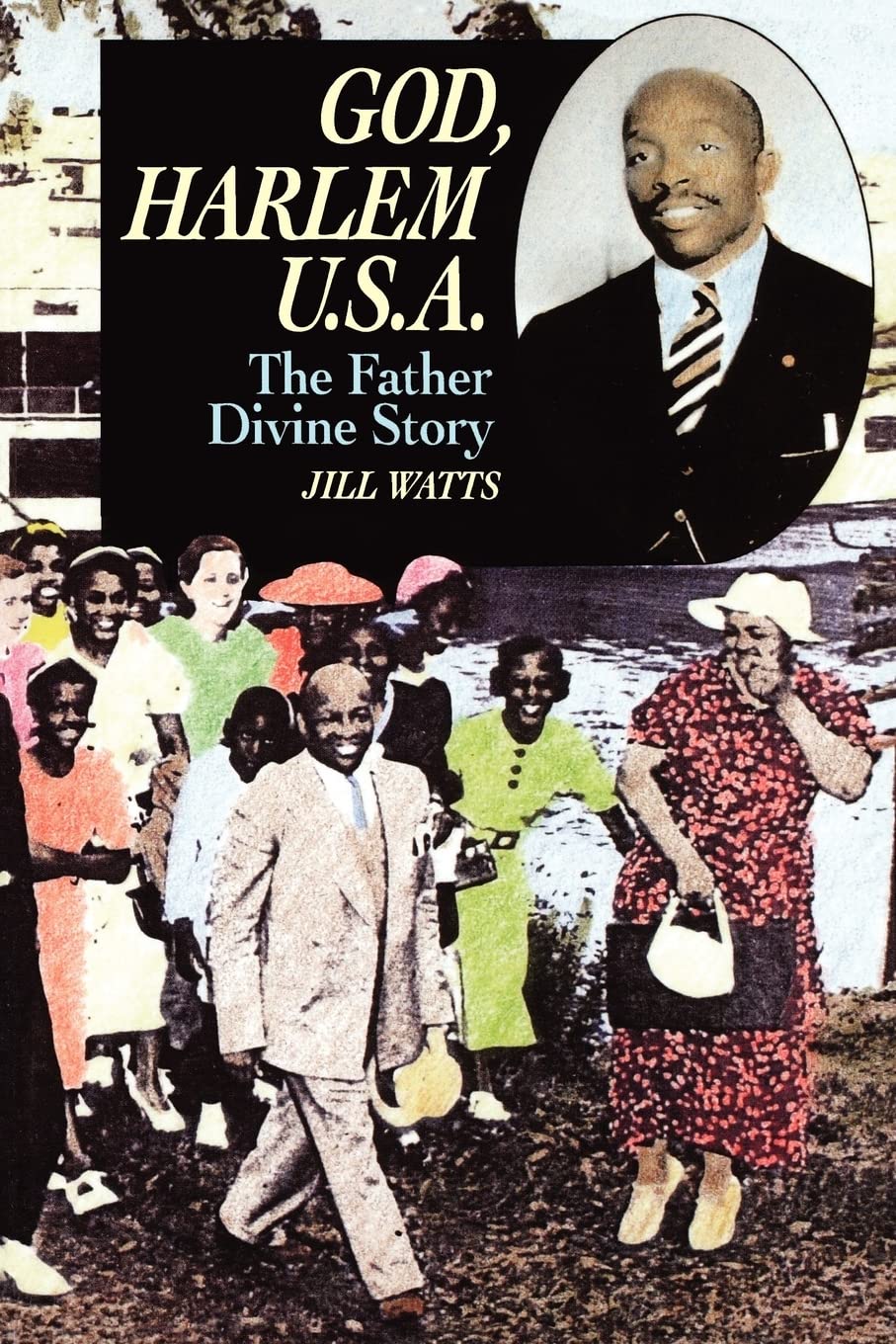



How did an African-American man born in a ghetto in 1879 rise to such religious prominence that his followers addressed letters to him simply "God, Harlem U.S.A."? Using hitherto unknown materials, Jill Watts portrays the life and career of one of the twentieth century's most intriguing religious leaders, Father Divine. Starting as an itinerant preacher, Father Divine built an unprecedented movement that by the 1930s had attracted followers across the nation and around the world. As his ministry grew, so did the controversy surrounding his enormous wealth, flamboyant style, and committed "angels"―black and white, rich and poor alike. Here for the first time a full account of Father Divine's childhood and early years challenges previous contentions that he was born into a sharecropping family in the deep South. While earlier biographers have concentrated on Father Divine's social and economic programs, Watts focuses on his theology, which gives new meaning to secular activities that often appeared contradictory. Although much has been written about Father Divine, God, Harlem U.S.A . finally provides a balanced and intimate account of his life's work. "A meticulously researched portrait of an influential African American."--"Publishers Weekly "Unearthing rare, scarce, and previously unknown original sources, Watts spells out a comprehensive, even definitive account of Father's controversial life and charismatic ministry. In addition to the fascinating biography, this is solid social and intellectual history as well." American Academy of Religion "Unearthing rare, scarce, and previously unknown original sources, Watts spells out a comprehensive, even definitive account of Father's controversial life and charismatic ministry. In addition to the fascinating biography, this is solid social and intellectual history as well."―American Academy of Religion Jill Watts , Associate Professor of History at California State University, San Marcos, is at work on a book about Mae West. God, Harlem U.S.A. The Father Divine Story By Jill Watts University of California Press Copyright © 1995 Jill Watts All right reserved. ISBN: 9780520201729 1 According to the Flesh But if I would bear record of myself according to the flesh, it would only be a material or literary record. It would not really be practical or essential for the good of mankind. . . . Man, consciously, has in himself and in his history the records of every material thing in history of man and the history of the earth, and it proves nothing, in a way, towards salvation in my opinion. New York News, August 20, 1932 Before the 1870s, Rockville was a quiet, modest village tucked among the rolling hills and dense woods of Montgomery County, Maryland. But after the Civil War, land developers saw an opportunity to make a profit and began promoting the town as "Peerless Rockville," an undiscovered treasure for "homeseekers and investors" searching for "health, wealth, and comfort." In 1873, the Baltimore and Ohio Railroad established a regular route through Rockville, and by 1880, the town was in the midst of a housing boom. Sixteen miles up the Potomac River from Washington, D.C., Rockville, with its mild temperatures and cool breezes, offered a summertime refuge from the sweltering heat and humidity of the nation's capital. Rockville quickly became a popular resort town and lured the elite of Washington society, who fled from mugginess, mosquitoes, and malaria to the elegant homes and quaint cottages in the growing but still serene little town.1 Yet not everyone in Rockville enjoyed the pleasures of prosperity and leisure. At the northern edge of town was a black ghetto known as Monkey Run. White vacationers and residents of Rockville maintained an awkward relationship with the black population. Although they treated African Americans with contempt, whites were thoroughly dependent on the inhabitants of Monkey Run to work in their homes, on their farms, and in their businesses. Six days a week, black men, women, and children trudged up a gentle slope to work in white neighborhoods. Except for the police, who monitored the ghetto from the courthouse bell tower, white residents paid little attention to the lives of those who lived in Monkey Run.2 However, in May 1897 the local white newspaper took notice of the death of Nancy Baker, a resident of Monkey Run. The paper reported that when Nancy Baker passed away, she was five feet tall and weighed 480 pounds. Her body lay in her home for almost two days as a local carpenter rushed to build a coffin large enough to accommodate her. On the day of her funeral, the coffin could not be removed until the door of her home had been cut away. Ten pallbearers carried Nancy Baker to her final resting place in a black Rockville cemetery. She left behind a husband and several children, including a teenage son, George Baker, Jr., who would become the evangelist Father Divine.3 Nancy Baker's l