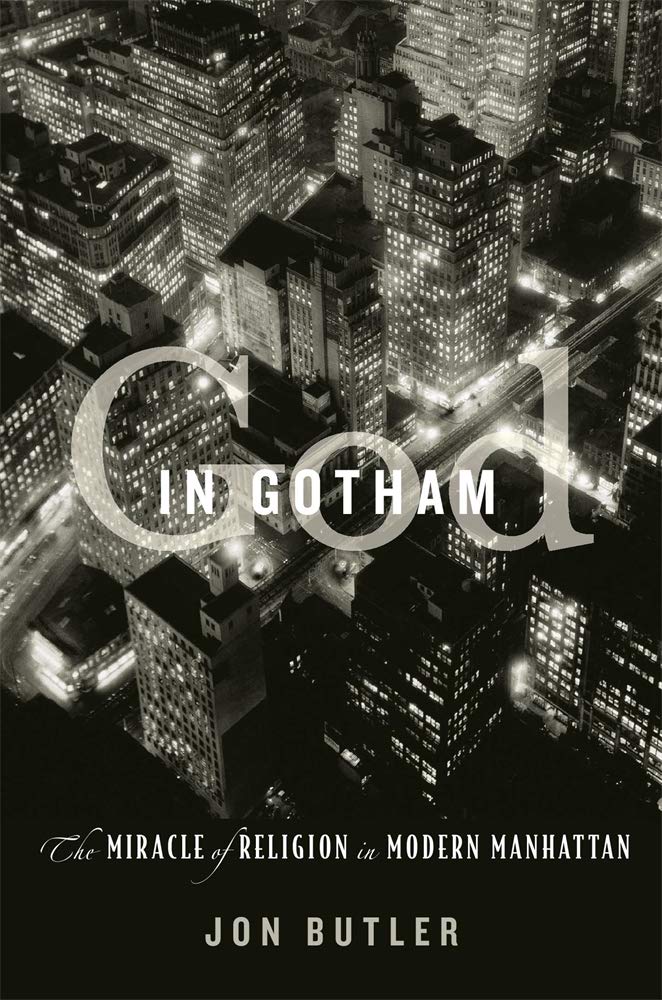



A master historian traces the flourishing of organized religion in Manhattan between the 1880s and the 1960s, revealing how faith adapted and thrived in the supposed capital of American secularism. In Gilded Age Manhattan, Catholic, Jewish, and Protestant leaders agonized over the fate of traditional religious practice amid chaotic and multiplying pluralism. Massive immigration, the anonymity of urban life, and modernity’s rationalism, bureaucratization, and professionalization seemingly eviscerated the sense of religious community. Yet fears of religion’s demise were dramatically overblown. Jon Butler finds a spiritual hothouse in the supposed capital of American secularism. By the 1950s Manhattan was full of the sacred. Catholics, Jews, and Protestants peppered the borough with sanctuaries great and small. Manhattan became a center of religious publishing and broadcasting and was home to august spiritual reformers from Reinhold Niebuhr to Abraham Heschel, Dorothy Day, and Norman Vincent Peale. A host of white nontraditional groups met in midtown hotels, while black worshippers gathered in Harlem’s storefront churches. Though denied the ministry almost everywhere, women shaped the lived religion of congregations, founded missionary societies, and, in organizations such as the Zionist Hadassah, fused spirituality and political activism. And after 1945, when Manhattan’s young families rushed to New Jersey and Long Island’s booming suburbs, they recreated the religious institutions that had shaped their youth. God in Gotham portrays a city where people of faith engaged modernity rather than foundered in it. Far from the world of “disenchantment” that sociologist Max Weber bemoaned, modern Manhattan actually birthed an urban spiritual landscape of unparalleled breadth, suggesting that modernity enabled rather than crippled religion in America well into the 1960s. “Are you there, God? It’s me, Manhattan…Butler…argues that far from being a Sodom on the Hudson, New York was a center of religious dynamism throughout the 20th century…[He] reminds us that New York was a center for Catholic religious orders too, their numbers rivaling any city’s except Rome.” ― Katrina Gulliver , Wall Street Journal “In his enthralling God in Gotham , Butler takes us through the mighty city’s neighborhoods, traditions old and new, and bustling heterogeneous populations to illuminate the ways diverse Manhattanites have organized themselves in pursuit of community and faith. I learned something rich and surprising on every single page of this compelling book, as fascinating as Gotham itself.” ― Elizabeth Alexander, President, Andrew W. Mellon Foundation “What a pleasure it is to take a tour of Manhattan’s sacred past led by one of the nation’s preeminent religious historians…Butler offers yet one more reason why contemporary Americans might want to ask hard questions the next time they hear someone declaiming against urban places. The worlds of the city, the suburbs, and beyond are more interdependent than we sometimes think. And an unrelenting pursuit of the divine is common to them all.” ― Heath W. Carter , Christianity Today “Elegantly written and persuasively argued…You cannot put this book down without feeling that Sin City has gotten a bad rap from the media. The metropolis has long been characterized by deep religious feeling and expression…This is a major book on a major topic in American history. It will complicate our judgements about the nation’s biggest city.” ― Kenneth T. Jackson , Gotham “Serves as a reminder of how vital religiosity was to the old New York of 1900–1960…Butler gives readers a deeper sense of how ‘New York values’ were once a modus vivendi for religious pluralism that provided a broadly religious foundation for American culture. He believes that it could be so again.” ― James M. Patterson , Law & Liberty “If I were still teaching Introduction to Religion in American History , I would assign Jon Butler’s God in Gotham , with its excellent cameos of Reinhold Niebuhr, Paul Tillich, Abraham Heschel, Dorothy Day, the Reverends Adam Clayton Powell Jr. and Sr., and other great or notorious divines who shaped Manhattan’s religious landscape from the Gilded Age to the Sixties.” ― Bob Carey , The Metropole “Proves that ‘tools of modernity’ were also the tools of religion. Scholars of urban history, American religion, urban religion and modernity and secularism will find much to think with in God in Gotham ’s compelling history of how congregations responded to the technologies, pace, and cityscape of Manhattan to engage with ‘the enchanted,’ not turn away from it.” ― Alyssa Maldonado-Estrada , Journal of Ecclesiastical History “Butler paints a landscape of religious vitality in arguably the heart of burgeoning modernity―Manhattan…[He] shows that religion adapted to modernity rather than being trampled on the concrete.” ― Justin McGeary , Modern Reformation “A splendid read, the mos