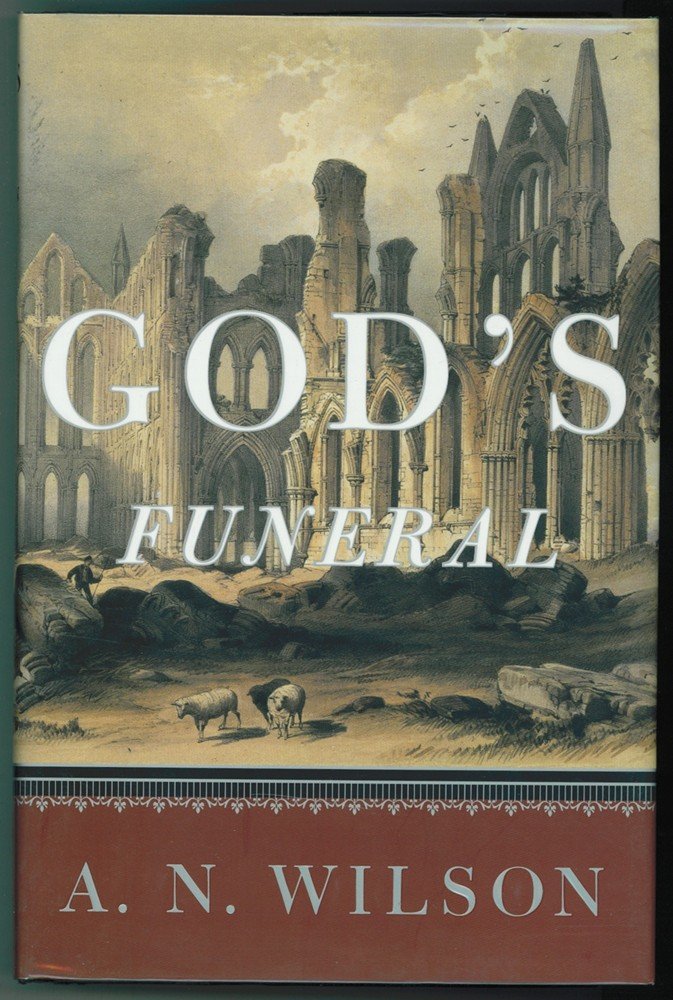



A magisterial, colorful narrative illuminates the central tragedy of the nineteenth century--that God, or rather man's faith in God, died, but the need to worship remained as a torment to those who thought they had buried Him. Tour. God's Funeral is A.N. Wilson's account of the decline of orthodox Christianity in Victorian Britain. The most popular explanation for this widely-recognized phenomenon is the acceptance by intellectuals of Charles Darwin's theory of evolution. To disprove the notion that Darwin singlehandedly committed deicide, Wilson describes a host of secularizing predecessors and accomplices such as Hume, Gibbon, John Stuart Mill, Hegel, Marx, and Carlyle. All play major roles in Wilson's brilliantly staged reconstruction of the so-called death of God. God's Funeral also takes account of the pain and confusion these intellectuals brought upon themselves when their great achievements helped erode the social and intellectual foundations of their lives. Furthermore, Wilson shows how their crises of faith relate to our own. Like our Victorian forebears, contemporary readers still must ask, "Is our personal religion that which links us to the ultimate reality, or is it the final human fantasy...?" and, "Is there a world of value outside ourselves, or do we, collectively and individually, invent what we call The Good?" God's Funeral helps readers learn to ask these questions in smarter and sharper ways by giving them a clearer sense of how Western society reached its current state of confusion. Wilson (Jesus, LJ 9/15/92; Paul: The Mind of the Apostle, LJ 4/1/97) chose this vehicle to "revisit the Victorian experience of faith and doubt," noting that our late-20th-century questions regarding religion seem as uninformed and polemical as did such inquiries in Darwin's and Eliot's time. Taking his title from a Thomas Hardy poem, Wilson considers the ways Victorians reconciled advancing modern thought with human religious instincts. Looking at intellectual giants (e.g., Carlyle, William James, Marx, and Tyrrell, among many others), Wilson makes a profoundly lucid case for the agonizing diminishment of a transcendent, objective truth. Presenting European biography as a means to do intellectual history, this is a stunning and provocative work, not necessarily in its scope but in its readability and its well-developed analysis, culminating in Wilson's equivocal sigh: "It is more remarkable that the intellectual human mind, knowing all it knows about the arguments against God's existence, should continue to practice religious observance." Highly recommended for all collections.ASandra Collins, Univ. of Pittsburgh Copyright 1999 Reed Business Information, Inc. What did nineteenth-century intellectuals mean by the "death of God" ? The prolific Wilson provides a thoughtful but complex answer in this lively narrative of just how belief in God died, for many, over the course of the century. Wilson goes back to Gibbon, Hume, and Kant, then moves through the century to Mill, Hegel, and Comte; Carlyle; Engels and Marx; Froude, Pusey, Bishop Colenso, Newman, Thomas Arnold, and Jowett; George Eliot and German biblical criticism; Spencer; Huxley's defense of Darwin; Swinburne; Samuel Butler and Freud; Arnold and Ruskin; the Fabians; and William James. This long list is not as daunting as it may seem, since Wilson mixes biography and commentary with his metaphysics and epistemology. One gains a sense of who these thinkers are as well as how they wrestled with the great issue of their age. From the end of the twentieth century, it may be difficult to understand why Gibbon and Hume, Darwin and Strauss' Life of Jesus seemed so threatening to those who wanted to retain a deep faith in the Christian church; Wilson makes the nature of that threat crystal clear. Fascinating and lively intellectual history. Mary Carroll A mellifluous, perceptive intellectual history of the Victorians' struggles with faith. This study continues English critic/biographer/novelist Wilson's recent spate of articulate religion books (including Jesus: A Life, 1992, and Paul: The Mind of an Apostle, 1997). It defies easy classification. In the sweeping style of the grand narrative, Wilson converses wittily on the philosophy, literature, art, science, music, and theology of Europe during more than six decades. Amazingly enough, he does it brilliantly. Wilson has a keen eye for historical detail and can chronicle even a familiar story (such as why Darwin hesitated before publishing On the Origin of Species) in a fresh way. He notes that religious faith was shaken in the last half of the 19th century because of biblical criticism, the onslaught of Darwinism, and a new awareness of economic injustice. We meet the era's most famous thinkers, such as Kant, Marx, and the James brothers, as well as some less celebrated, such as the libertine poet Algernon Swinburne. The latter was among those most openly hostile to religion, while others (George