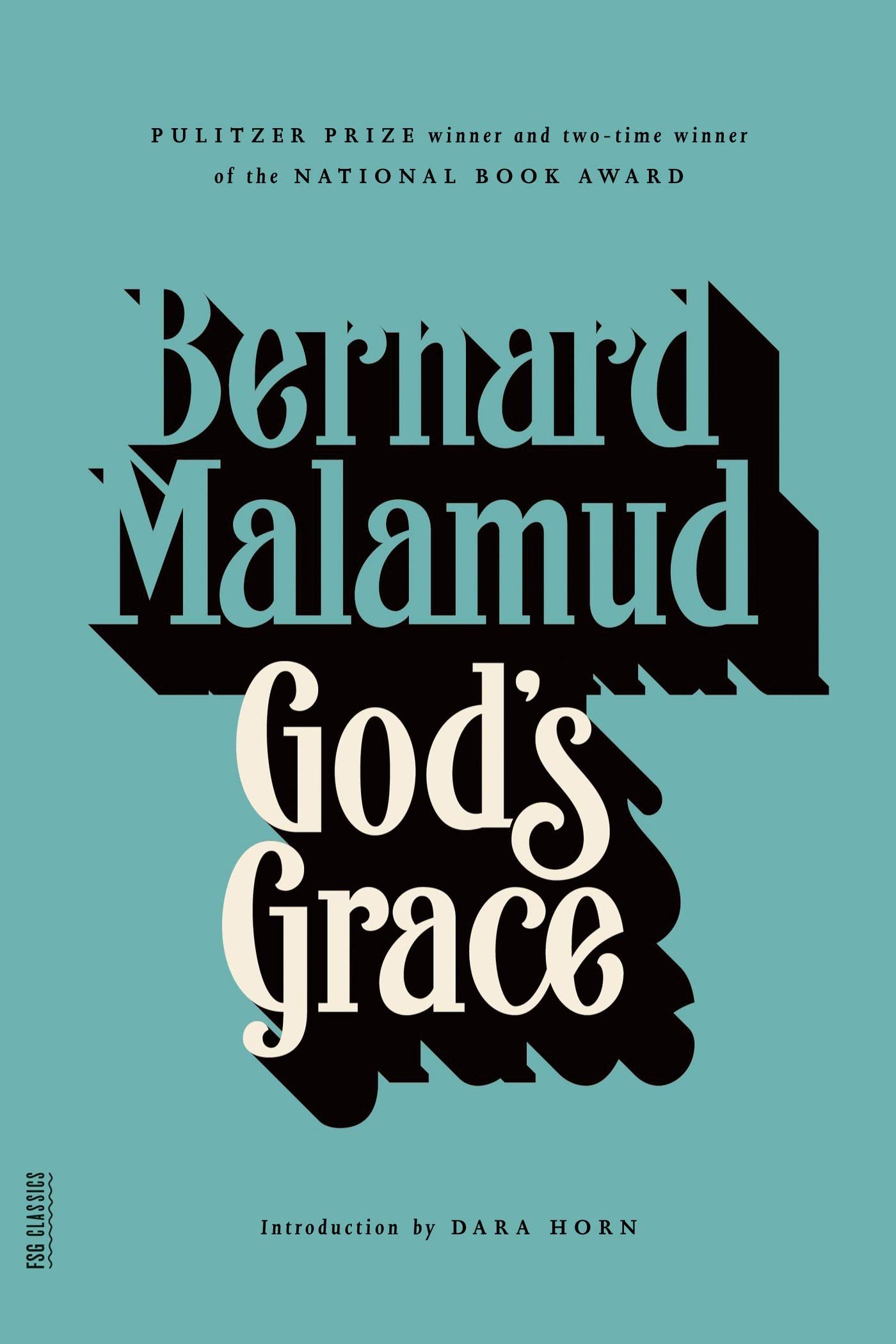



God's Grace (1982), Bernard Malamud's last novel, is a modern-day dystopian fantasy, set in a time after a thermonuclear war prompts a second flood -- a radical departure from Malamud's previous fiction. The novel's protagonist is paleolosist Calvin Cohn, who had been attending to his work at the bottom of the ocean when the Devastation struck, and who alone survived. This rabbi's son -- a "marginal error" -- finds himself shipwrecked with an experimental chimpanzee capable of speech, to whom he gives the name Buz. Soon other creatures appear on their island-baboons, chimps, five apes, and a lone gorilla. Cohn works hard to make it possible for God to love His creation again, and his hopes increase as he encounters the unknown and the unforeseen in this strange new world. With God's Grace , Malamud took a great risk, and it paid off. The novel's fresh and pervasive humor, narrative ingenuity, and tragic sense of the human condition make it one of Malamud's most extraordinary books. "Is he an American Master? Of course. He not only wrote in the American language, he augmented it with fresh plasticity, he shaped our English into startling new configurations." --Cynthia Ozick “Malamud is a crafty storyteller, and his Judeo-Christian narrative compels interest and anticipation.” ― The New York Times Bernard Malamud (1914–86) wrote eight novels; he won the Pulitzer Prize and a National Book Award for The Fixer , and the National Book Award for The Magic Barrel . Born in Brooklyn, he taught for many years at Bennington College in Vermont. God's Grace By Bernard Malamud Farrar, Straus and Giroux Copyright © 2005 Bernard Malamud All right reserved. ISBN: 9780374529673 God's Grace The Flood This is that storyThe heaving high seas were laden with scumThe dull sky glowed redDust and ashes drifted in the wind circling the earthThe burdened seas slanted this way, and that, flooding the scorched land under a daylight moonA black oily rain rainedNo one was there At the end, after the thermonuclear war between the Djanks and Druzhkies, in consequence of which they had destroyed themselves, and, madly, all other inhabitants of the earth, God spoke through a glowing crack in a bulbous black cloud to Calvin Cohn, the paleologist, who of all men had miraculously survived in a battered oceanography vessel with sails, as the swollen seas tilted this way and that;Saying this:""Don't presume on Me a visible face, Mr. Cohn, I am not that kind, but if you can, imagine Me. I regret to say it was through a minuscule error that you escaped destruction.Though mine, it was not a serious one; a serious mistake might have jammed the universe. The cosmos is so conceived that I myself don't know what goes on everywhere. It is not perfection although I, of course, am perfect. That's how I arranged my mind.""And that you, Mr. Cohn, happen to exist when no one else does, though embarrassing to Me, has nothing to do with your once having studied for the rabbinate, or for that matter, having given it up.""That was your concern, but I don't want you to conceive any false expectations. Inevitably, my purpose is to rectify the error I conceived.""I have no wish to torment you, only once more affirm cause and effect. It is no more than a system within a system, yet I depend on it to maintain a certain order. Man, after failing to use to a sufficient purpose his possibilities, and my good will, has destroyed himself; therefore, in truth, so have you.""Cohn, shivering in his dripping rubber diving suit, complained bitterly:"After Your first Holocaust You promised no further Floods." "Never again shall there be a Flood to destroy the earth." That was Your Covenant with Noah and all living creatures. Instead, You turned the water on again. Everyone who wasn't consumed in fire is drowned in bitter water, and a Second Flood covers the earth."God said this: ""All that was pre-Torah. There was no such thing as Holocaust, only cause and effect. But after I had created man I did not know how he would fail Me next, in what manner of violence, corruption, blasphemy, beastliness,sin beyond belief. Thus he defiled himself. I had not foreseen the extent of it.""The present Devastation, ending in smoke and dust, comes as a consequence of man's self-betrayal. From the beginning, when I gave them the gift of life, they were perversely greedy for death. At last I thought, I will give them death because they are engrossed in evil.""They have destroyed my handiwork, the conditions of their survival: the sweet air I gave them to breathe; the fresh water I blessed them with, to drink and bathe in; the fertile green earth. They tore apart my ozone, carbonized my oxygen, acidified my refreshing rain. Now they affront my cosmos. How much shall the Lord endure?""I made man to be free, but his freedom, badly used, destroyed him. In sum, the evil overwhelmed the good. The Second Flood, this that now subsides on the broken earth, they brought