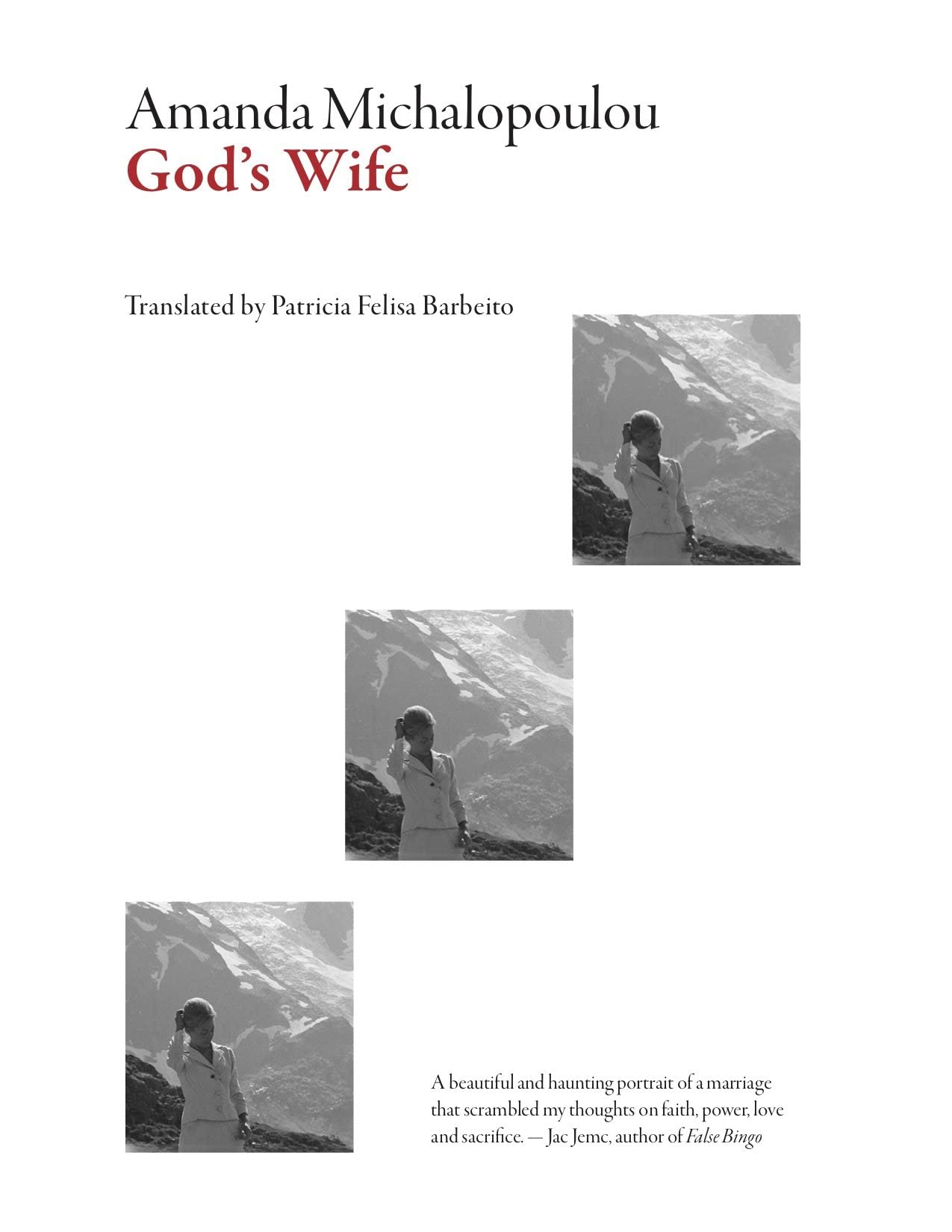



Amanda Michalopoulou’s God’s Wife is a deceptive novel: it draws us close with promises of titillating confession and heart-warming intimacy only to send us on a conceptual scavenger hunt that probes the ethics of reading, writing, and the unspoken conventions of literary mastery. “It sounds like a lie, but I am His wife,” is the arresting opening declaration made by the novel’s unnamed narrator, who will always be known through her role as an appendage, “at His side.” This premise—bringing to mind as it does the very origins of the western novel: epistolary novels of romance as both salvation and captivity—immediately also raises issues of power, domination, truth and belief. God’s Wife , then, is ultimately a meditation on the power of literature to create a space of imaginative play. It is a love story, a philosophical treatise on the nature of faith and divinity, a self-conscious meditation on the nature of writing and creativity, and a feminist tract all rolled into one. What holds all these strands together is what can only be described as the compelling authenticity of the narrator’s voice and her relentless focus on the role of femininity as performance and convention in literature. Her voice is, of course, shaped by Michalopoulou’s inimitably spare, elegant and masterfully evocative prose, which like the narrator’s mother’s brand of storytelling, uses few words and eschews didacticism. "A beautiful and haunting portrait of a marriage that scrambled my thoughts on faith, power, love and sacrifice. This text embodies the act of questioning in a way that is at once startling and affirming. A gorgeous, important book." — Jac Jemc, author of The Grip of It and False Bingo "God's Wife is an incredible book. Playful and deeply disturbing at the same time, fierce and funny, a romantic comedy and a profound philosophical treatise at the same time-- and many, many other things. It's a book like no other I've ever read, a book impossible to pull off. I have no idea how Amanda Michalopoulou did it." — Daniel Kehlmann, author of Measuring the World "God's Wife is a stunningly brilliant book. At every turn, it avoids obviousness and cliche. The writing, crisp, clear, clever and compelling. It is a moving love story that unfolds with the rigorous intellectual logic of a piece of first-rate theology, into a vast, beautiful repetitive loop that urges the reader on to make fresh associations and new lines of thought. Highly recommended." — Simon Critchley, author of The Book of Dead Philosophers "God's Wife is a novel of marvels—and marvelous, in how splendidly Michalopoulou has conjured and told this story of the longing of a young girl for God, for great love. Her voice is charming and engaging, even though God doesn't always answer her questions. God's Wife is an allegorical work that speaks to these troubling times with an unusual voice, with wit and intelligence." — Lynne Tillman author of Men and Apparitions ― ΧΡΟΝΟΣ Amanda Michalopoulou is the internationally acclaimed author of several books of fiction, two of which have previously been published in English: I’d Like (Dalkey Archive Press, 2008) and Why I Killed My Best Friend (2014), both translated by Karen Emmerich. Her work, which has been translated into twenty languages, has been awarded the Diavazo Novel Prize, the Academy of Athens Award, and the International Literature Award by the National Endowment for the Arts among others. She lives in Athens, Greece. Patricia Felisa Barbeito is Professor of American Literatures at the Rhode Island School of Design. Her translations include? Their Smell Makes Me Want to Cry (Birmingham Modern Greek Translations,2004), ? The Interrogation (Birmingham Modern Greek Translations, 2013), and The Great Chimera (Aiora, 2019). It may sound like a lie: I am His wife. We married ages ago. He asked for my hand and I said yes. Sometimes, not even I can quite believe all the things I have lived, first without Him, then by His side. I never imagined my life like this. I’m writing these pages to tell you my story. I could just as easily say that it’s to keep the promise I made to my brother. I should have written him off, but you know how it is: people forget and no matter how far they go, the day always comes when they long for home. But this is not for my brother. Nor am I writing out of a need for solidarity exactly. To care, to be truly human, one must live among other people. What brings us close is the knowledge of a shared, a common fate. I have forgotten the meaning of the most basic things: a slap in the face; sewing back a button hanging by its thread; enclosing arms offering comfort. I have yet to give any thought to what you’ll make of this letter. The only thing that matters is the conviction that you are listening. Having lived for so long by the side of Him who created All from Nothing, I am finally creating something of my own. I am creating you. Who are you? I don’t care―be whoever