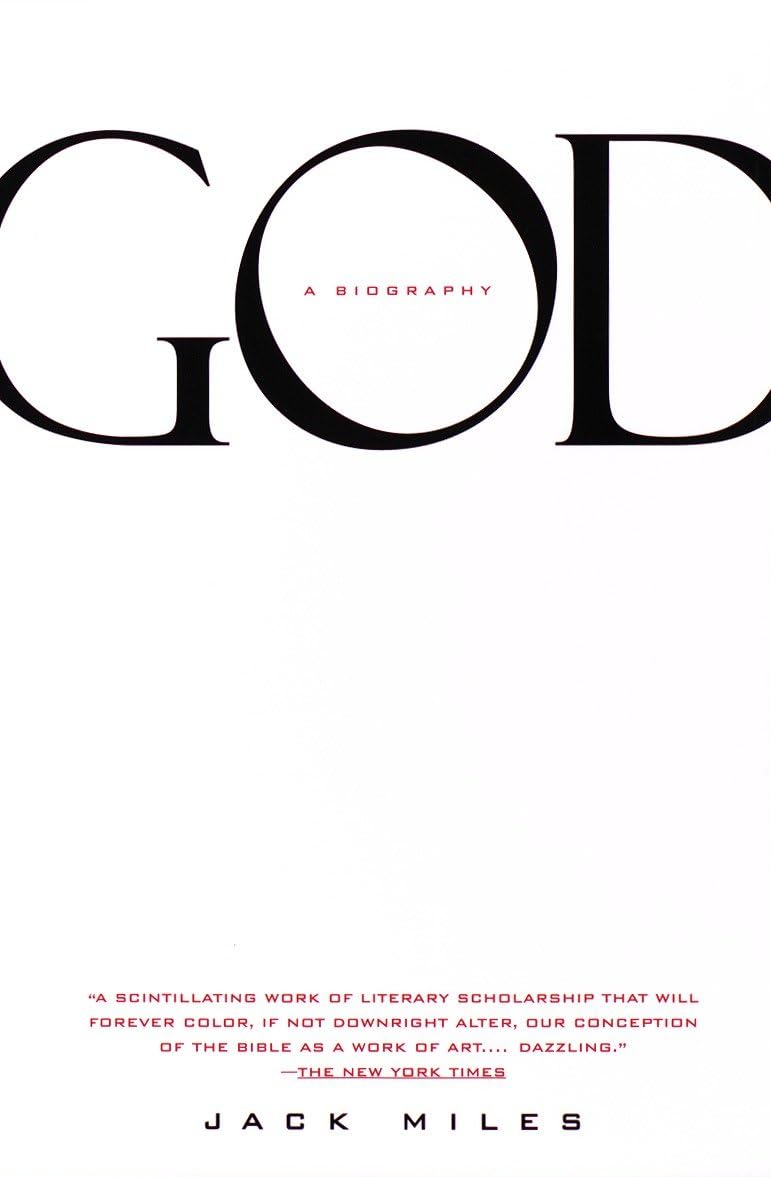



WINNER OF THE PULITZER PRIZE What sort of "person" is God? What is his "life story"? Is it possible to approach him not as an object of religious reverence, but as the protagonist of the world's greatest book—as a character who possesses all the depths, contradictions, and abiguities of a Hamlet? This is the task that Jack Miles—a former Jesuit trained in religious studies and Near Eastern languages—accomplishes with such brilliance and originality in God: A Biography . Using the Hebrew Bible as his text, Miles shows us a God who evolves through his relationship with man, the image who in time becomes his rival. Here is the Creator who nearly destroys his chief creation; the bloodthirsty warrior and the protector of the downtrodden; the lawless law-giver; the scourge and the penitent. Profoundly learned, stylishly written, the resulting work illuminates God and man alike and returns us to the Bible with a sense of discovery and wonder. Is it possible to approach God not as an object of religious reverence, but as the protagonist of the world's greatest book -- as a character who possesses all the depths, contradictions, and ambiguities of a Hamlet? How does he depend on the other characters, and how does his relationship with them show his development? Miles provides a learned, original exegesis that will send readers back to the Bible in curious amazement. Winner of the 1996 Pulitzer Prize for biography. A scintillating work of literary scholarship that will forever color, if not downright alter, our conception of the Bible as a work of art...Dazzling. -- The New York Times What sort of "person" is God? Is it possible to approach him not as an object of religious reverence, but as the protagonist of the world's greatest book--as a character who possesses all the depths, contradictions, and abiguities of a Hamlet? In this "brilliant, audacious book" (Chicago Tribune), a former Jesuit marshalls a vast array of learning and knowledge of the Hebrew Bible to illuminate God--and man--with a sense of discovery and wonder. Jack Miles is a writer whose work has appeared in numerous national publications, including The Atlantic Monthly , the The New York Times , The Boston Globe , The Washington Post , and the Los Angeles Times , where he served for ten years as literary editor and as a member of the newspaper’s editorial board. The recipient of a Ph.D. in Near Eastern languages from Harvard University and a former Jesuit, he has been a Regents Lecturer at the University of California, director of the Humanities Center at Claremont Graduate University, and visiting professor of humanities at the California Institute of Technology. His first book, God: A Biography , won a Pulitzer Prize and has been translated into fifteen languages. Currently senior advisor to the president of the J. Paul Getty Trust, a foundation supporting art and scholarship, Dr. Miles lives with his wife and daughter in Southern California. 1 PRELUDE Can God's Life Be Written? Can a literary character be said to live a life from birth to death or otherwise to undergo a development from beginning to end? Or is a literary character-fixed on the pages of a book, trapped forever in the same few words and actions-the very opposite of a living, developing human being? Contention on this point has shaped a century of Hamlet criticism, according to a recent survey by William Kerrigan, who calls the two contending groups the critics and the scholars. The critics, he says, dominant at the start of the century, believed in character. They believed that to talk about Hamlet the play, you had to talk about Hamlet the man: what he said, what he did, and how he changed during the time between his first and his last words onstage. The scholars, dominant in the middle of the century, took as their motto Hamlet's own line "The play's the thing." They believed that, empirically speaking, there was no Hamlet, only Shakespeare's words on the page, and that therefore one could legitimately talk only about them. If one went beyond them, it could not be into the imagined rest of Hamlet, for the rest was silence, to borrow another line from the play. One could go only into the rest of Elizabethan drama and Elizabethan society, seeking other plays that Shakespeare might have known, deepening one's knowledge of the language he spoke, and so forth. The dean of the critics was A. C. Bradley, whose still influential Shakespearean Tragedy was published in 1904. The turning point from criticism to scholarship and from character to dramaturgy as a focus may be dated to 1933, when L. C. Knights wrote a famous essay, "How Many Children Had Lady Macbeth?" mocking Bradley's assumption-naive in Knights's view-that literary character could ever be talked about in its own right. Knights believed that Bradley's approach was perhaps appropriate for biography but certainly inappropriate for literary criticism. For decades, Kerrigan shows, the triumph of scholarship ov